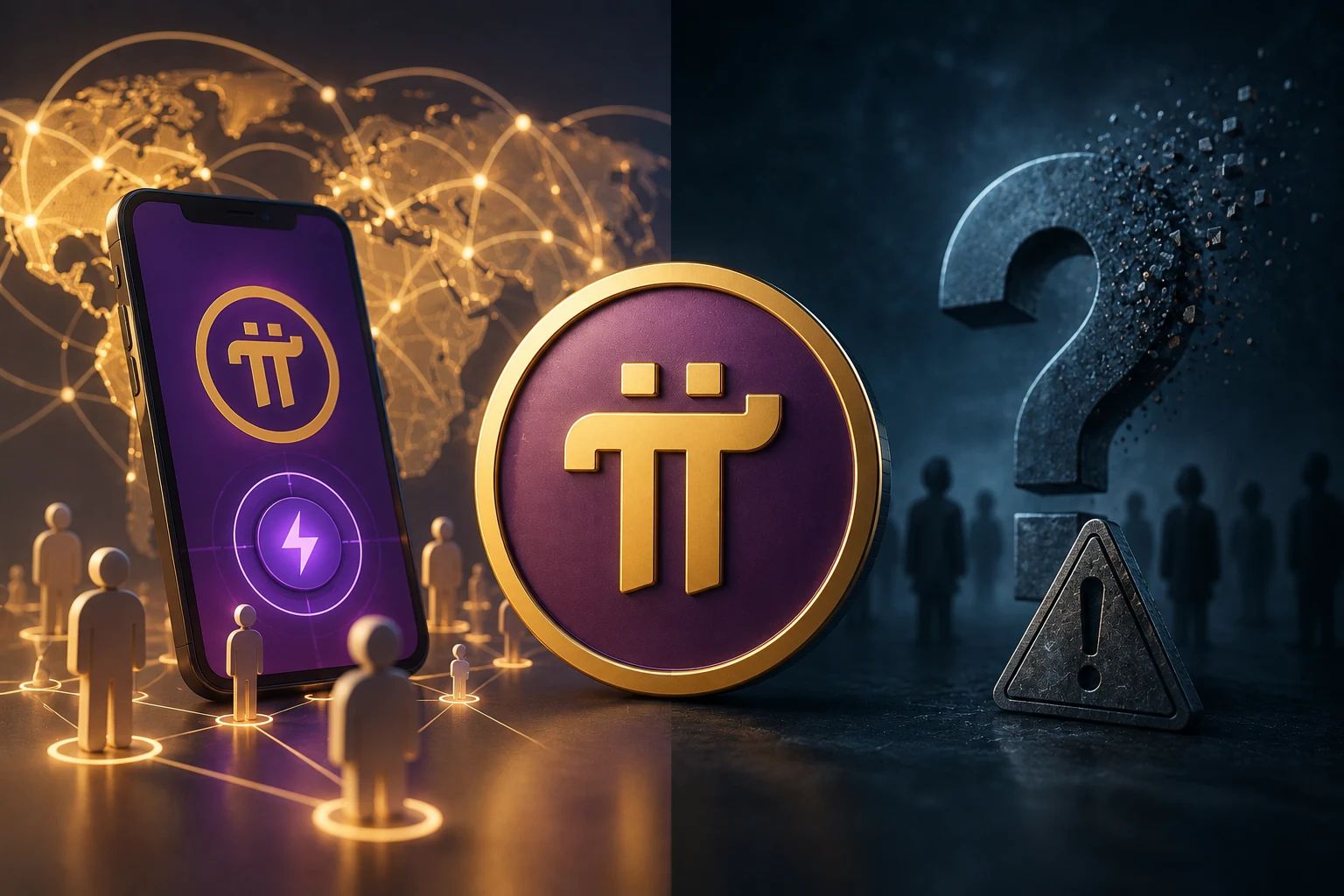
What is Pi Network, in plain English?
Pi Network is a crypto project that launched on March 14, 2019 (Pi Day), built around an unusual premise: let anyone with a smartphone "mine" its token, called PI, without burning through battery or processing power. The project was started by a group of Stanford graduates, most notably Nicolas Kokkalis and Chengdiao Fan, both with backgrounds in social computing and blockchain research.
Unlike Bitcoin, where mining means competing with specialized hardware to solve cryptographic puzzles, Pi's app just checks that you are a real human, taps a button once every 24 hours, and credits your account with a small amount of PI. The mining rate falls as your network grows, and earning rates drop further once you reach a certain number of referrals.
The idea was accessibility. Bitcoin's proof-of-work (PoW) was deliberately designed so that, over time, ordinary people could no longer compete with industrial mining operations. Pi positioned itself as a counter to that trend: a coin anyone could earn just by showing up. Whether that design also creates durable value is a separate, and much harder, question.
How the mobile-mining model actually works
When you install the Pi app and sign up with a phone number or Facebook account, you become a "Pioneer." Every 24 hours you tap a button to confirm you're still active, and the app credits you PI at a base rate. There is no heavy computation happening on your phone; the app simply checks a server and updates a counter tied to your account.
The interesting part is the referral structure. Pi originally rewarded users more PI for inviting other active members, which is how the network grew to tens of millions of accounts within a couple of years. Each user is assigned a "security circle" of trusted contacts, and the protocol uses those circles, plus a variant of the Stellar Consensus Protocol, to validate transactions on its ledger.
In practical terms, this means three roles for participants: Pioneers, who mine by tapping the button; Contributors, who build out security circles and run consensus nodes; and Ambassadors, who refer new users. Mining rates decay over time and shrink further once you stop adding new active referrals. The model is designed to reward growth, and to punish growth that stalls.
Critics have long argued this structure looks less like a decentralized network and more like a referral funnel. Supporters counter that real cryptographic work happens elsewhere in the protocol, and that the social-mining step is just onboarding. Both framings have merit, and the truth depends on which parts of the system you inspect.
Risks every PI holder should understand
The first risk is the mining model itself. Because PI is created for showing up and inviting friends, there is no scarcity mechanism baked into the act of earning. A user with patience and a large contact list can accumulate a meaningful balance without doing anything that looks like economic work. Compare that with Bitcoin, where every new coin required real energy expenditure and verification by independent nodes.
The second risk is transparency. For most of Pi's existence, there was no public blockchain explorer, the kind of tool that lets anyone inspect every transaction, wallet, and balance. Mainnet launched in late 2023 and an explorer eventually followed, but for roughly four and a half years, holders had to trust the Pi core team to report supply honestly. That kind of trust requirement is the opposite of what most crypto projects promise.
The third risk is concentration. Pi Network was long accused, fairly or not, of being a project where insiders and early adopters hold disproportionate amounts of the token. With mobile mining, the earliest users earned at the highest rates, and the team's own allocation has never been fully transparent. Even after Mainnet, the team and foundation still control substantial reserves.
The fourth risk is liquidity and listing quality. When PI did become tradable, listings appeared on a small number of exchanges, several of which have since faced enforcement actions or accusations of wash trading. Thin liquidity on a small venue can make prices move dramatically on small orders, which is exactly the kind of environment that attracts manipulation and disadvantages retail holders.
Fifth, there is regulatory exposure. Mobile mining apps that promise future value have drawn the attention of regulators in several countries, and Pi has at times faced scrutiny over whether its early marketing implied a guaranteed return. None of this means PI is illegal, but it does mean holders are taking on legal risk that more established assets do not carry.
KYC, Mainnet, and why migration matters
Mainnet, the version of Pi's blockchain that runs independently of the original app, went live on December 28, 2023. From that point, users who wanted to actually own transferable PI had to complete a "Know Your Customer" (KYC) verification, a process where you prove your real-world identity to the project. Migrated balances would be issued as on-chain PI; un-migrated balances would remain trapped in the old app ledger.
KYC was, and remains, a bottleneck. The Pi team partnered with a third-party verifier and rolled the process out gradually by region. Millions of users who had been tapping the button for years suddenly had to submit government ID, and many found the system slow, buggy, or unable to handle users from countries with limited ID infrastructure. Some pioneers gave up. Others had balances partially or fully locked because their identity documents failed automated checks.
The migration matters because only PI that has cleared KYC and moved to Mainnet is, in theory, tradable. That linkage between identity and on-chain balance is what supposedly keeps the network compliant with anti-money-laundering rules. It also means the Pi team, through its KYC vendor, sits at a critical choke point: if verification stalls, supply that the market expects to see simply does not arrive, and prices can swing on nothing but the rate at which users pass review.
For users, the practical implication is that a PI balance shown in the app for years might not be the same PI that ends up tradable. Balances can be slashed for suspected fraud, balances earned in violation of the rate-decay rules can be reclaimed, and balances tied to unverified accounts simply do not migrate. This has been a frustrating reality for many long-time users.
Tokenomics: total supply and emissions
Pi Network has, at various points, cited a maximum supply in the neighborhood of 100 billion PI, though the exact number and the unlock schedule have changed several times. Roughly speaking, the allocation breaks down into shares for the community (the people who mined), the core team, and a foundation that funds development and ecosystem grants.
What matters more than the headline number is the emission rate. In Bitcoin, new supply is fixed by protocol and halves roughly every four years, so anyone can predict future issuance. In Pi, the rate at which new PI entered circulation depended on how many active miners there were and how aggressively the team throttled rewards. That made forward supply hard to model.
Locked balances also distort the picture. Even after Mainnet, a large portion of community-mined PI sits in vesting or transfer-lock states, meaning the circulating supply on exchanges is much smaller than the total supply claimed by the network. That gap between "minted" and "circulating" PI is one of the most important numbers to watch when trying to value the asset.
The foundation reserves and team allocations are another unknown. The Pi core team has published some allocation figures, but independent audits have been limited. When insiders hold large unlocks that are not on a published schedule, holders are exposed to future sell pressure that the market cannot price in advance.
Exchange listings, liquidity, and price
By 2024, PI was trading on a handful of platforms. Some were reputable global exchanges; others were smaller venues that have since drawn scrutiny for low-quality listings. The pattern that emerged was familiar from other controversial assets: a few venues with thin order books, wide bid-ask spreads, and price action that does not always track anything observable in the underlying network.
Liquidity is a particular concern. A coin can have a flashy headline price and still be effectively illiquid if the order book is shallow. On small exchanges, a few hundred thousand dollars of selling can move the price by double-digit percentages, and the trades that produce those moves may not represent any real economic activity in the broader network.
Major global exchanges were slow to list PI, and several publicly explained their hesitation by pointing to transparency and governance concerns. That gap, between the small venues that did list PI and the larger venues that did not, is itself a signal. Established exchanges tend to be conservative, and when they stay away, it is often because they cannot satisfy themselves that the token meets listing standards.
For users, the practical question is whether PI can ever move beyond this narrow listing footprint. Wider listings would improve liquidity, but they would also expose the token to greater scrutiny, and the team would need to demonstrate governance, supply transparency, and ecosystem activity at a level that, so far, it has not publicly met.
What PI is actually used for today
Pi has spent most of its life as a closed-loop token: you can earn it in the app, and you can spend it with a small set of merchants who accept PI through the Pi Browser, but you cannot easily move it elsewhere. The Pi ecosystem includes a marketplace of sorts, plus a handful of dapps, most built by community developers on the Pi blockchain.
Real-world adoption has been modest. Some small businesses in regions with limited banking infrastructure reportedly accept PI, but volumes are tiny compared to mainstream crypto usage. The team has talked about building out a developer ecosystem and a DeFi layer on Pi, but compared with established chains like Ethereum or Solana, on-chain activity on Pi remains minimal by any independent measurement.
For a beginner, the honest answer is that PI today is best understood as a closed ecosystem token with limited transferability, modest merchant adoption, and limited utility beyond what is built inside Pi's own apps. Whether that changes depends on execution by the core team, the openness of the broader listing environment, and the willingness of independent developers to build on the chain.
How to follow PI the smart way
Pi moves fast, and so does the news around it. Migration milestones, exchange listings, KYC rule changes, and unlock events can all shift sentiment in a single day. Tracking PI manually, scrolling through Telegram groups and fragmented exchange announcements, is a losing game. Zippfeed surfaces PI headlines with sentiment scoring (bullish, neutral, or bearish) and an importance rating, so you can separate real developments from noise and react before the crowd.


 CryptoSlate
 Glassnode
 WatcherGuru
 Altcoin Daily
 WuBlockchain