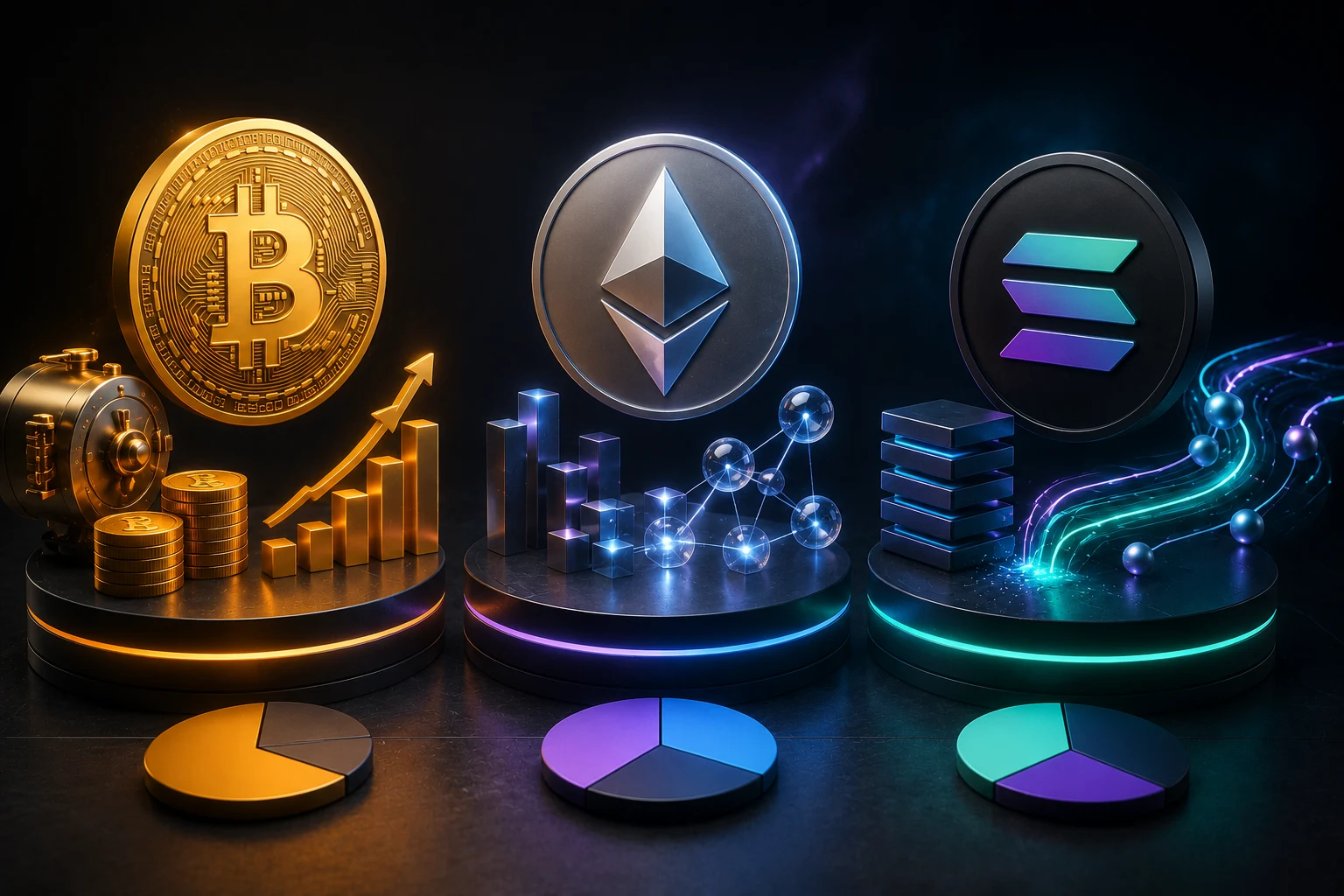
What does 'tokenomics' actually mean?
Tokenomics is the set of rules that governs how a cryptocurrency is created, distributed, and removed from circulation. Think of it as the monetary policy of a network written in code instead of central bank memos. For a beginner, the easiest way to think about it is supply and demand: how many new coins enter the system each year, how many get removed, who holds the rest, and what gives the token any value at all.
These rules matter because they shape whether holding a coin is closer to holding a scarce commodity, a share in a productive network, or a payment token that gets used up. The same dollar can buy you three very different exposures depending on which of those descriptions fits. That is why comparing BTC, ETH, and SOL on tokenomics is not just trivia; it changes what you are actually buying.
It also matters what tokenomics is not. Tokenomics is not a profit forecast. It does not promise you income. It does not tell you whether the price will go up next quarter. It is a script that describes how supply behaves under certain conditions. Whether those conditions hold, and how the market prices the result, is a separate question.
What are the real risks of judging coins by tokenomics?
The biggest risk is reading a tokenomics chart and treating it like an earnings report. None of BTC, ETH, or SOL pay holders a dividend in the traditional sense. There is no board of directors sending profits to coin holders. When people talk about 'value capture' in crypto, they mean indirect mechanisms, like fee burns reducing supply or staking rewards funding yield. None of these are contracts you can sue over.
A second risk is assuming that scarcity alone makes price go up. Bitcoin's 21 million cap is real, but plenty of scarce things have lost value because demand collapsed. The 2022 downturn showed that even assets with predictable supply schedules can fall 70%+ when risk appetite disappears. Tokenomics describes a ceiling, not a floor.
A third risk is projecting current mechanics into the future. Ethereum's burn rate depends on how busy the network is. Solana's net inflation depends on how many transactions actually pay priority fees. Bitcoin's halving schedule is fixed, but miner economics after each halving have changed in ways the original whitepaper did not predict. Tokenomics are governance, not physics; humans can change them through protocol upgrades, and have.
How does Bitcoin's tokenomics work?
Bitcoin has the simplest tokenomics of the three. When the network launched in 2009, the rules were hard-coded: total supply will never exceed 21 million coins, and new BTC enters circulation on a predictable schedule tied to 'halvings'.
The 21 million cap and the halving
Every roughly ten minutes, a new block is mined and the miner receives freshly created BTC as a reward. That reward started at 50 BTC per block. About every four years, or every 210,000 blocks, the reward is cut in half. As of the 2024 halving, the reward is 3.125 BTC per block. The next halving will drop it again, and so on until the reward rounds to zero sometime after the year 2140. At that point, miners will rely entirely on transaction fees.
This creates a curve of new supply that is easy to model. New issuance shrinks on a known schedule. The cap is enforced by code that thousands of nodes verify. No one, not the developers, not a government, can print more BTC through this mechanism. That predictability is the core of Bitcoin's tokenomics pitch.
What Bitcoin's tokenomics do not give you
Bitcoin's design is intentionally minimal. There is no built-in staking. There is no native burn mechanism. If you hold BTC in a self-custody wallet, you do not earn anything just for holding. Some centralized platforms offer 'staking' or 'yield' on BTC, but that is the platform paying you, usually by lending your BTC out or running wrapped-asset strategies, not the Bitcoin network itself.
Bitcoin also has no formal fee burn. Every fee a user pays goes to the miner who includes the transaction in a block. There is no mechanism by which transaction volume reduces future BTC supply. Demand for block space matters for miner revenue, but it does not directly tighten the float.
How does Ethereum's tokenomics work?
Ethereum is a different animal. It is not a fixed-supply asset. ETH is issued continuously to reward validators who secure the network under proof-of-stake (a consensus method where validators lock up ETH instead of solving puzzles with energy). On top of that, part of every transaction fee is destroyed.
EIP-1559 and the burn
Since the London upgrade in 2021, every Ethereum transaction pays a 'base fee' that is burned, meaning it is sent to an address no one controls and removed from circulation forever. Users can optionally add a 'priority fee' that goes to the validator. The base fee adjusts up or down based on demand for block space, the scarce resource the network sells.
When the network is busy and the base fee is high, the burn can outpace new issuance from staking rewards, and total ETH supply shrinks. When the network is quiet and validators are still being rewarded, total ETH supply grows. As of late 2024, Ethereum was running modestly inflationary on net, though individual weeks have seen deflation. Whether ETH is net deflationary over a year depends on usage.
Staking yield on Ethereum
Ethereum has roughly 30+ million ETH staked, paying a variable yield that has ranged roughly between 2.5% and 5% annually in recent years. That yield comes from two sources: protocol issuance (new ETH minted to reward validators) and priority fees (tips users attach to transactions).
This is where the 'value capture' claim gets tested. The yield is not a dividend. It is a function of how many ETH are staked versus how many are issued, plus how much priority fee traffic flows through. If more people stake, the per-validator reward falls. If priority fees dry up, only issuance remains. The yield can change, sometimes meaningfully, with no warning.
How does Solana's tokenomics work?
Solana takes a third path. It runs a planned inflation schedule that decays over time, plus a fee mechanism that burns a portion of every transaction.
The inflation curve
Solana started with an initial inflation rate of around 8% per year when mainnet launched, designed to incentivize validators. The protocol is set to decrease inflation by 15% each year until it reaches a long-term floor of 1.5% per year. As of 2024–2025, Solana's inflation is in the mid-single digits and trending down on schedule.
Unlike Bitcoin, where halvings are dramatic cliffs, Solana's inflation glide path is gradual. Unlike Ethereum, where issuance depends on how much ETH is staked, Solana's issuance is on a pre-set curve regardless of validator participation.
The fee burn and priority fees
Solana burns 50% of each transaction's base fee, with the other 50% going to the validator that processed the transaction. On top of that, users can attach a 'priority fee' that goes entirely to the validator. The intent is that when the network is busy, fee burns offset enough of the inflation to make net supply change small or even negative in some windows.
In practice, Solana's transactions are very cheap in absolute dollar terms, so the burn per transaction is tiny. Net inflation has generally remained positive, though spikes in memecoin and DeFi trading in 2024 periodically pushed weekly issuance into negative territory. Predicting when this happens is hard, because demand for Solana blockspace is driven by application cycles that come and go.
How do staking yields compare across BTC, ETH, and SOL?
None of these tokens pay you for simply holding them in a self-custody wallet. Any yield you see comes from somewhere else, and understanding where is the difference between investing and chasing yield.
Bitcoin: native yield is zero
Holding BTC in your own wallet earns nothing from the protocol. 'Bitcoin yield' products on centralized platforms are not Bitcoin yield; they are the platform's yield, funded by lending, derivatives, or wrapping your BTC into other ecosystems. Those carry counterparty risk (the risk that the other side of the deal fails to pay) and have failed before, including in high-profile exchange collapses.
Ethereum: variable validator yield
Ethereum staking yield has historically tracked between roughly 2.5% and 5%, paid in ETH. It varies with the amount of ETH staked and the level of priority fee activity. When the network is busy, you earn more; when it is quiet, you earn less. This yield is denominated in ETH, so its dollar value moves with ETH's price.
Solana: inflation-driven, decay on schedule
Solana staking yield is funded primarily by inflation. Since inflation is decaying on a known schedule, the per-token yield is also trending down over time. Recent yields have ranged roughly 5% to 8% in nominal terms but are designed to fall. Like ETH, the dollar value of that yield depends on SOL's price at the time you measure it.
The key honest framing here: all three yields are policy decisions, not business results. They can be changed by governance, they can fall when more people participate, and they do not represent a claim on anyone's revenue. Anyone promising you 'sustainable staking yield' is selling you a guess about future network conditions.
Practical implications for an investor weighing the three
If you are deciding what to allocate among BTC, ETH, and SOL based purely on tokenomics, the cleanest framing is: what script are you betting on? Bitcoin's script is scarcity and predictability. You are betting that a hard cap and a known issuance schedule matter more than features. Ethereum's script is active use. You are betting that network activity will stay high enough that burns consistently offset issuance, and that staking yield stays attractive. Solana's script is cheap throughput plus a decaying inflation curve. You are betting that demand for blockspace will keep pace with a shrinking but still-positive issuance.
What you are not buying in any of these cases is a stream of revenue, a legal claim, or a guarantee that the rules will not change. Bitcoin's 21 million cap is enforced by thousands of nodes and would require an extraordinary social consensus to alter. Ethereum's monetary policy has been changed multiple times via community-driven upgrades, including the move to proof-of-stake. Solana's inflation schedule is set by the protocol but, like all of these, lives at the mercy of its validator community.
For a beginner, the practical advice is boring but real: understand the supply mechanics, treat any promised yield as variable and policy-dependent, and never confuse a clean chart with a profit forecast. Tokenomics is one input into price, not the only one.
Track BTC, ETH, and SOL tokenomics news the smart way
Bitcoin, Ethereum, and Solana each shift on a different cadence. Bitcoin news tends to cluster around halvings and miner economics. Ethereum headlines swing with EIP proposals, staking participation, and burn-rate data. Solana chatter tracks validator changes, fee market dynamics, and inflation-decay milestones. Zippfeed surfaces BTC, ETH, and SOL headlines with sentiment scoring (bullish, neutral, or bearish) and an importance rating, so you can separate protocol-level signal from day-to-day noise.



 CryptoSlate
 Glassnode
 TheBlock
 CoinTelegraph
 WatcherGuru