Why these three tokens keep getting compared
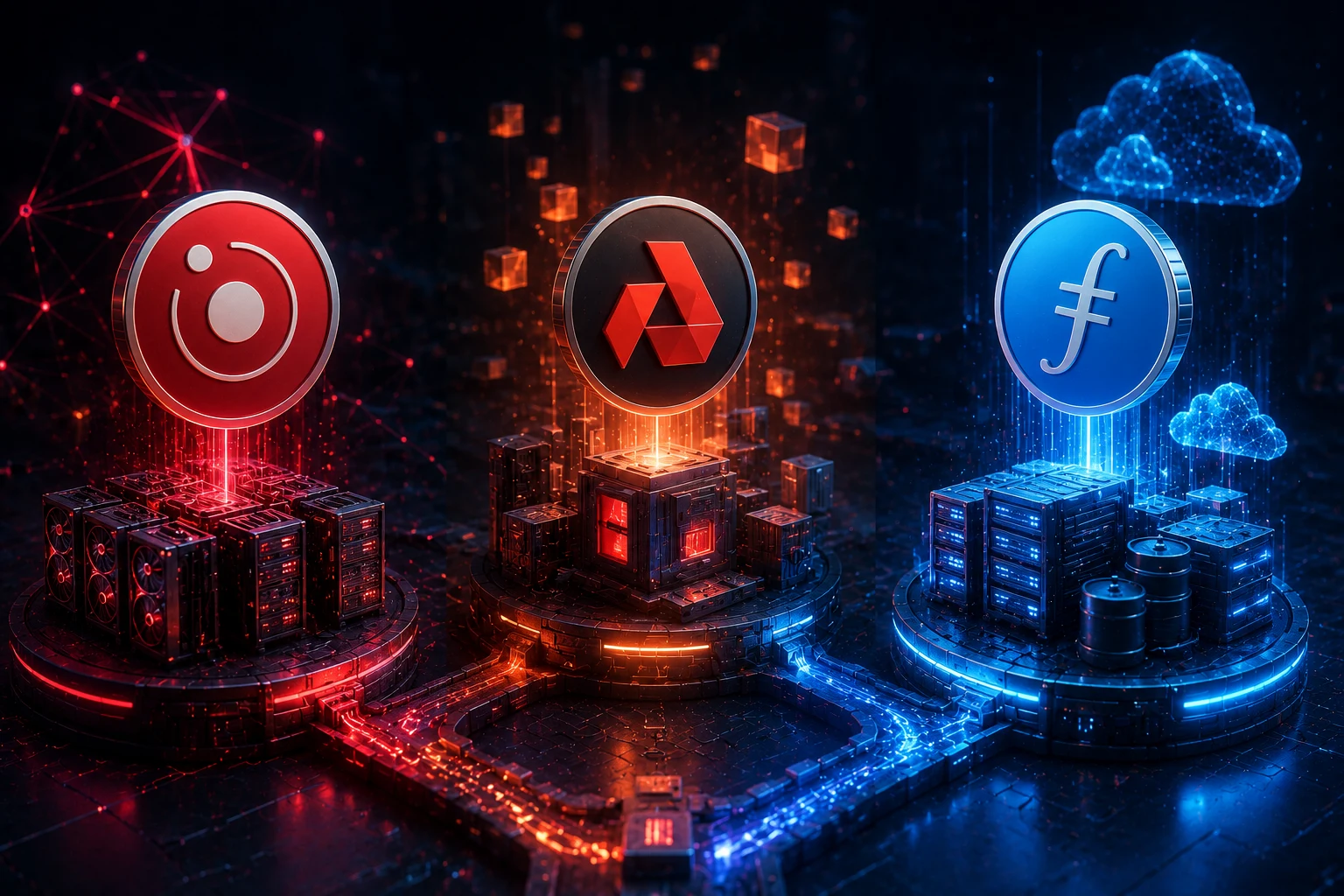
If you have spent more than ten minutes in crypto Twitter or any AI-crypto Discord, you have seen Render (RENDER), Akash (AKT), and Filecoin (FIL) bundled into a single narrative bucket called 'decentralized compute' or 'DePIN AI infrastructure.' The bucket is convenient. It lets a single thesis absorb three projects, and it lets traders rotate among them when one cools off.
The problem is that the bucket is mostly a marketing convenience. Render, Akash, and Filecoin were built to solve three different problems. Two of them actually rent out compute cycles. One of them rents out hard drive space. Their economics, customer bases, hardware requirements, and risk profiles diverge in ways that matter a lot more than the shared 'DePIN' label suggests.
This article breaks down what each network actually does, where the demand comes from, how the tokens capture (or fail to capture) that demand, and why grouping them as competitors is misleading. If you are trying to decide which one, if any, deserves a place in a portfolio, the answer starts with being honest about what each project sells.
The risks of treating DePIN compute tokens as one trade
Before the mechanics, it is worth pausing on the risks. Decentralized compute is one of crypto's loudest sectors and one of its most uneven. The headline-grabbing projects share a sector tag, but the underlying businesses are different, and the failure modes are different.
Concentration risk inside a 'thematic' basket. When a sector runs hot, capital rotates in, and tokens with no real revenue catch the same bid as tokens with paying customers. The 2024 DePIN narrative lifted dozens of projects at once, including ones that were still pre-revenue. By early 2025, multiple 'DePIN' tokens had retraced 70 to 90 percent from their narrative peaks despite no fundamental shift in their own networks. A basket of 'compute tokens' is not a diversified position when half the names share the same speculative bid.
Provider economics versus token economics. A network can be growing in real usage while its token bleeds. Render and Akash have both seen periods where provider revenue rose while the token's circulating supply expanded faster than demand absorbed it. Filecoin has the inverse problem at times: token price can stagnate even as terabytes stored grow. None of the three networks has historically aligned provider revenue, burn rate, and token holder return cleanly. Treat any chart that claims otherwise as marketing, not analysis.
Regulatory and rug risk. Decentralized networks face unclear classification in most jurisdictions. The SEC has signaled it views some tokens as securities, and offshore exchanges have delisted 'DePIN' tokens during prior enforcement waves. Hardware providers in some jurisdictions also face tax and licensing uncertainty. None of this is a death sentence, but it is tail risk that a passive basket buyer tends to ignore.
The 'AI infrastructure' narrative is fragile. The pitch 'this token powers AI' has carried enormous weight in 2024 and 2025. If the narrative cools, as 'metaverse tokens' and 'Web3 social tokens' cooled before them, the same projects will be valued on cash flow rather than story, and many will look expensive on cash flow. That is the single biggest non-technical risk for the whole sector.
What Render (RENDER) actually does
Render started in 2017 as a way to rent out idle gaming and workstation GPUs for 3D rendering. Studios and artists would upload a scene file, the network would distribute the workload across hundreds of consumer GPUs, and the resulting frames would be stitched back together. The original token (RNDR) was an ERC-20 utility token on Ethereum.
In 2023 the project migrated to a new chain (Render Network on Solana, later expanding to Base and other chains) and rebranded the token as RENDER. The 2024 roadmap added 'AI inference' as an explicit workload, meaning the same GPU providers can serve model inference jobs (running a trained AI model on inputs to produce outputs) in addition to traditional rendering. This is the source of most of the 2024-2025 AI narrative lift.
Render's customer base splits roughly into two groups: 3D and motion graphics studios that need burst rendering capacity for film, advertising, and product visualization, and AI teams that need cheap GPU inference. The first group is mature and steady. The second is the growth story and is dominated by cost-sensitive startups running open-source models.
How RENDER captures value. Render burns a portion of the RENDER paid by customers and redistributes the rest to GPU providers. This 'burn-and-pay' mechanic is the closest of the three to a real value sink, because customer fiat or stablecoin flows in, and a fraction of RENDER is permanently removed from circulation. The size of that sink relative to total emissions is what determines whether RENDER is inflationary or deflationary in any given quarter.
Where Render is weak. The biggest practical weakness is hardware quality variance. Consumer GPUs are not data-center GPUs. They have less VRAM, weaker cooling, and inconsistent uptime. For 3D rendering, that is mostly fine. For serious AI inference on large models, it is a real constraint, and serious buyers often still prefer centralized clouds like AWS, Lambda, or CoreWeave. Render's growth depends on continued price pressure pushing AI teams toward cheaper, less reliable hardware.
What Akash (AKT) actually does
Akash is a general-purpose cloud computing marketplace. Where Render specializes in GPU rendering and AI inference, Akash tries to be a decentralized alternative to AWS or DigitalOcean for almost any workload: containers, web servers, machine learning training, and GPU jobs alike.
The technical model is a 'reverse auction.' People who want compute (called 'tenants') post what they want to run and the maximum they will pay. Hardware providers (called 'providers') compete to offer it at the lowest price. The market clears, the lease is signed on chain, and the provider runs the workload. Settlement happens in AKT, the network's native token.
Akash's customer base is broader and more developer-driven than Render's. A typical Akash tenant is a small team deploying a backend service, a researcher running batch jobs, or an AI startup spinning up GPU containers. Akash positions itself as a censorship-resistant alternative to AWS and as a way to access hardware that is otherwise unavailable.
How AKT captures value. Akash burns AKT when leases are created and takes a small fee on transactions. The token also serves as the staking and security asset for the network. This means holders can be validators (the computers that secure the network and reach consensus on transactions) or delegators (token holders who lend their stake to validators and share in rewards). Unlike Render, however, the burn rate is small relative to emissions, and AKT has historically been net inflationary. Holders rely on staking yields and on the broader narrative bid rather than on a powerful burn sink.
Where Akash is weak. Two big weaknesses. First, the 'general-purpose cloud' positioning means Akash competes head-on with hyperscalers (very large centralized cloud providers such as AWS, Azure, and Google Cloud) and with bare-metal providers on price, and hyperscalers have structural advantages in scale, support, and SLAs (Service Level Agreements, the uptime and performance guarantees that enterprise customers demand). Second, the AI workload that lifted Akash in 2024 (cheap GPU rentals for training and inference) is the same workload Render is chasing, which means the two are direct competitors in the segment that matters most.
What Filecoin (FIL) actually does
Filecoin is the oldest of the three and the one most often misunderstood. Filecoin is not a compute network. It is a storage network. Providers commit hard drive space to the network, and clients pay FIL to store data for a specified duration. The network verifies storage with cryptographic proofs (mathematical evidence that lets the chain confirm the data is actually being kept and replicated without needing to re-download it). This is sometimes confused with 'decentralized cloud storage' projects like Arweave or Storj, which serve similar but not identical purposes.
The AI angle for Filecoin is real but indirect. AI teams need training data, model weights, and inference logs stored durably. Storing that data on Filecoin is cheaper than AWS S3 for long-tail archival. There are also projects building 'compute-over-data' layers on top of Filecoin, meaning systems that let you run computations against data without first moving it, which is appealing for large datasets that would be expensive to transfer. These are genuine use cases, but they do not turn Filecoin into a compute network. They turn Filecoin into a storage layer that compute networks sometimes sit on top of.
How FIL captures value. Storage deals burn a small amount of FIL and lock up collateral from providers. The bigger economic force is 'pledge collateral,' meaning FIL that providers must lock up as a security deposit, which removes it from the liquid supply. When storage demand rises, more FIL gets locked, and the circulating supply tightens. The base rewards paid to miners come from emissions, not from customer revenue, so the network is structurally inflationary unless collateral demand absorbs the new supply.
Where Filecoin is weak. Filecoin has struggled with two persistent issues. First, the majority of storage on the network has historically been 'parked' storage from miners fulfilling pledge requirements rather than organic customer demand. Real, paying customer deals are a smaller fraction of total capacity than the headlines suggest. Second, the token has decoupled from network usage multiple times, meaning storage grew while the price stagnated or fell. Holders have learned not to confuse terabytes stored with token returns.
Burn vs pay: how each token's economics actually work
Because the three networks use the word 'token' for very different jobs, it helps to lay out the mechanics side by side.
Render burns a share of customer payments in RENDER, pays the rest to GPU providers, and uses RENDER for governance (the on-chain voting process that decides protocol upgrades and treasury spending). RENDER's net inflation or deflation depends on whether the burn exceeds emissions. In periods of high rendering demand the network has trended deflationary; in quiet periods it has trended inflationary.
Akash burns AKT on lease creation and uses AKT for staking and governance. AKT has been net inflationary in most quarters because lease volume is small relative to emissions. Holders earn staking yield but rely heavily on the narrative bid for price appreciation.
Filecoin burns a small amount of FIL on deals and locks large amounts of FIL as provider collateral (pledge). New FIL is emitted to miners as block rewards (the FIL paid out for producing new blocks, similar to how Bitcoin pays miners in BTC). The economic story is supply tightening via collateral versus supply expansion via emissions. The balance shifts quarter to quarter.
The takeaway is that 'the token accrues value' is a meaningless phrase on its own. What matters is whether the specific sink in each network (burn, collateral lock, fee capture) exceeds the specific source (emissions, unlocks, treasury sales). For all three, this calculation requires reading on-chain dashboards, not headlines.
Practical implications: which one, if any, belongs in your portfolio
Three honest implications follow from the breakdown above.
If your thesis is 'AI inference demand will keep growing,' Render is the cleanest exposure because GPU inference is its primary workload and its burn sink is the most direct. Akash also captures some of that demand but with weaker token economics. Filecoin is a distant, indirect beneficiary at best.
If your thesis is 'DePIN will replace centralized clouds,' Akash is the broadest bet because it covers the most workloads. But the thesis is itself questionable: hyperscalers have structural advantages that DePIN has not overcome for enterprise workloads. Be honest about how much of your Akash position is a real cloud thesis versus a narrative rotation.
If your thesis is 'data storage demand will explode,' Filecoin is the most direct play, but be aware that storage growth has decoupled from FIL price historically. Owning FIL because 'storage is going up' is not the same as making money on the trade.
Across all three, the same caution applies: real revenue from providers is the only metric that justifies a long-term position. Speculative demand can lift any of these tokens in a narrative cycle and drop them just as fast, as the 2021 NFT and metaverse tokens showed.
How to follow DePIN compute tokens without getting burned
Render, Akash, and Filecoin all move on a cocktail of AI narrative shifts, macro liquidity, provider revenue, and token unlock schedules (pre-set dates when previously locked tokens become tradeable, often creating sell pressure). Tracking all four by hand is a losing game. Zippfeed surfaces DePIN and AI-crypto headlines with sentiment scoring (bullish, neutral, or bearish) and an importance rating, so you can separate real revenue news from narrative noise and react before the crowd rotates.


 CoinDesk
 CryptoSlate