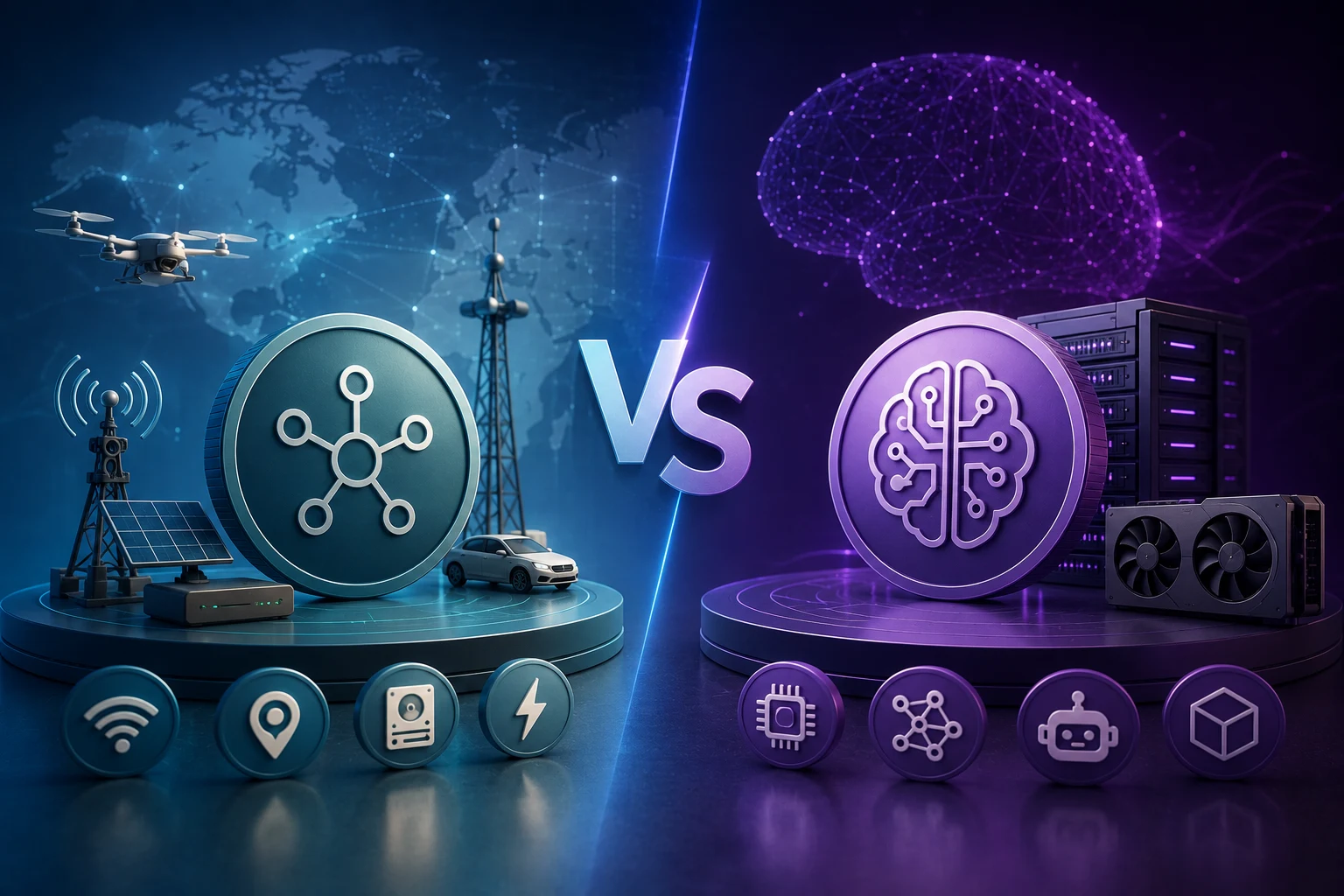
Why the DePIN vs AI token confusion is so common
The two categories get lumped together because they sit next to each other on investor pitch decks and on the same Layer 1 narratives around 2024 and 2025. Both promise decentralized infrastructure. Both involve tokens that coordinate work. Both have raised billions from venture funds during the same cycle. To a casual observer, a Render GPU and a Bittensor subnet validator can look like the same idea wearing a different shirt.
They are not the same idea. A DePIN token is, at its core, a receipt for revenue paid to a person running a physical piece of infrastructure somewhere in the world. The hardware has to be plugged in, cooled, and connected. The token's job is to settle payments between whoever needs that hardware and whoever owns it. An AI token, in the typical case, is a coordination mechanism for software: model weights, inference endpoints, agent services, and data pipelines. There is no plug.
This distinction matters because it dictates where the cash comes from, who pays it, what the token actually represents, and what could go wrong. Once the categories are separated, every other comparison (valuation, risk, hype cycles) becomes much more honest.
The risks of confusing the two
Confusing DePIN tokens with AI tokens is not a harmless mental shortcut. It changes how investors size positions, set price targets, and interpret on-chain data. Three concrete risks follow from mixing the two theses.
First, the demand source is invisible. A DePIN token's bull case assumes real customers are paying for storage, bandwidth, or compute. An AI token's bull case often assumes speculative demand for a software product that may or may not have paying customers today. If a reader assumes both tokens are riding the same AI capex wave, they will misread what a doubling in either actually signals.
Second, the failure modes are different. A storage network can go bankrupt when hardware costs fall faster than storage fees. An AI-agent network can go to zero when a foundation model company releases a free alternative. Treating one risk as if it were the other leads to the wrong hedges.
Third, the valuation multiples do not transfer. Hardware networks look a bit like commodity infrastructure businesses; you can compare them to cloud providers and CDN operators. AI agent networks look more like early-stage SaaS, marketplaces, or speculative developer tools. The same revenue dollar means something different in each frame.
What a DePIN token actually is
DePIN stands for Decentralized Physical Infrastructure Networks. The acronym covers projects that pay independent operators, usually in tokens, for running real hardware: storage drives (Filecoin), GPUs (Render), wireless hotspots (Helium), sensors, and similar. The token sits on top of this hardware layer and serves three practical jobs.
The token coordinates supply. New operators can join the network by staking tokens, which discourages spam and sybil attacks. The token coordinates demand. Customers pay in stablecoins or the native token, and providers receive payment for verified work (a stored file, a rendered frame, a relayed megabyte). The token also captures optional upside through governance, fee burns, or staking rewards.
Filecoin is the clearest example. Storage providers put down collateral in FIL, pledge disk space, and earn FIL when clients sign storage deals. Those deals are real two-sided contracts, denominated in dollars and settled in token. The FIL market cap moves with expectations about how many of those deals will land, at what price, and on which competitors.
Render works the same way for GPU rendering and, increasingly, for AI inference. Operators run GPUs. Customers (studios, AI labs, researchers) submit jobs. RNDR, recently rebranded to RENDER, is the settlement token. The interesting twist is that Render now serves both traditional rendering workloads and AI inference workloads, which puts it on the border between DePIN and AI infrastructure.
What an AI token actually is
AI tokens fund software-native networks whose product is a model, an agent, a data set, or a coordination layer for AI services. There is no required hardware to buy. Operators run validators, miners, or agents on commodity cloud servers, and the network routes inference or data requests between them.
Bittensor (TAO) is the archetype. Subnet operators register AI services, and TAO holders rank them. Well-ranked subnets earn TAO emissions. The thesis is that an open market of competing AI services, scored by token-weighted ranking, will eventually produce a more useful aggregate intelligence than any single lab. Whether that thesis holds is a separate question, but the structure is software-only: there are no physical antennas or storage racks to plug in.
Virtuals Protocol (VIRTUAL) and its agent token VVV take a different angle. Virtuals lets developers spin up autonomous AI agents, each with its own token, that can sell services or content to users. VVV is the base layer that coordinates agent creation, agent discovery, and fee distribution. Again, the underlying product is software, and the network effects come from the quality of the agents rather than the locations of the servers.
The common thread across AI tokens is that the demand thesis assumes someone is willing to pay for AI services routed through the token's network, or that the AI services themselves generate enough on-chain activity to justify the token's value. Many of these networks are early. The revenue is thin. The token price is driven more by emissions, unlocks, and narrative than by dollars flowing in from customers.
Real revenue versus emissions-driven yield
The single most useful question to ask of any token in either category is simple: where do the dollars come from, and who pays them? That question splits the two categories cleanly.
For a DePIN token like Filecoin, the answer is a storage customer. Maybe it is a Web3 protocol backing up its snapshot data. Maybe it is an enterprise using Filecoin as cold storage for compliance. That customer pays Filecoin storage providers in a mix of stablecoins and FIL, the providers earn a margin, and the network settles the deal. You can trace the revenue on-chain, you can name the counterparties, and you can estimate the price per terabyte per month. The token's value derives from a claim on a slice of that cash flow, either through staking yields, fee burns, or expected appreciation as deal volume grows.
For an AI token like TAO, the answer is murkier. New TAO is minted and distributed to subnet operators who rank highly. That TAO is then sold, often on the open market, to pay for compute or to take profit. The dollar flowing out (in the form of selling pressure) can exceed the dollar flowing in (from customers paying for AI services). When that gap is large, the token is being funded by emissions rather than by customers, which is closer to a venture-style investment than to an infrastructure business.
This is not a moral judgment. Many legitimate networks go through an emissions phase to bootstrap supply. But it means that the AI token category as a whole has a much higher fraction of projects whose current revenue is largely self-generated by token issuance. DePIN tokens have a higher fraction of projects with at least some external customers paying in dollars.
How to tell whether a token has paying customers
Reading a tokenomics deck is not the same as verifying revenue. Five checks separate the projects with real customers from the projects that are mostly running on emissions and unlocks.
Look at on-chain payment flows
If a network claims to have enterprise customers, those customers will leave a trail. Stablecoins will move from known addresses into the network's payment contracts, and the network will distribute revenue to provider addresses. Dashboards like Filecoin's storage deal explorer, Render's job explorer, and various Dune queries for other networks make this visible. If you cannot find an explorer, that itself is a signal.
Check the difference between token emissions and fees
Token Terminal and similar dashboards report protocol revenue (fees paid by customers) versus token incentives (new tokens distributed to providers). A network where incentives dwarf revenue is paying its providers with inflation rather than customers. That can work in a bull cycle, and it breaks badly when the cycle turns.
Ask who the customer is
DePIN networks often have a small number of named customers. Filecoin has highlighted deals with enterprise storage customers. Render has publicly named studios and AI labs. AI agent networks tend to point to broader category demand: thousands of agents, hundreds of thousands of API calls. The latter is harder to verify and easier to inflate.
Test the unit economics
For DePIN, the question is whether the fees paid by customers cover the hardware operator's costs (electricity, depreciation, bandwidth) plus a margin. If fees are below cost, providers will eventually switch off the hardware and the network dies. For AI tokens, the question is whether fees from end users cover the cost of running the AI service. If they do not, the only thing keeping the lights on is new emissions.
Watch for self-dealing
Some networks route fees back through foundation-controlled wallets or related parties, which makes revenue look larger than it really is. A clean DePIN network has thousands of independent providers earning fees from thousands of independent customers. A network where the top ten addresses earn most of the fees is centralized in all but name.
The grey zone where Render lives
Render is the cleanest example of a DePIN project whose demand thesis now blends into AI. Historically, Render was a marketplace for 3D rendering jobs: studios needed GPUs to render animation frames, Render matched them with operators running GPUs, and RNDR settled the deals. The thesis was about Hollywood, gaming, and visual effects.
In 2024 and 2025, Render positioned itself more aggressively as a network for AI inference workloads. AI labs need GPUs for training and serving models, and Render's operator base can supply them. The token was rebranded from RNDR to RENDER, and the roadmap leaned into AI demand. This is what makes Render such a useful case study: it is the same network with two different demand stories. The 3D rendering customer base is real but cyclical, tied to entertainment budgets. The AI customer base is growing fast but is also being competed for by every hyperscaler, every GPU cloud, and every other DePIN project.
For investors, Render illustrates how the DePIN and AI theses can merge. It also illustrates the risk. If AI inference commoditizes faster than expected, Render's pricing power on its GPU marketplace collapses, and the network looks more like a commodity infrastructure business. If the DePIN angle dominates, Render looks like a slower-growth utility play. Either way, the token's value depends on real fees from real customers, not on the AI narrative in general.
Common valuation pitfalls for both categories
Both DePIN and AI tokens are vulnerable to the same handful of mental shortcuts. Knowing them in advance makes it harder to fall for them.
The TAM shortcut
Founders love to say their network will capture a sliver of a trillion-dollar market. The cloud storage market is huge, the AI inference market is huge, the wireless connectivity market is huge. A sliver of a huge market is still huge. The shortcut is that the sliver is not free: a DePIN network has to win customers on price, reliability, and latency, and an AI network has to win on model quality and developer adoption. Both take years.
The emissions-as-revenue shortcut
Token emissions distributed to providers look like revenue on dashboards. They are not revenue. They are new token issuance that becomes selling pressure as providers cash out. Investors who treat emissions as recurring revenue will massively overstate the cash-generating capacity of both DePIN and AI tokens.
The narrative-as-demand shortcut
Both categories ride waves. DePIN had its moment in 2023 and 2024. AI tokens had theirs in 2024 and 2025. During the wave, narrative alone can move prices, which makes it tempting to believe narrative equals demand. It does not. Narrative evaporates when the cycle turns. Real demand does not.
The competitor-blind shortcut
Filecoin competes with Arweave, with centralized cloud storage, and with hyperscalers that already have the customers locked in. Render competes with AWS, Google Cloud, Azure, CoreWeave, Lambda Labs, and dozens of smaller GPU clouds. AI agent networks compete with foundation-model APIs that are often free or heavily subsidized. Every DePIN and AI token faces entrenched competitors. The shortcut is to assume the decentralized version will win on ideology. It will only win on price, performance, and trust.
The unlock shortcut
Token unlocks are scheduled dilution. If a project's circulating supply is going to triple over the next two years, the token has to absorb that dilution before any price appreciation is meaningful. Both DePIN and AI tokens from the 2024 cycle face heavy unlock schedules. Treat them as a known headwind.
Practical implications for the reader
For someone deciding how to think about DePIN versus AI tokens, the practical playbook is straightforward. Separate the categories in your head before you compare them. Within each category, identify the projects with verifiable external customers and ignore the rest until they prove themselves. Within those projects, look at the on-chain payment flows, the difference between emissions and fees, and the unit economics of the operator.
Render deserves its own bucket because it lives on the border. TAO and VIRTUAL belong in the AI token bucket, where the demand thesis is largely about speculative and developer adoption rather than enterprise customers. FIL belongs in the DePIN bucket, with a customer base that includes real storage deals, even if the growth rate is slower than the AI category.
Be skeptical of any token that cannot answer the question, who pays the fees? in concrete terms with on-chain evidence. Be equally skeptical of any token whose only answer is the TAM of cloud computing or AI in general. Both categories have winners. Neither category has a free lunch.
How to follow the DePIN vs AI token split the smart way
DePIN and AI tokens move on different signals, and so does the news around them. Storage deal volumes, GPU rental rates, and operator count matter for one category. Model releases, agent adoption, and developer activity matter for the other. Tracking both manually is a losing game, especially when the news cycle rotates between the two categories every few weeks. Zippfeed surfaces DePIN and AI token headlines with sentiment scoring (bullish, neutral, or bearish) and an importance rating, so you can separate the signal from the narrative without losing hours to feeds.





 Altcoin Daily