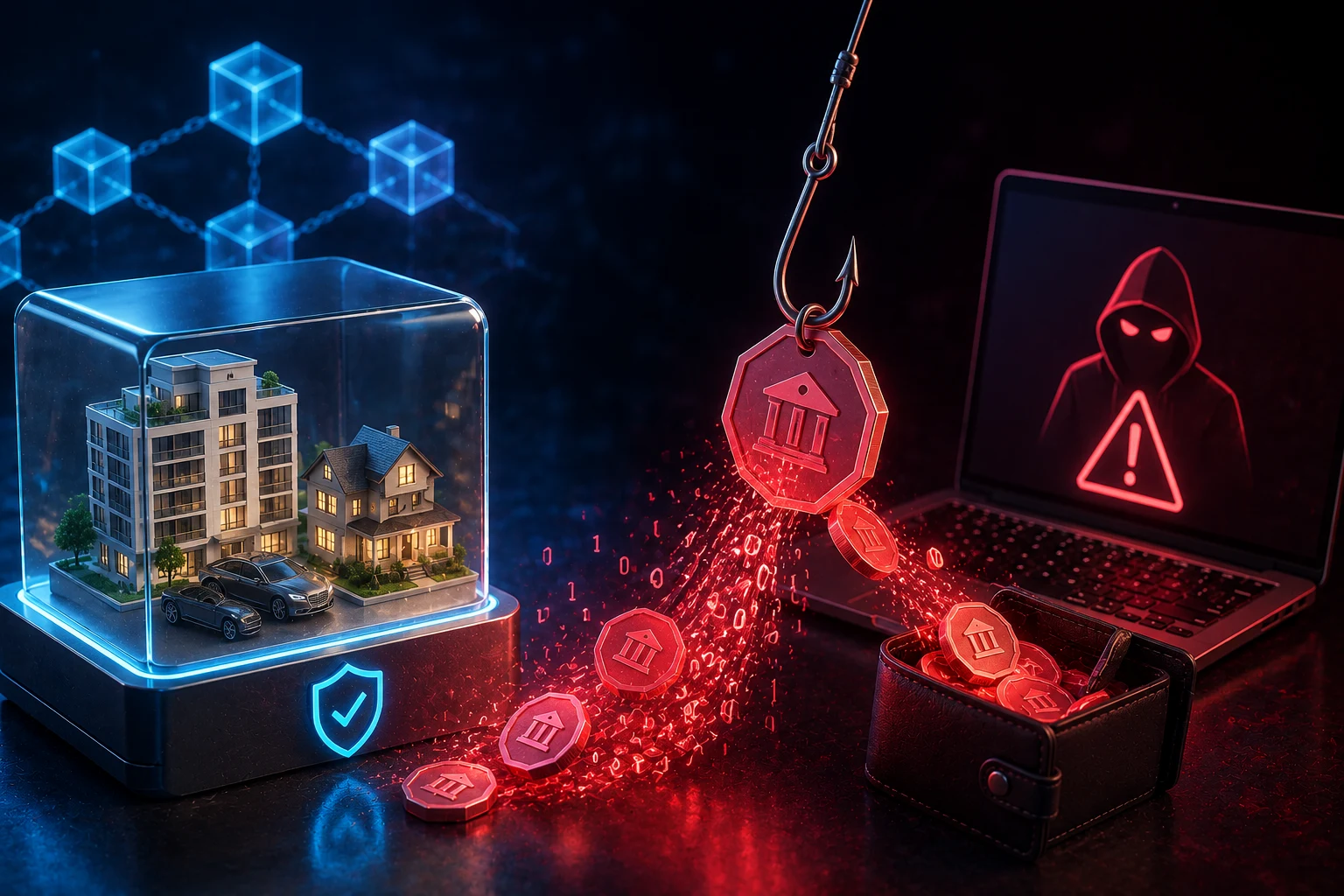
What is RWA phishing, and why is it different from a generic airdrop scam?
RWA phishing is a category of crypto scam that impersonates tokenized real-world asset products, things like money market funds, short-duration US Treasuries, or private credit, in order to trick holders into signing malicious transactions. The category exists because the underlying products have a built-in trust signal that older scams had to manufacture from scratch: an institutional brand.
When a wallet shows a token with the BUIDL or OUSG ticker, a holder is more likely to assume it came from the real issuer. Scammers exploit that assumption. They deploy a new ERC-20 contract, give it the same ticker symbol, sometimes even the same name, and airdrop worthless copies to active addresses. The copy sits in the wallet next to the real token, indistinguishable on a casual glance.
That is what makes RWA phishing a more sophisticated cousin of address-poisoning. Address-poisoning relies on a victim sending to the wrong address. RWA phishing relies on a victim signing the wrong approval. The attacker does not need to convince you the protocol is real, because the logo and the ticker do that work for free.
The products being impersonated, tokenized Treasuries and private credit, are also some of the fastest-growing corners of on-chain finance. That growth pulls in retail users who have never dealt with on-chain credit before, and who may not realize that the ticker on Etherscan is just a string a deployer typed in. The bar for a credible-looking scam has dropped to almost zero.
What are the real risks before you touch a tokenized RWA?
The honest answer is that the risks start before you ever interact with a real issuer, because the impersonation problem alone can empty a wallet. The technical risks of the real products, like smart contract bugs, oracle failures, or issuer bankruptcy, are secondary to the social engineering risk for most retail users.
Approval phishing is the dominant failure mode. When you interact with a DeFi protocol, you typically grant a smart contract permission to move a specific token from your wallet. The default interface often lets you set that allowance to unlimited, which is convenient but catastrophic if the contract is malicious. A single signature can hand an attacker the ability to drain every copy of that token you hold, now or later.
Wrapper tokens are particularly dangerous. Most RWA products are not transferable to a regular wallet directly. They sit inside a wrapper, an intermediate contract that issues a tradeable receipt. Scammers deploy their own wrappers and label them with the real ticker. Approving the wrong wrapper means the attacker can pull the wrapper out of your wallet at any time, and you may not notice until the balance is gone.
Impersonation gets harder to spot as the brand gets bigger. A scam copying OUSG can register ondo-ousg-claim.com, buy Google ads for the search term, and ship a pixel-perfect clone of Ondo's actual landing page. The fake KYC portal will ask for a wallet signature under the guise of accreditation verification, and the signed payload will be an unlimited token approval. There is no recourse once that signature is on-chain.
Historical context matters. The pattern is not new. The 2022 Badger DAO hack drained roughly $120 million by tricking users into approving a malicious contract through a compromised front-end. The 2023 Ledger Connect Kit compromise hit dozens of legitimate dApps at once. In each case, the user signed something that looked routine, and the loss was total. RWA phishing is the same playbook with a different costume.
Counterparty risk on the real product still exists. If you successfully buy the real BUIDL or OUSG through the real channel, you still carry the risk that the underlying fund pauses redemptions, that the issuer's bank fails, or that a custodian cannot deliver Treasuries on demand. These tail risks are real, and they sit on top of the impersonation risk, not in place of it.
How does RWA phishing actually work, step by step?
The mechanics are consistent across campaigns, which is what makes them teachable. Once you see one, you can name every stage in the next one.
Stage 1: Domain registration. The attacker registers a domain that visually matches a real issuer. Common patterns include hyphens (ondo-finance-claim.com), country-code TLDs (ondo.fi or ondo-app.io), or substituted letters (0ndo.com with a zero). The site loads a near-perfect copy of the issuer's homepage, scraped from public marketing assets.
Stage 2: Contract deployment. The attacker deploys a new ERC-20 contract on Ethereum or a Layer 2 network. The contract has the same name and ticker as the real token. There is no on-chain registry that prevents this. The attacker then airdrops the fake token to thousands of addresses that already hold the real product, so the scam token shows up alongside the genuine one.
Stage 3: Distribution channels. The fake site and contract get pushed through paid search ads, hacked Discord or Telegram channels, compromised X accounts, and reply spam on real issuer announcements. KOLs and aggregators occasionally index the fake contract, which makes it surface in wallet scanners as if it were legitimate.
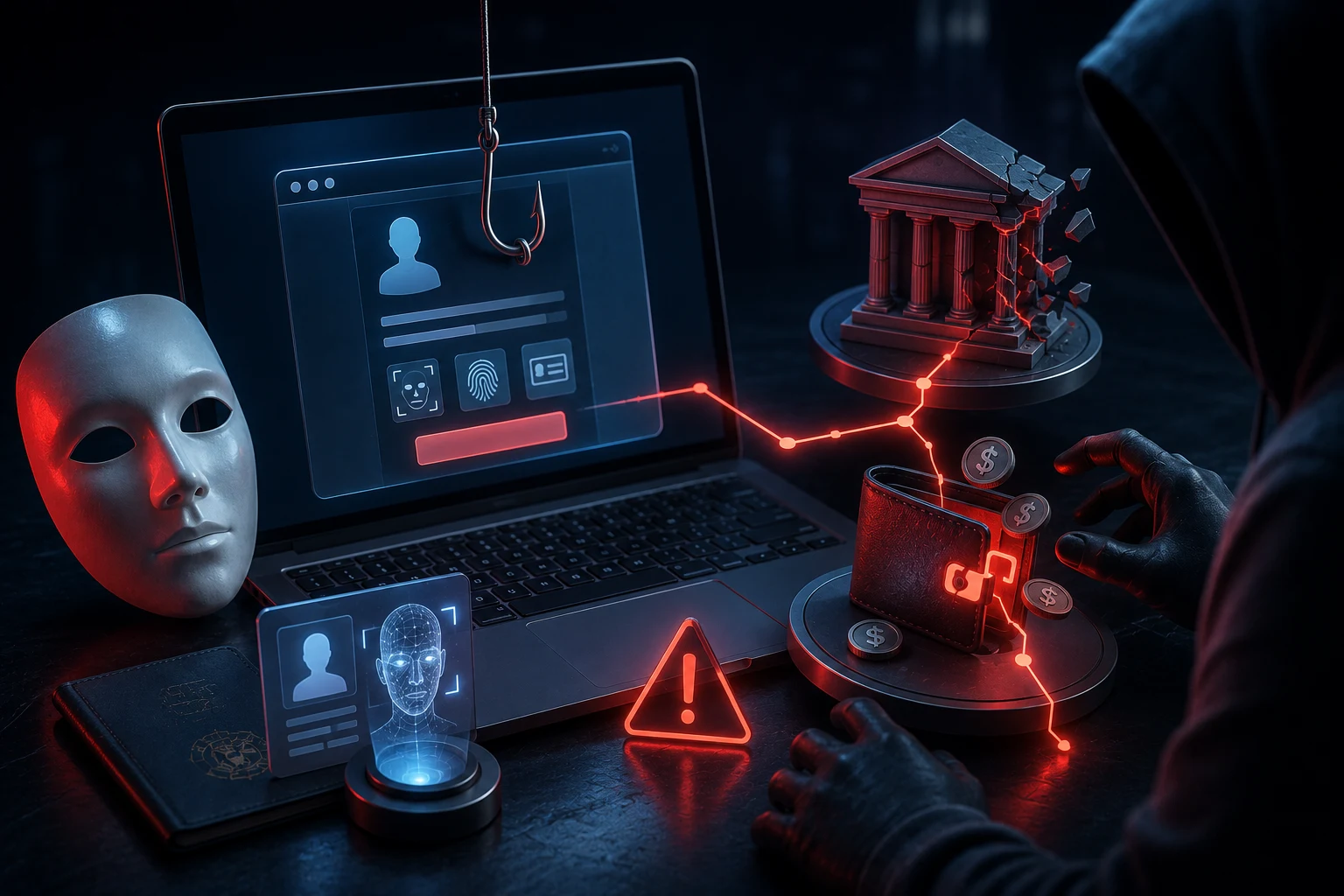
Stage 4: The trap. Victims are routed to a fake 'claim' or 'redeem' portal. The page explains that the user must complete KYC or accreditation before they can receive distributions, yield, or airdropped bonuses. The wallet signature requested at the end of the KYC flow is not actually verifying identity. It is an approval, often unlimited, often for a non-transferable wrapper token that the attacker controls.
Stage 5: Drain. Once the approval is signed, the attacker calls the wrapper's transferFrom function and pulls the wrapper out of the wallet. Depending on the design, the underlying real RWA may go with it, or the wrapper may simply be worthless, but the holder usually only notices after the balance is gone.
Why are KYC and accreditation portals part of the trick?
Most legitimate RWA products are restricted to accredited or qualified investors under securities rules. That creates a friction point scammers love: the user expects to be asked for documents before they can transact. The scammer simply moves the phishing payload inside what looks like a compliance step.
The fake portal typically asks for an email, a selfie, and a wallet signature to 'verify accreditation on-chain'. The signature is the malicious approval. The selfie and email are bonus data the scammer can sell or use in follow-on scams. Victims often report feeling that something was off but signing anyway because the step seemed normal.
This is also why the impersonation feels more convincing to retail than to institutions. A prime broker knows that BUIDL is only distributed through Securitize and never through a public claim page. A retail user who saw a BlackRock logo on a YouTube ad has no comparable context. The KYC framing makes the wallet signature feel like a regulatory checkpoint rather than a financial one.
The defense is structural. Real issuers like Securitize, Ondo, and Maple publish their canonical contract addresses on their own primary domains. Compliance steps happen inside the issuer's actual app, not in a page you arrived at from a DM, an ad, or a reply. If a site is asking for your wallet to sign anything during KYC, that is a red flag by itself, regardless of how polished the rest of the page looks.
What do fake 'claim' and 'redeem' portals actually do to a wallet?
Most of them request an ERC-20 approval, the same primitive used by Uniswap and Aave to let smart contracts move tokens on your behalf. The difference is the spender. A legitimate DEX asks you to approve the Uniswap router, a known address with public audits and a track record. A phishing site asks you to approve an address the attacker controls, often freshly deployed, often with no audit, often without a verified source on Etherscan.
The worst variant is the approval for a non-transferable wrapper token. The attacker deploys a wrapper contract that mints and burns a receipt token representing a stake in the underlying RWA. The real issuer does something similar, but with a verified contract. The fake wrapper lets the attacker move the receipt out of your wallet at will. Even if you later revoke the approval, the tokens are already gone.
Some sites go further and request a setApprovalForAll call, which grants blanket permission over ERC-721 or ERC-1155 tokens at the wallet level. This is the same primitive NFT marketplaces use, and it is also what drainers chain together to clear out an entire wallet in one transaction. Once a setApprovalForAll is signed for a malicious operator, anything at that contract address is fair game.
There is also a newer variant where the 'claim' page asks you to sign an off-chain message using eth_sign or personal_sign. The signed payload is then used to construct a replayable permit that authorizes the attacker to spend your tokens without ever submitting an on-chain approval. Permit-style phishing has been growing because it leaves no obvious approval row to revoke after the fact.
The pattern across all of these is the same: the page turns a moment that feels like paperwork into a moment that is actually a financial authorization. The strongest single defense is to treat any wallet signature request during a 'verification' step as the point of no return, and to read the decoded transaction in your wallet before you confirm.
How do you verify the canonical contract before you sign anything?
Verification is a five-step routine, and it should run before any interaction with an RWA product, especially if you arrived through a link rather than typing the URL yourself.
1. Start at the issuer's official domain. Type the address bar manually. For BlackRock's BUIDL, that is the Securitize-marketed page on Securitize's primary domain, not a search result. For Ondo's USDY and OUSG, that is the official ondo.finance site. Bookmark the real URL once and never click through search ads or social replies again.
2. Find the canonical contract address on that page. Real issuers publish their contract addresses in their documentation, often with a link to Etherscan and a clear note about which networks they are deployed on. Write the address down. Better yet, copy it once into a notes app so you can compare against what your wallet is showing you later.
3. Cross-check on Etherscan. The contract page on Etherscan should show the issuer name as the verified contract creator, a high holder count, real transfer history, and a deployment date that lines up with the issuer's launch announcements. If the deployer is a fresh wallet with no history, you are not looking at the real product.
4. Watch for two contracts sharing a ticker. This is the smoking gun. If Etherscan shows two or more contracts labelled with the same ticker, the older one with verified source code and the canonical deployer is the real product, the newer one is the impersonator. Tickers are not unique on-chain. Anyone can name their contract BUIDL.
5. Revoke stale approvals proactively. Tools like revoke.cash let you audit every active approval on your wallet and revoke the ones you no longer use. Running this once a quarter, or after any incident that touched a high-value address, prevents old approvals from becoming silent liabilities.
What should you do if you have already signed something suspicious?
The first hour matters more than anything that comes after. Move remaining assets to a fresh wallet that has never interacted with the suspicious site. Do not try to 'clean' the compromised wallet by revoking and hoping; the approval may already have been used, or another signed payload may still be pending.
Revoke approvals on revoke.cash from a clean browser session if you have time. Then check the wallet on a block explorer to see whether any tokens have already moved out. If the approval was a permit or an off-chain signature, there may not be an obvious on-chain trace until the attacker sweeps, so speed matters.
Report the scam site to the issuer being impersonated. Most legitimate RWA issuers maintain a security contact or abuse mailbox. The faster they can warn other users and get the domain taken down, the smaller the blast radius. Do not expect to recover funds by reporting, but expect the report to slow the next victim.
If a meaningful amount was lost, document the signatures, the contract addresses, and the site URLs before they disappear. This is the input that blockchain forensics firms and law enforcement actually use. Screenshots from the moment of the incident are far more useful than screenshots taken a week later.
How to follow RWA phishing the smart way
RWA phishing moves fast, and so does the news around it. Tracking new scam domains, fake contract deployments, and approval drainers manually is a losing game for any individual investor. Zippfeed surfaces RWA and tokenized-asset headlines with sentiment scoring (bullish, neutral, or bearish) and an importance rating, so you can see which stories the market treats as material and which ones are noise. Pair that feed with a five-minute pre-click checklist, and the impersonation playbook becomes far easier to resist.



 TheBlock
 Crypto Capital Venture
 CoinDesk
 CoinTelegraph