What the SEC and CFTC actually do
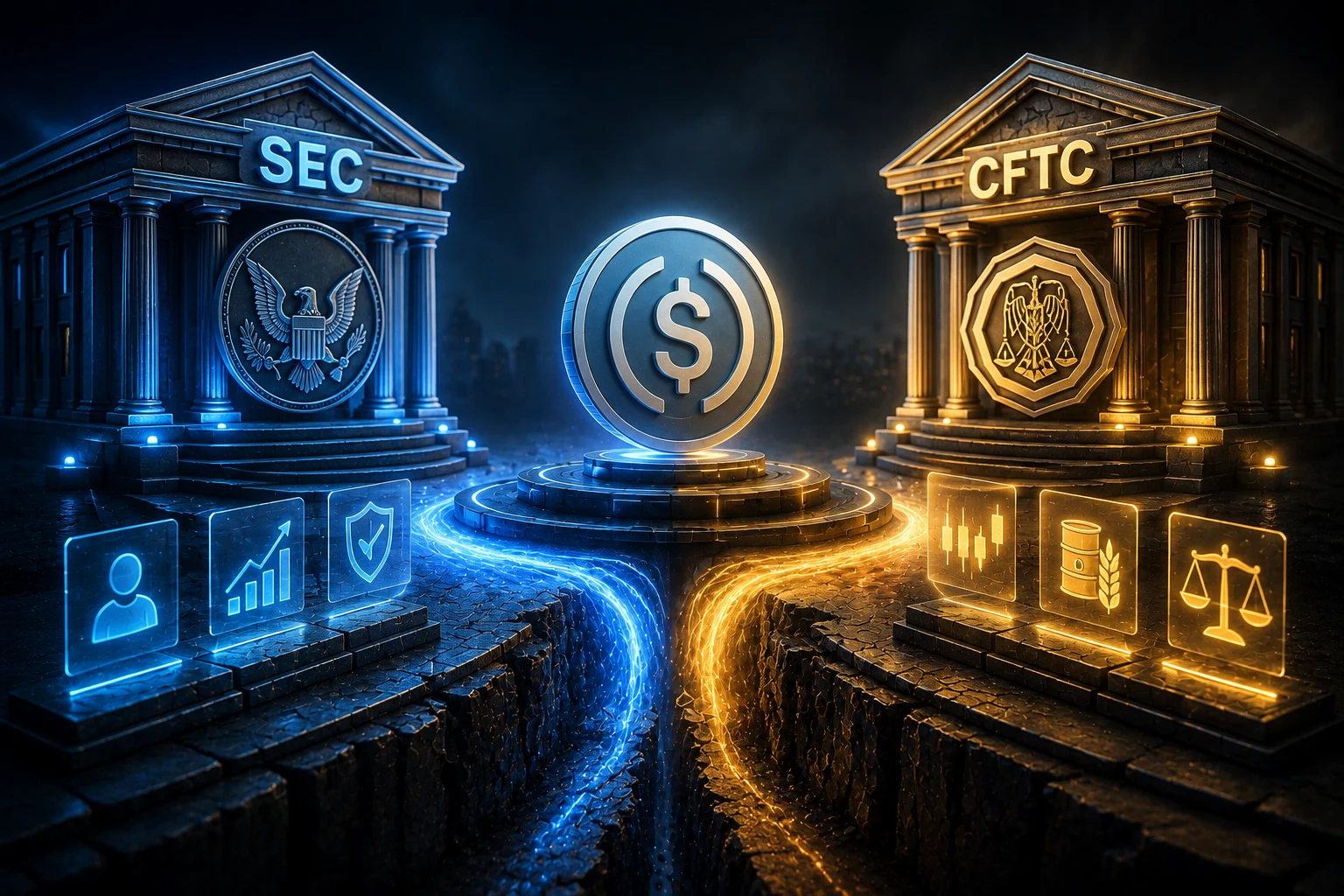
Two federal agencies compete for authority over digital assets in the United States. Neither was built for crypto, which is why the boundaries are blurry.
The Securities and Exchange Commission (SEC) enforces the securities laws passed in the 1930s. Its job is to protect investors from fraud and ensure fair markets. To do that, it can pursue anyone who sells an unregistered security or runs an unregistered exchange. A security, under the Howey test, is an investment of money in a common enterprise with a reasonable expectation of profits from the efforts of others. That definition is broad and fact-specific, which is why the SEC has spent years arguing case-by-case that various tokens qualify.
The Commodity Futures Trading Commission (CFTC) has narrower statutory authority. It regulates derivatives markets (futures, swaps, options) and the commodities underlying those derivatives. The 2010 Dodd-Frank Act gave it a bit more power over spot markets when fraud targets retail customers. Stablecoins like USDC and USDT are pegged to the US dollar, technically a commodity under longstanding case law, so the CFTC has argued it can police their spot trading when manipulation or fraud is involved.
The confusion comes from overlap. A stablecoin issuer might simultaneously touch securities law (if it pays yield), commodities law (because it is dollar-pegged), money transmission (because it moves dollars), and banking regulation (because it holds reserves). No single agency holds the whole picture, and coordination between them has historically been weak.
The turf war: three concrete flashpoints
The regulatory fight is not a polite turf split. It is three distinct arguments, and each agency wants a different one.
Flashpoint 1: classification. Does a stablecoin count as a security, a commodity, or something else entirely? The SEC has argued that algorithmic stablecoins, yield-bearing variants, and tokens sold under an investment contract can be securities. The CFTC has argued that reserve-backed stablecoins are commodities, like the dollars they mirror. This is the most disputed flashpoint because the answer determines which agency gets to police issuance and sale.
Flashpoint 2: issuer supervision. Even if a stablecoin is not a security, someone has to watch the company that issues it. The SEC has invoked its authority over investment contracts to police issuers like the parent of BUSD. The CFTC, the Office of the Comptroller of the Currency (OCC), the Federal Reserve, and state banking regulators all have pieces of this puzzle. The Treasury and FinCEN worry about Bank Secrecy Act compliance, including anti-money-laundering (AML) and know-your-customer (KYC) rules.
Flashpoint 3: trading venue. Where a stablecoin trades matters. On a derivatives exchange, the CFTC has clear authority. On a spot exchange, the answer depends on whether the underlying token is treated as a security or a commodity. Several large exchanges have run afoul of both agencies for different reasons, and the jurisdictional overlap is part of why compliance costs are high.
How the 2025 XRP ruling shifted the lines
The single most important event in the SEC vs CFTC story happened in 2025, and it involved a token that is not a stablecoin.
In a long-running case, a federal court ruled that XRP, sold directly to retail buyers on exchanges, did not meet the Howey test for an investment contract. The SEC had argued that every XRP sale by Ripple Labs was an unregistered securities offering. The court disagreed in part, distinguishing between institutional sales (which it said were securities contracts) and programmatic retail sales (which it said were not). The narrow ruling did not declare XRP a commodity, but it sharply limited how aggressively the SEC could use securities law against widely-traded tokens.
The decision bled into the stablecoin debate even though tokens like USDC and USDT were not parties to the case. The court's reasoning suggested that secondary-market trading of a token, by itself, does not make it a security. That is a powerful argument for treating stablecoins as commodities under CFTC authority rather than securities under SEC authority. It also emboldened industry arguments that the SEC has overreached.
The case is on appeal. The SEC's enforcement posture has softened under 2025 leadership changes, but the underlying precedent remains a tool that issuers and trading platforms use to argue against SEC jurisdiction.
FIT21: the framework that almost drew a line
The Financial Innovation and Technology for the 21st Century Act, known as FIT21, was the most ambitious attempt to sort the mess. The House passed the draft bill in 2024, and the Senate considered versions through 2025 before the bill stalled.
FIT21 proposed a clear split. Tokens deemed to be part of a decentralized network would fall outside SEC jurisdiction unless they met specific decentralization criteria. Tokens tied to real-world assets, including stablecoins, would face a different regime: their issuers would need to register with a new digital-asset regulatory body, comply with capital and disclosure rules, and accept periodic examinations.
For stablecoins specifically, the bill carved out a "payment stablecoin" category. A payment stablecoin, under FIT21, was defined by three traits: it was pegged to a fixed value (typically one US dollar), it could be redeemed by the issuer at par on demand, and it did not pay interest to holders in a way that made it look like a security. Tokens in this category would be regulated primarily under banking and anti-money-laundering frameworks, not as securities.
FIT21 never reached the president's desk. The Senate considered amendments related to yield-bearing stablecoins, decentralized finance (DeFi), and consumer protection, but ran out of legislative time. Parts of the bill have been folded into other discussions, including the GENIUS Act covered below.
The GENIUS Act and the preemption gambit
Stablecoin-specific legislation has moved further than FIT21 in one respect. The Guiding and Establishing National Innovation for US Stablecoins Act, the GENIUS Act, was the first federal framework aimed directly at stablecoin issuers.
The bill's most consequential move was preemption. It would have blocked states from imposing their own money-transmitter regimes on issuers that met federal standards, ending the patchwork of state-by-state licensing. It also explicitly limited the SEC's residual authority over payment stablecoins: a token meeting the bill's criteria could not be regulated as a securities contract, and its trading could not be treated as an unregistered securities exchange.
The language was carefully drawn. The bill did not give the CFTC primary jurisdiction either. Instead, it created a stablecoin-specific license issued by the OCC for issuers above a threshold of issuance, with the Federal Reserve retaining authority over issuers that partnered with banks. The CFTC's role was restricted to derivatives markets where stablecoins are used as collateral or margin.
The GENIUS Act passed the House but stalled in the Senate during 2025. Advocates argued that federal preemption was essential for institutional adoption. Critics argued that the SEC carve-out was too broad and that the bill did not adequately address algorithmic stablecoins. As of mid-2026, the bill has not been reintroduced in its 2025 form, but the preemption concept lives on in ongoing stablecoin discussions.
Risks and real failure modes
The jurisdictional fight matters because the wrong regulator, or no regulator, raises the chance of failure. Stablecoins have a history of collapse that flows directly from regulatory gaps.
TerraUSD (UST) was an algorithmic stablecoin with no reserves and no regulator watching its issuer. When confidence broke in May 2022, the peg failed, the native token LUNA collapsed from roughly $80 toward zero, and retail buyers lost tens of billions of dollars. No SEC charge, no CFTC charge, no banking regulator action ever arrived before the collapse.
Reserve-backed stablecoins are not immune. Tether (USDT) has faced repeated questions about the quality and audit status of its reserves, settled CFTC and New York Attorney General actions for misrepresentation, and continues to operate without a full US audit at the time of writing. Circle (USDC), which issues USDC, has been more transparent but still holds reserves in US Treasuries, money-market funds, and cash at banks. In a banking crisis, redemption pressure could strain any issuer.
Counterparty risk is also real. Stablecoins move across exchanges, lending protocols, and cross-chain bridges, and each handoff is a place where reserves can be misused or stolen. The largest DeFi exploits in 2023 and 2024 involved stablecoins that were either swapped for imperfect collateral or sent across bridges with weak security.
Finally, regulatory risk cuts both ways. A regulator that asserts jurisdiction may demand disclosures an issuer cannot or will not provide, forcing a wind-down. We have seen this pattern play out with stablecoins and stablecoin-adjacent tokens tied to entities under SEC or state-level enforcement.
Where yield-bearing stablecoins fit (or don't)
The largest open question in 2026 is what to do with stablecoins that pay holders a return.
Yield-bearing tokens divide into two camps. Some are rebasing tokens: the issuer credits interest automatically and the token count grows in your wallet. Others are wrapper tokens, where a yield source (lending, liquidity provision, treasury bills) generates interest that accrues to the holder through a synthetic representation. Examples include stUSDT, sDAI, and several USDC-based wrappers.
The SEC has signaled through enforcement actions and informal guidance that yielding tokens look more like securities contracts than non-yielding ones. The CFTC has generally not asserted jurisdiction over the issuance of these tokens, focusing instead on derivatives markets where they trade. FIT21 would have required most yield-bearing stablecoins to register under its token regime rather than qualify for the payment stablecoin carve-out. The GENIUS Act applied only to non-yielding payment stablecoins.
Until a federal framework passes, yield-bearing stablecoins operate in a gray zone. A US-issued yield-bearing token would likely face SEC scrutiny on issuance, CFTC scrutiny on derivatives, and OCC scrutiny if it partners with a bank. The risk for users is that a regulator decides the structure is unregistered securities activity and forces a wind-down, leaving holders with a token redeemable only at the issuer's discretion.
Where the lines stand now
Three things are true in mid-2026. The SEC has reduced its enforcement activity under new leadership. The CFTC has stated openly that it considers most major stablecoins to be commodities under its anti-fraud authority. And no comprehensive federal law has passed to replace the patchwork.
For practical purposes, US issuers of non-yielding, fully reserved, redeemable stablecoins operate under a mix of state money-transmission rules, OCC guidance when banking partners are involved, and CFTC anti-fraud authority over trading. Yield-bearing variants face higher SEC risk and have generally chosen to issue outside the United States. Trading platforms face the costliest compliance burden, because they must navigate both regimes simultaneously.
The jurisdictional map will keep shifting until Congress passes a framework that draws clear lines. Until that happens, the turf war is unresolved, and users pay for the ambiguity through higher spreads, fewer products, and ongoing issuer risk.
Follow the stablecoin story with sharper signal
Stablecoin regulation moves in fits and starts, and headline coverage rarely tells you whether a story matters for the issuers, exchanges, and protocols you actually care about. Zippfeed aggregates stablecoin, USDC, USDT, and XRP headlines, scores each one for sentiment (bullish, neutral, or bearish), and rates importance so you can tell a routine regulatory comment from a bill that would preempt state oversight. Use that filter to spend less time sifting and more time acting.



 CryptoSlate
 WuBlockchain
 CoinDesk
 Crypto News