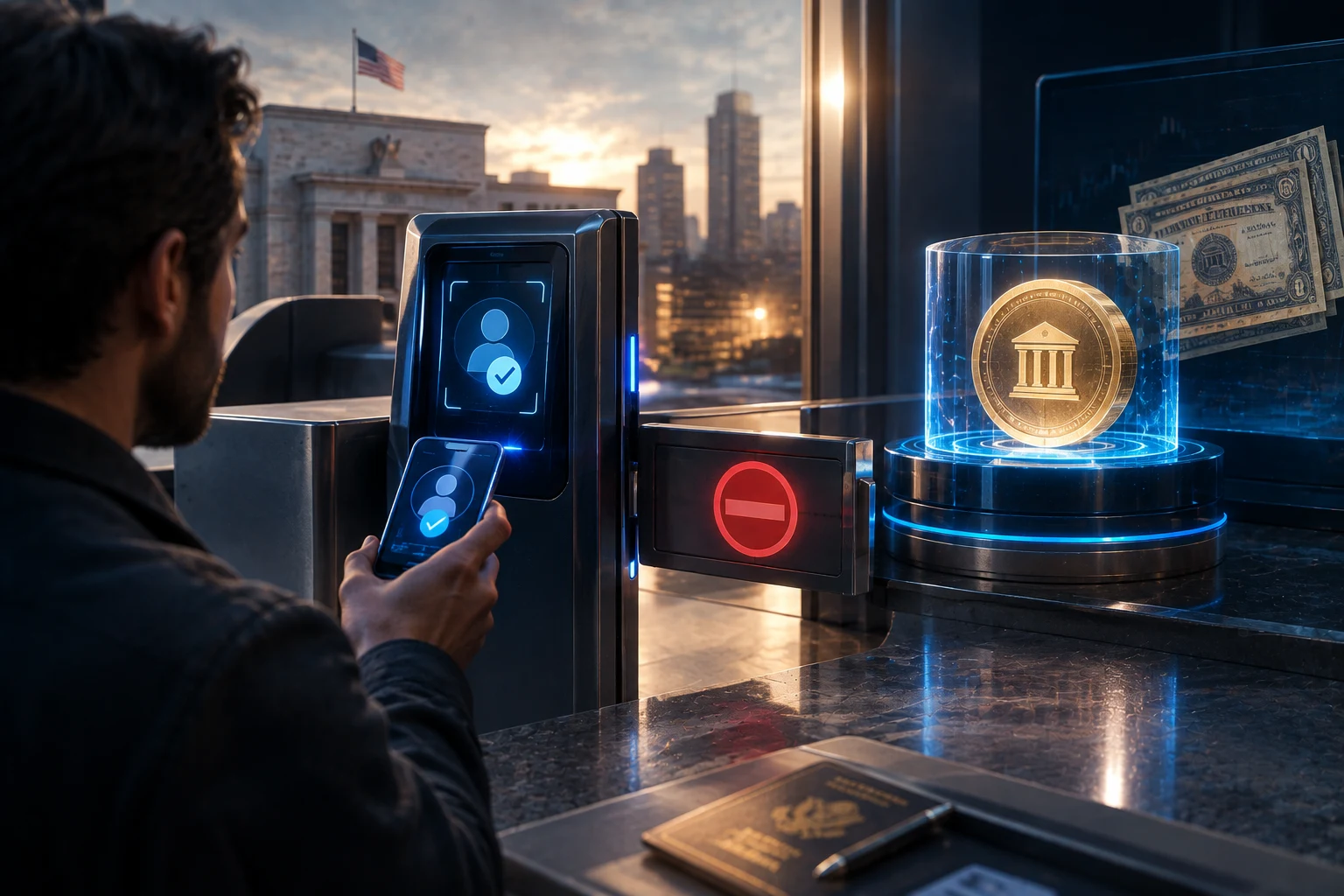
Why this question matters more for RWAs than for Bitcoin or ETH
For Bitcoin and Ether, the rule of thumb "not your keys, not your coins" is reasonably accurate. Whoever controls the private keys controls the on-chain asset, and there is no off-chain legal layer to complicate things. The chain is the asset.
Tokenized real-world assets are different. A token such as BUIDL, OUSG, or USDY represents a claim against a legal entity, usually a Cayman or Delaware special-purpose vehicle, that holds the underlying instrument. The token is a registry entry pointing to a real-world contract. Move the token, and you usually transfer the rights described in that contract, but only if the issuer's transfer agent updates their books to match. If the issuer collapses, freezes redemptions, or simply ignores the on-chain signal, your wallet's keys are technically intact and your token is technically spendable, yet the legal claim it represents may be unreachable.
This is why a beginner who reads "tokenized treasuries, self-custody, earn yield" can walk away with a model of rights that is dangerously wrong. They might assume that holding BUIDL in a hardware wallet is equivalent to holding a T-bill at a custodian. It is not. The wallet is a tool for moving a registry pointer. The rights behind that pointer are governed by a paper document that very few retail token holders ever read.
The real risks of self-custody for RWAs, before the upsides
Risk first, because the marketing around tokenized RWAs tends to skip this part.
Risk 1: Losing your keys still means losing the token. Most tokenized treasury products do not have a "forgot password" flow. If you lose your seed phrase, you cannot rotate to a new address and recover the right to redeem, because the issuer's allowlist links your address to your KYC record. Some issuers offer recovery windows where you can re-KYC into a new address, but that process takes days and assumes the issuer is still operating and willing to help.
Risk 2: Transfer restrictions mean your "property" cannot move freely. A standard ERC-20 token can be sent to any address. A regulated RWA token usually cannot. The smart contract checks a permission list on every transfer, and only addresses that the issuer's compliance team has approved can receive the token. If you sell to an unverified buyer on a DEX, the transfer reverts. If you try to move the token to a brand-new wallet, the transfer reverts. Your keys control the asset, but the asset's own code refuses to cooperate with unauthorized wallets.
Risk 3: Issuer failure exposes you as an unsecured creditor. When the SPV behind the token runs into trouble, token holders are typically treated as a specific class of creditor under the offering documents. Self-custody does not put you ahead of that waterfall. The chain does not lend you priority; the indenture does. A famous example is the 2022 Maple Finance default, where lenders, including on-chain participants, learned that being a wallet holder was not the same as being a secured creditor.
Risk 4: Smart-contract bugs and oracle failures. The token's behavior depends on code written by the issuer, plus price feeds and redemption routers maintained by third parties. Bugs have historically frozen user balances, minted duplicate tokens, or allowed unauthorized redemptions. Self-custody does not protect you from software failure on the asset's side.
What "holding the token" legally means under SPV documentation
Every regulated tokenized RWA is backed by a stack of legal documents: a private placement memorandum, a subscription agreement, an operating agreement for the SPV, and a transfer agent agreement. Together they define who is allowed to own a unit, how transfers work, what happens at redemption, and where the issuer can pause or restrict activity.
When you buy BUIDL, OUSG, USDY, or similar products, you sign (or click through) those documents. The token is then issued to your address as a representation of your position in the SPV. The chain is the ledger the issuer chose to use, but the issuer maintains its own off-chain cap table, and that cap table is the source of truth when the two disagree.
This is why token transfers often go through a "controller" or "transfer agent" role in the smart contract. The contract checks both the allowlist and the off-chain registration, and only then allows movement. A purely peer-to-peer transfer, which is the dream for self-custody maximalists, is generally not supported for compliant tokenized securities.
The practical consequence is that the question "do I own this?" has two answers. On-chain, you hold the token and can submit a redemption request through the contract. Off-chain, you own a contractual interest in the SPV, and your rights are bounded by the documents you signed. The two views can drift apart.
KYC allowlists live at the token, not the wallet
A common beginner assumption is that if a stranger obtains your seed phrase, they can drain your wallet and inherit your rights. For a regulated RWA token, this is largely false.
The allowlist is enforced at the token-contract level. When a transfer is initiated, the smart contract checks the recipient address against a permission map maintained by the issuer or its delegate. If the recipient is not allowlisted, the transaction reverts before it is mined. The stranger's wallet can hold your BTC and your mainstream ERC-20s with no problem, but your BUIDL or OUSG will simply refuse to move.
This has a counterintuitive implication for security. Because the allowlist blocks bad recipients, a compromised seed phrase is a smaller disaster for restricted tokens than it is for fully permissionless assets. Of course, the phrase also unlocks your other assets, so the overall risk is still severe. But the RWA portion is partially protected by code that the holder cannot bypass and cannot disable.
It also means that recovering from a lost seed phrase requires interacting with the issuer's compliance team, not just your wallet software. You re-KYC, prove control of the original wallet, and the issuer updates the allowlist to point at a new address. Some products make this easy. Many do not, and the process can take days during which your redemption rights are technically frozen.
Smart accounts (ERC-4337) and session keys for compliance-aware transfers
Smart accounts, also called account abstraction wallets, are a newer wallet architecture built around ERC-4337. Instead of a single private key controlling one externally owned address, a smart account is a contract wallet whose logic you can program: daily spending limits, time-locked transfers, social recovery, and most relevant for RWAs, session keys.
A session key is a temporary key with scoped permissions. You might authorize a session key that can move your stablecoins up to a daily cap for a DeFi app, while your main holdings in BUIDL stay behind a different key that requires a hardware wallet signature plus a time delay. This is a security upgrade over the single-key model, and it composes well with RWA workflows where you want everyday operations to be fast but high-value transfers to require extra friction.
Compliance-aware transfers are another natural fit. The smart account can enforce additional rules on top of the token contract's allowlist: it can refuse to sign a transfer unless the recipient is on an internal whitelist you maintain, or it can require a multisignature for any movement above a threshold. These rules do not change the legal framework, but they reduce the chance of an operational mistake.
What smart accounts do not change is the legal layer. They cannot grant you rights you did not sign for in the SPV documents, and they cannot force the issuer to honor a transfer the issuer did not approve. They are a wallet upgrade, not a legal upgrade.
MPC custodians, qualified custodians, and broker-dealers: the rights ladder
The cleanest way to think about RWA custody options is as a ladder of legal protections, with each rung trading some control for some recourse.
- Self-custody wallet. You hold the keys. The issuer's allowlist still governs transfers. You have no fiduciary duty from anyone. If the issuer fails, you are a contract creditor per the offering docs, and the chain does not help you.
- MPC wallet run by a regulated custodian. A regulated custodian uses multiparty computation, where key shares are split across multiple parties and combined to sign transactions, so no single employee or server can move assets. You still own the asset, but the custodian is usually a fiduciary for operational custody. You gain a regulated counterparty but not a fiduciary for legal ownership of the underlying security.
- Qualified custodian. This is a specific U.S. regulatory category (SEC-defined, typically a bank or trust company) that holds assets for clients under strict rules, including segregation of client assets from firm assets. Tokenized RWAs held by a qualified custodian are treated similarly to traditional securities in many respects. Costs are higher, but the protection is real and tested in bankruptcy scenarios.
- Broker-dealer. The full-service option. A broker-dealer holds the position in your name, handles KYC, processes corporate actions, and provides regulatory protections such as SIPC coverage on certain cash balances. You give up direct on-chain access in exchange for the most complete legal wrapper.
The ladder is not "lowest to highest." It is "most direct on-chain access to most legal protection." Picking a rung depends on what you value: composability with DeFi protocols, simplicity, regulatory cover for tax or audit purposes, or the ability to redeem directly into your own bank account without depending on a transfer agent.
Practical implications for someone deciding today
If you are choosing how to hold a tokenized RWA, the wallet choice is downstream of the legal choice. Three concrete questions help clarify which path actually fits.
First, will you need to interact with DeFi protocols using the token? If yes, you probably need a self-custody or smart-account setup, because most custodians do not allow you to move tokenized RWAs into Uniswap-style pools or lending markets. Be honest about whether the yield you would earn in DeFi justifies giving up the protections of a qualified custodian.
Second, how large is the position relative to your net worth? A few hundred dollars of OUSG in a smart account is a reasonable experiment. A meaningful fraction of your savings in a single issuer deserves a qualified custodian and probably a conversation with a tax advisor.
Third, do you actually have the operational discipline for self-custody? Seed phrase storage, hardware wallet hygiene, address allowlist management, and the patience to wait for a recovery process during an issuer incident are all on you. If any of those sound like overhead you will skip, an MPC wallet from a regulated provider is a sensible middle ground.
Read the offering documents before you read the wallet comparison. The legal wrapper is the asset. The chain is just where the registry lives.
Track tokenized RWA headlines with clear-eyed sentiment
Tokenized RWAs move fast and the news around them moves faster: new issuers, regulatory updates, redemption pauses, allowlist changes, and occasional failures. Tracking those signals manually is a losing game, especially when each headline sits next to a price chart that does not tell you about the legal mechanics underneath. Zippfeed surfaces RWA headlines with sentiment scoring (bullish, neutral, or bearish) and an importance rating, so you can separate genuine issuer risk from short-term market noise and react to the news that actually affects your rights.




 CoinDesk
 TheBlock