What "RWA issuer bankruptcy" actually means
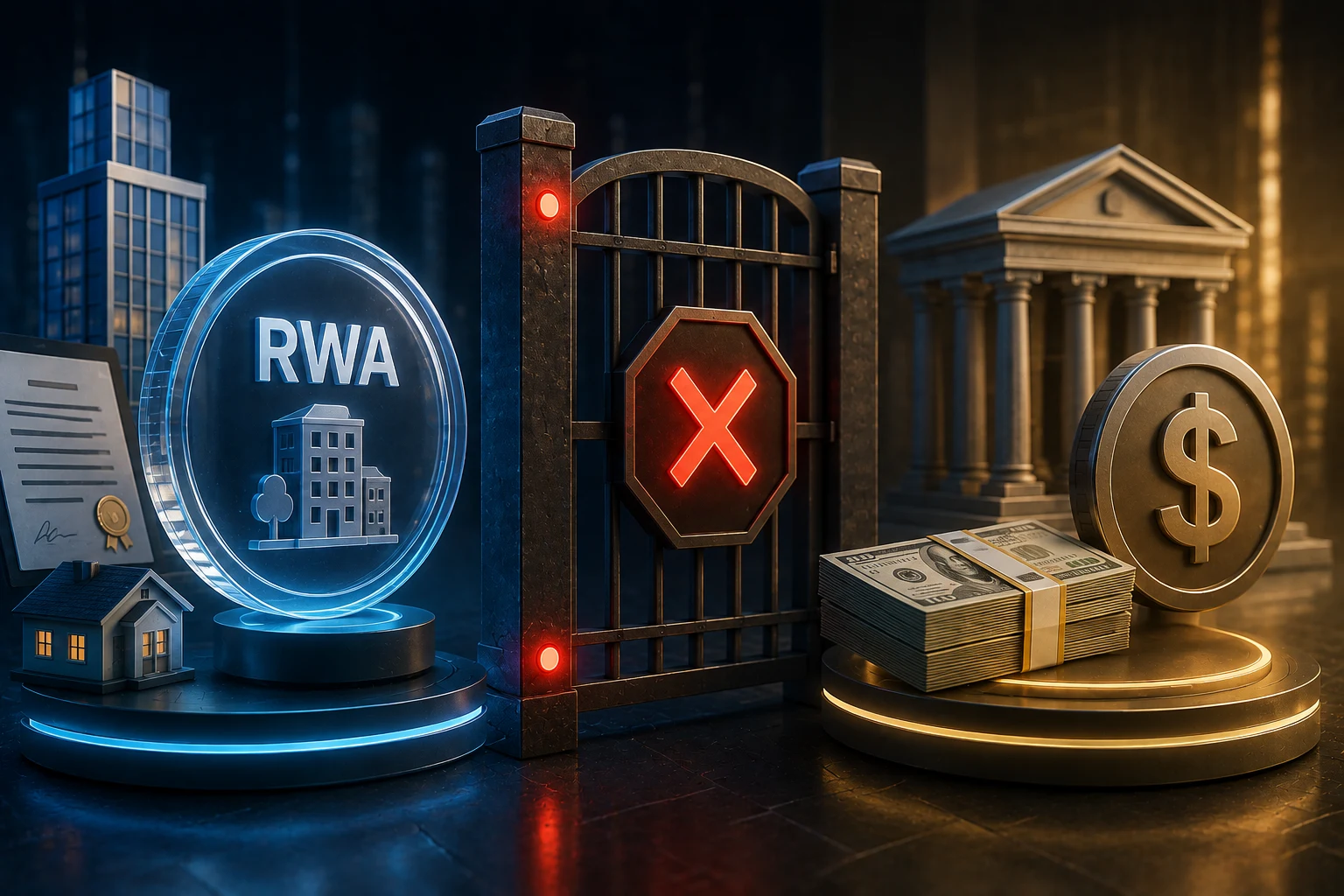
An RWA issuer is the legal entity that originates, sells, or manages a tokenized claim. In practice the entity is usually a Cayman or Delaware company, sometimes wrapped inside an SPV, and the token you hold is a receipt issued by that company. The token does one job: it points back to a legal agreement that says the issuer owes you something, usually a share of a Treasury fund, a money-market portfolio, a private-credit pool, or a single loan.
"Bankruptcy" in this context can mean three different things, and they matter in very different ways. A Chapter 11 reorganization means the issuer wants to keep operating while it negotiates with creditors. A Chapter 7 liquidation means the company is being wound down and assets are sold off. A receivership or equivalent foreign proceeding, in the Cayman Islands, BVI, or Singapore, is a parallel process with its own waterfall. In every case, the moment a filing is made, an automatic stay generally pauses enforcement of claims, including your redemption right.
The token itself does not stop working. The smart contract on Ethereum or another chain keeps minting, burning, and transferring as designed. But the legal right to redeem the underlying asset now runs through a bankruptcy court, not through the issuer's redemption desk. That is the gap most holders discover too late.
What can go wrong: the real risk surface
The single biggest risk is misclassifying your position. If the issuer collapses, your token does not automatically turn into dollars. It turns into a claim, and claims sit in a queue behind secured creditors, employees, tax authorities, and counterparties. The bankruptcy waterfall is the legal pecking order that decides who gets paid first and how much.
Concrete failure modes have already played out in adjacent markets. Celsius paused withdrawals in June 2022 and filed Chapter 11 a month later; customer balances were treated as unsecured claims, and the bankruptcy estate was so undercapitalized that early payout projections were a fraction of on-book balances. FTX's collapse in November 2022 had a similar structure: customer deposits became general unsecured claims, and recoveries depend on how much the estate can claw back and monetize. BlockFi emerged from Chapter 11 in late 2023 after converting user balances into equity and creditor claims. None of these were true RWA issuers, but the legal mechanics for an unsecured token holder are nearly identical.
For RWA-specific failures, the most common traps are commingling, rehypothecation, and weak SPV separation. Commingling means client assets sit in the same bank or custody account as the operating company's own treasury. Rehypothecation means the issuer lends out your collateral to fund its own balance sheet. Weak SPV separation means the SPV was a paper shell rather than a genuinely ringfenced entity, so when the parent blows up, the SPV's assets get pulled into the estate. Each of these turns a "bankruptcy-remote" structure into a regular bankruptcy.
How an RWA issuer is normally structured
The cleanest tokenized Treasury or credit product has three layers. At the top is the operating company, which handles marketing, technology, and investor relations. In the middle is a special-purpose vehicle (SPV), a separate legal entity whose only job is to hold the underlying assets and issue the tokens. At the bottom are the actual assets, held with a qualified custodian at a regulated bank.
The whole point of the SPV is "bankruptcy remoteness." If the operating company is sued or enters insolvency, the SPV's assets are supposed to be off-limits to the operating company's creditors, because the SPV is a separate legal person with its own assets and liabilities. The token holder is a creditor of the SPV, not of the operating company.
Real examples you may have heard of illustrate the spectrum. BUIDL from BlackRock uses a Cayman structure designed to keep the underlying Treasuries outside the operating company's balance sheet. OUSG and USDY from Ondo use similar separation, although the legal opinion letters vary in strength. JAAA from Janus Henderson and USTB from several issuers sit at different points on the same spectrum. In every case, the key question is not whether an SPV exists on paper, but whether the assets, custody accounts, and contractual rights were actually segregated before any trouble started.
The order of claims in an insolvency
Inside a bankruptcy proceeding, claims are paid in a strict sequence. Secured creditors with specific collateral, often the custodian or a prime broker with a rehypothecation lien, are paid first from the assets they have a claim against. Administrative expenses of the bankruptcy itself, including lawyers and the trustee, come next. Then come priority unsecured creditors, including certain wage claims and tax authorities. Finally, general unsecured creditors, the bucket most token holders fall into, share whatever is left pro rata.
Equity holders, the shareholders of the issuer, are paid last and usually receive nothing. As a token holder you are generally not an equity holder. You are a creditor. That is technically better than being last in line, but in practice it means you collect cents on the dollar when the estate is insolvent.
Token-specific claims can be subordinated even further. Some token prospectuses include a contractual subordination clause that places token holders behind senior lenders to the SPV. Some include a "most-favored creditor" clause that pushes token holders ahead of other unsecured creditors; others do not. Reading the subscription agreement, not the marketing page, is the only way to know where you sit.
\p>What the chain does and does not do
- The smart contract continues to mint, burn, and transfer tokens exactly as programmed, because it has no awareness of any court.
- On-chain markets may continue trading the token at a discount, but a price on Uniswap or a DEX is not a redemption price and offers no legal claim.
- A redemption freeze is enforced off-chain by the issuer and the transfer agent, and on-chain transfers can still move tokens between wallets while no one can actually cash out.
The first 30-90 days of a bankruptcy run
Once a bankruptcy or equivalent filing lands, the practical sequence for a token holder looks like this.
Day 0, the filing date: the issuer publishes a notice, often on its website, and the transfer agent or administrator typically disables the redemption function in the issuer's portal. On-chain transfers may still work, but every transfer is now between two holders of a frozen claim.
Days 1-14: a creditors' committee is appointed, a debtor-in-possession (DIP) financing package may be announced to fund operations through the case, and a bar date is set. The bar date is the deadline by which you must file a formal proof of claim form with the bankruptcy court to be recognized as a creditor. Miss it and your claim is discharged even if it was valid.
Days 14-60: the issuer publishes a schedule of assets and liabilities, and a claims agent (often a firm like Kroll or Stretto) opens a portal for creditors to register. Token holders must convert their on-chain balance into an off-chain claim by submitting documentation. The conversion process varies, but typically requires proof of wallet ownership, KYC documents, and reference to the original subscription agreement.
Days 60-90 and beyond: the court either confirms a plan of reorganization or moves toward liquidation. Recovery percentages for unsecured creditors in failed crypto-adjacent estates have ranged from roughly single-digit percentages to around 50-70 cents on the dollar, depending on how much value the estate was able to preserve and claw back.
What you can do right now: a defensive playbook
Five concrete habits materially change your outcome if an issuer ever files.
1. Keep your subscription documents off-platform. Download the private placement memorandum (PPM), the subscription agreement, the legal opinion letter, and any side letters. Store them somewhere independent of the issuer's servers. If the issuer's website goes dark, you still need proof of what you bought and on what terms.
2. Map the legal entity, not the token. For every RWA position, write down the issuer's legal name, jurisdiction, SPV name, custodian, transfer agent, and the law that governs the token. The chain address is the least important field. The legal name of the SPV is the one that matters when a court is involved.
3. Monitor issuer filings weekly. Subscribe to the issuer's investor communications, follow the transfer agent, and set Google Alerts for the issuer name plus the words "bankruptcy," "insolvency," "Chapter 11," and "winding up." Set calendar reminders for any quarterly or annual reports that are due. A missed filing is often the earliest public signal of trouble.
4. Size positions so a 90-day freeze is survivable. If a complete redemption freeze would force you to sell other assets or trigger margin calls, your RWA position is too large. Treat the worst case, a 30-90 day freeze plus partial recovery, as the base case for sizing.
5. Practice the off-chain claim process now. Confirm that you can reach the transfer agent and the claims agent if the marketing site disappears. Confirm that your wallet can produce a signed message that proves ownership of the address holding the token. Confirm that your KYC information with the issuer is current. The day a filing happens is the wrong day to discover your paperwork is outdated.
Frequently asked questions, and the honest answers
Even careful holders run into the same set of questions when an issuer wobbles.
Does the chain keep running if the issuer goes bankrupt? Yes. The smart contract is autonomous and will continue to mint, burn, and transfer tokens, because it has no awareness of any court. But the legal right to redeem now runs through a bankruptcy estate, and the on-chain token becomes a tradable claim rather than a cash-equivalent receipt.
Are token holders secured creditors? Usually not. Most tokenized Treasury and credit structures place holders as either senior or subordinated unsecured creditors of the SPV. Secured status requires specific collateral granted to you, which is rare. Read your subscription agreement.
Can I just sell my tokens on a DEX during the freeze? You can transfer them, but a DEX price reflects the market's guess at recovery, not a redemption right. Selling at 60 cents on the dollar in a panic often means crystallizing a loss you could have avoided by filing a creditor claim and waiting out the estate.
Will I get my money back? History says: usually a fraction, sometimes a small one, and only after months of paperwork. Celsius customer recoveries are still being distributed years later. BlockFi unsecured creditors received a mix of cash and equity under the plan. Outcomes depend on estate value, claim priority, and the speed of the proceeding.
How to stay ahead of an RWA issuer run
RWA issuer runs are rare, but when they happen, they move fast and the news cycle is fragmented across court filings, transfer-agent notices, and on-chain chatter. Tracking it manually is a losing game. Zippfeed surfaces RWA headlines with sentiment scoring, bullish, neutral, or bearish, and an importance rating, so you can spot the early warning signs and react before a freeze locks you out.





 CoinDesk
 TheBlock