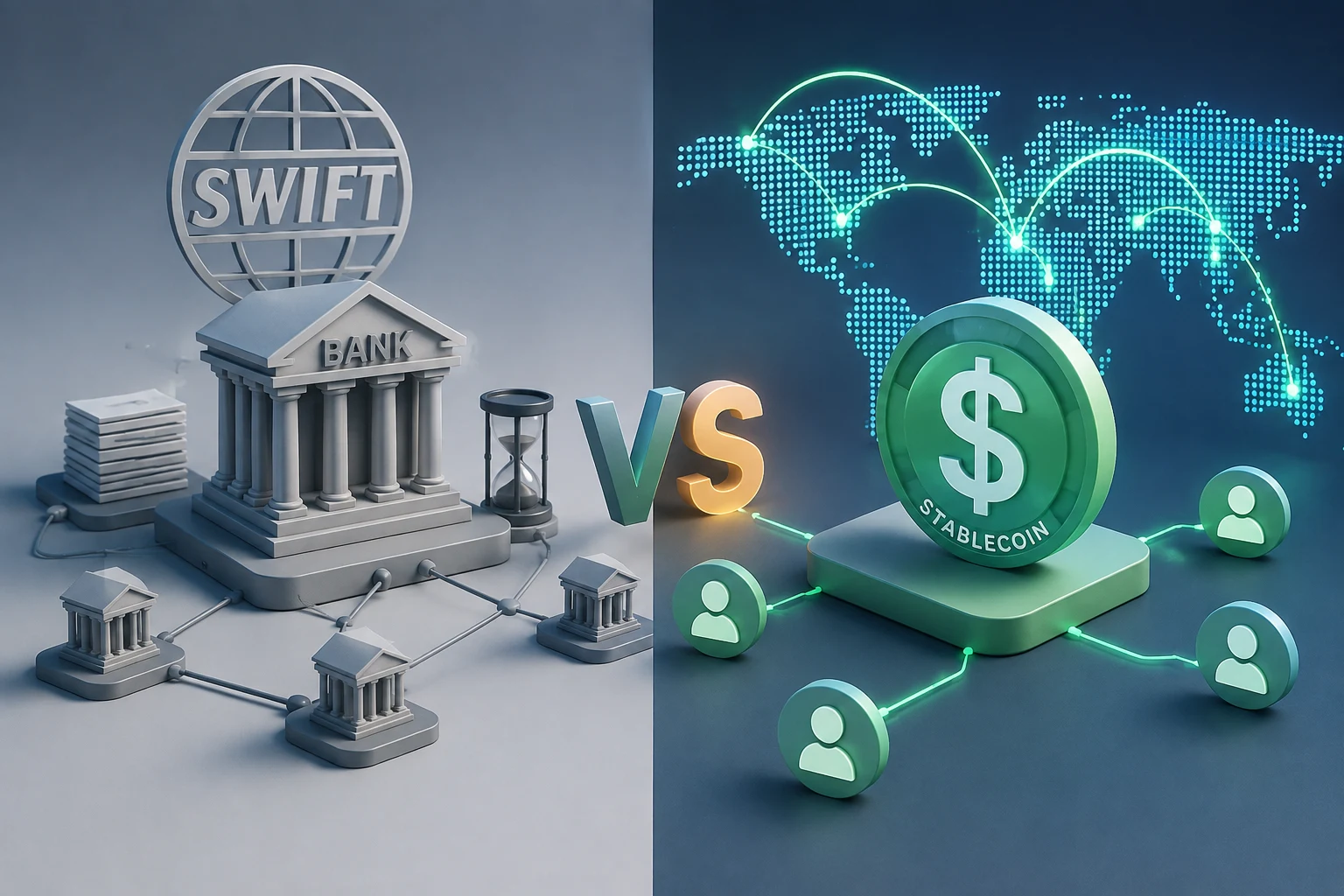
What people actually mean when they compare stablecoins to SWIFT
Most headlines frame stablecoin cross-border payments versus SWIFT as a speed contest, and that framing is misleading. SWIFT is not a money mover. SWIFT is a messaging network that lets a bank in one country send a standardised instruction to a bank in another country, which then has to find the dollars, route them through one or more intermediary banks, and finally credit the beneficiary's account. The message takes seconds; the money takes one to three business days, sometimes longer, and each intermediary skims a fee along the way.
Stablecoins, by contrast, are bearer instruments on a public blockchain. Sending USDC from one wallet to another is genuinely near-instant, costs fractions of a cent on a rollup like Base or on Solana, and never needs a bank in the middle. That is the part that gets the press. What the press usually skips is the rest of the journey: the sender's bank or card processor, the exchange or licensed issuer that mints or releases the stablecoin, the destination exchange that converts it to local currency, and the local bank or e-wallet that pays out pesos or pesos.
So a fair comparison has to look at the whole corridor, not just the on-chain leg. That is also where the trade-offs live, and where this article spends most of its time.
Where the cost really hides: correspondent banking and FX slippage
The standard fee line you will see for a SWIFT wire from the United States to the Philippines is 25 to 45 dollars per transaction, plus a 2 to 4 percent currency conversion spread baked into the rate. Add an intermediary correspondent bank fee of 10 to 25 dollars, and the all-in cost of a 1,000 dollar remittance lands somewhere between 50 and 90 dollars, or 5 to 9 percent. The World Bank's Remittance Prices Worldwide database consistently puts the global average closer to 6.3 percent, which means the typical Filipino family sending 300 dollars home is losing about 19 dollars before the recipient sees a cent.
FX slippage is the silent tax. Banks advertise a rate, then widen it by 1 to 3 percent compared to the mid-market rate on Reuters or Bloomberg. On a 1,000 dollar transfer that is another 10 to 30 dollars nobody itemises. Stablecoin rails can bypass this spread entirely if the recipient's wallet is denominated in dollars, but in practice most corridors still require conversion to local currency at payout, so the FX problem mutates rather than disappears.
The fee stack on the stablecoin side looks different. You pay a small network fee (fractions of a cent on Solana or Base, one to five dollars on Ethereum mainnet during congestion), and you may pay a spread on the conversion at a licensed exchange. The on-ramp through a US bank via ACH or wire can still cost 5 to 15 dollars depending on the partner, and some exchanges charge a percentage for high-risk corridors. Real-world pilots run by Visa, MoneyGram, and several Philippine and Mexican fintechs report all-in costs of 1 to 3 percent when both ends are optimised, which is genuinely better than SWIFT but not the zero-fee fantasy the marketing implies.
Why the gap is wider for small transfers
Correspondent banking fees are mostly flat, so a 200 dollar transfer takes a much bigger percentage hit than a 50,000 dollar corporate payment. That is why the real beneficiary of stablecoin rails is the remittance customer sending under 1,000 dollars, not the enterprise treasury team moving payroll. A few cents of gas plus a tight FX partner beats a 40 dollar wire every time at that scale.
How the rails actually work on-chain
When someone says they sent a stablecoin cross-border payment, they usually mean one of three things happened. First, the sender bought USDC, USDT, PYUSD, or RLUSD on a centralised exchange using a local deposit method, and the exchange debited the recipient's account at a partner exchange in the destination country. The blockchain did not actually move; the exchange just shuffled internal ledger entries. Second, the sender withdrew stablecoins to a self-custody wallet and the recipient received them on-chain, then converted to local currency at a local exchange or e-wallet like GCash, Maya, or a Mexican neobank. Third, a fintech used a payment processor that batches and routes transfers across chains, settling in stablecoin and paying out in fiat at the destination.
The chain choice matters more than the marketing suggests. USDC exists as an ERC-20 on Ethereum, as an SPL token on Solana, and on Base, Arbitrum, Polygon, and a growing list of other networks. Liquidity is deepest on Ethereum, so large transfers usually settle there, but gas fees of 2 to 15 dollars per transfer make it expensive for small remittances. Solana settles USDC in under a second for a fraction of a cent, which is why remittance-focused apps default to it. Base sits in between, with sub-cent fees and easier fiat ramps.
Ripple's XRP ledger and RippleNet are a different beast: they sit closer to the SWIFT side of the spectrum, with a permissioned messaging layer and on-ledger XRP for liquidity. Ripple now offers a SWIFT bridge that lets banks use XRP as a bridge asset for cross-border settlement, which is how the company frames itself in the SWIFT comparison. That positioning is useful for banks that want blockchain settlement without touching public stablecoins, but it does not change the underlying correspondent banking economics.
The Travel Rule problem no one wants to talk about
The FATF Travel Rule requires virtual asset service providers to share sender and beneficiary information for transfers above a threshold (usually 1,000 dollars or euros). On a public chain, every wallet address is visible, but the identity behind it is not. That mismatch is why licensed exchanges now demand full KYC on every wallet that touches their platform, and why some corridors block transfers to or from unhosted wallets entirely.
For a B2B treasury team this means adding a Travel Rule compliance layer, often via a tool like Notabene or TRP, before any payment can leave the bank account. That step costs time and money, and it is where many early pilots quietly stalled. A transfer that takes ten minutes on-chain can take two business days of compliance review before it can be initiated.
What stablecoins genuinely fix, and what they do not
Stablecoins genuinely fix three things. First, they settle 24/7/365, including weekends and holidays, which is impossible on the SWIFT correspondent banking grid that still pauses for national banking holidays in each jurisdiction. Second, they compress the number of intermediaries from three or four banks down to one exchange on each end, which removes most of the flat fee stack. Third, they make the FX step optional: if the recipient is happy holding dollars or dollar-pegged stablecoins, the spread is zero.
They do not fix the licensing problem. To pay out in pesos or Philippine pesos, someone at the destination end needs a money transmitter licence, an EMI authorisation, or a partnership with one. To accept dollars from a US bank, the originating exchange needs MSB registration, state-by-state money transmitter licences, and bank partnerships that are increasingly hard to keep. The collapse of Silvergate, Signature, and several other US crypto-friendly banks in 2023 made those partnerships scarcer, and the survivors now charge more or demand stricter controls.
They also do not fix the recipient experience. Most remittance recipients do not want a stablecoin wallet; they want cash, a mobile wallet top-up, or a bank deposit. If the payout side still routes through a bank, you have added a stablecoin leg to a SWIFT corridor, not replaced SWIFT. The honest framing is that stablecoins are a settlement layer, not a full-stack payment product.
The new entrants: RLUSD, USD1, and PYUSD in B2B corridors
The interesting action in 2024 and 2025 is not consumer remittances; it is B2B and treasury use cases. Ripple's RLUSD is a US-regulated stablecoin designed for institutional settlement, and it has been piloted for treasury operations between the United States and Asia. PayPal's PYUSD has been positioned for merchant payouts and platform settlements, with PayPal's existing rails giving it an unusual on-ramp advantage. World Liberty Financial's USD1 has been marketed for sovereign and family-office flows, although its regulatory status and liquidity remain thin compared to USDC and USDT.
The pitch to corporate treasurers is different from the pitch to remittance customers. A treasury team moving payroll for a global contractor pool cares about finality, auditability, and regulatory clarity, not about a 5 dollar saving on gas. That is why regulated stablecoins with named US issuers, audited reserves, and clear redemption rights are gaining share in B2B corridors even though USDT still dominates total transfer volume by raw dollars moved.
The trade-off is real: regulated stablecoins like RLUSD and PYUSD have fewer liquidity pools, narrower exchange listings, and shorter redemption queues than USDC. For a corporate payment that matters; for a $200 remittance that does not.
Risks that the marketing consistently understates
De-peg risk is the headline. USDT briefly traded at 0.95 dollars during the March 2023 USDC de-peg caused by Silicon Valley Bank's collapse, and USDC traded as low as 0.87 dollars for several days. For a corporate treasury holding working capital in stablecoins, that is a meaningful mark-to-market loss. For a remittance customer whose recipient needs pesos in an hour, it is irrelevant. The risk profile depends entirely on the use case.
Counterparty risk on the off-ramp is the underappreciated one. If the licensed exchange at the destination end goes bankrupt, freezes withdrawals, or loses its banking partner, the recipient may not get paid even though the on-chain transfer succeeded. This happened with several Asian and Latin American exchanges in 2022 and 2023, leaving customers with stablecoin balances they could not easily convert.
Regulatory risk is the third leg. The EU's MiCA regime, the US's evolving stablecoin bill drafts, and the FATF guidance are all tightening. A stablecoin issued under one regime may be delisted from exchanges in another, which compresses liquidity and increases conversion spreads overnight. Treasury teams building on stablecoin rails need a contingency plan for sudden delistings.
Finally, sanctions and Travel Rule enforcement risk: a transfer routed through a non-compliant exchange or to a sanctioned address can result in frozen funds and regulatory exposure for the originating firm. The blockchain is transparent, which means mistakes are permanent.
Practical implications: when stablecoins beat SWIFT, and when they do not
Stablecoin rails beat SWIFT when the transfer is small (under 10,000 dollars), when speed matters (same-day or weekend settlement), when both ends have a licensed stablecoin on-ramp and off-ramp, and when the recipient is comfortable holding dollar-denominated value. They lose to SWIFT when the transfer is large and requires a full audit trail on a regulated channel, when the destination has no licensed stablecoin off-ramp, when the recipient needs local currency, or when the corporate treasury's compliance framework cannot accommodate Travel Rule obligations.
For SMBs paying overseas contractors, the calculus is shifting. A US SMB paying a developer in Manila or a designer in Mexico City can use a service like Bitwage, Request, or a SWIFT alternative built on USDC rails to settle same-day at 1 to 2 percent all-in cost. The same payment through a traditional SWIFT wire would cost 4 to 6 percent and arrive in two to three days. That is a real, quantifiable edge.
For enterprise treasury teams moving eight-figure payments, SWIFT's regulatory familiarity, insurance coverage through bank channels, and integration with existing ERP systems still make it the default. Stablecoins are an additional rail for specific corridors and use cases, not a replacement.
Follow stablecoin payment news with sentiment context
Stablecoin regulation and corridor coverage change weekly, and the difference between a useful pilot announcement and a marketing puff piece is not always obvious in the headline. Zippfeed tracks stablecoin cross-border payment stories across regulatory filings, exchange listings, and corridor launches, scoring each one for bullish, neutral, or bearish sentiment and rating importance so you can separate signal from noise. That makes it easier to see which corridors are opening up, which issuers are gaining licences, and where the fee compression is real versus aspirational.




 CoinDesk
 CryptoSlate
 WuBlockchain
 TheBlock