Why this regulatory fight matters in 2026
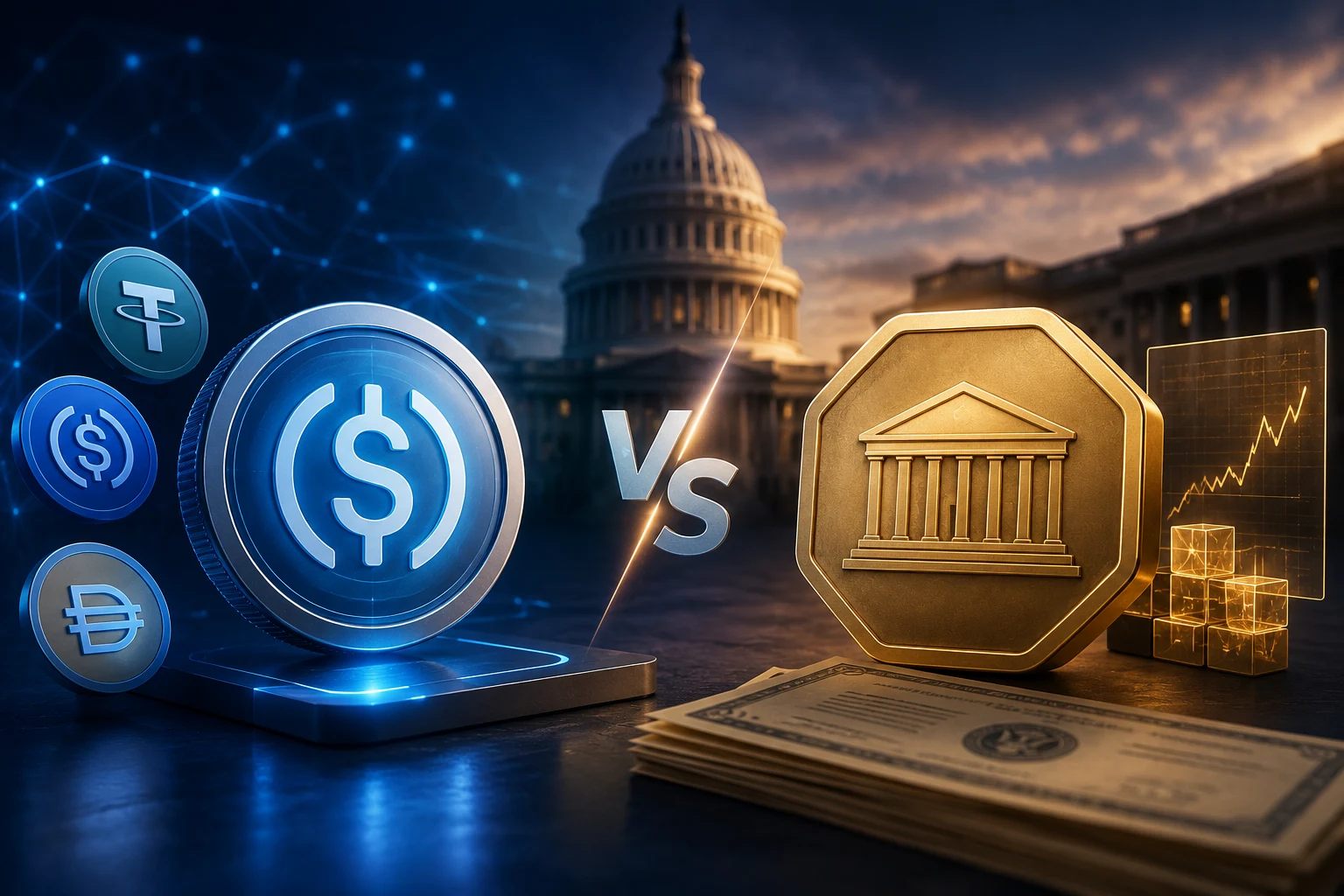
The crypto-dollar market has quietly split in two. On one side sit the familiar payment stablecoins. USDT from Tether and USDC from Circle are the two largest. PayPal's PYUSD, Ripple's RLUSD, the Global Dollar Network's USDG, and the newer USD1 and USDF from various issuers sit alongside them. Their job is simple: hold a dollar's worth of safe assets and let someone send it on-chain for cheap, in seconds, at any hour.
On the other side sit tokenized money-market and Treasury products. BlackRock's BUIDL, Ondo's OUSG, and Ondo's USDY are the visible names. These tokens also try to track a dollar, but they do it by holding short-dated U.S. Treasuries or repo agreements and passing the yield through to the holder, either by re-pricing the token or by distributing it.
Both kinds of tokens trade near $1 and both settle on public chains. To a user they can look identical. To a regulator they look very different. In 2026 that difference is the active fight in Washington, Brussels, London, and Singapore. Which bucket a token falls into decides who can issue it, who can custody it, what disclosures it must make, and whether it can pay the holder any return at all.
How the GENIUS Act sorts them
The U.S. framework is the GENIUS Act of 2025, with rules taking effect through 2026. Its definitions matter more than its penalties. A payment stablecoin is defined narrowly as a digital asset used as a means of payment, redemption, or transfer, whose issuer is obligated to maintain a reserve of dollar-equivalent assets and to redeem at par on demand.
Three points from that definition drive everything else. First, the GENIUS Act requires permitted payment stablecoins to be backed only by cash, short-dated Treasuries, repo collateral, and central bank deposits, with tight duration limits. Risky assets are out. Second, the issuer must publish monthly reserve compositions and get audited statements. Third, and most important for this fight, the GENIUS Act explicitly forbids the issuer from paying any interest or yield to holders.
That last rule is the wedge. Because the moment a token passes yield to the holder, it stops looking like a payment instrument and starts looking like an investment contract. At that point the GENIUS Act's payment-stablecoin regime does not apply, and the token falls back to securities law and investment-company rules.
Tokens like USDC, USDT, PYUSD, and RLUSD fit the payment bucket and accept that constraint. USDG, USD1, and USDF sit in the same camp. Tokenized treasuries like BUIDL, OUSG, and USDY live on the other side of the line. Whether that line will hold is the live question.
Where tokenized treasuries actually sit
Tokenized Treasury and tokenized money-market funds are not new inventions. BUIDL, launched by Securitize and tokenizing short Treasuries and repo on Ethereum, is registered as an SEC-registered securities offering. Ondo's OUSG invests in BUIDL itself, wrapping the exposure for non-U.S. users under a Cayman or BVI vehicle. USDY from Ondo adds a yield component paid directly to the holder.
Each of these structures leans on existing financial plumbing. The underlying assets sit in a regulated fund or trust, the manager is a registered investment adviser or equivalent offshore, and the on-chain token represents a beneficial interest in that fund. Investors get regulated disclosure, KYC and AML checks at the token-mint stage, and in some cases a daily NAV per token.
The trade-off is the opposite of a payment stablecoin. A payment stablecoin gives you a fast, cheap, programmable dollar but no return. A tokenized Treasury gives you the same rough asset (short-dated U.S. government debt) plus yield, but only inside a regulated wrapper that requires onboarding, may restrict who can hold it, and runs on securities-law terms. Neither product is the dominant model yet. They are dividing the market by use case.
SEC, FINRA, and the April 2024 staff statement
In April 2024, SEC staff issued a statement clarifying that crypto platforms facilitating in-kind redemptions for tokenized Treasury and money-market fund shares do not get a free pass on existing transfer-agent and rule-15c3-3 obligations. The follow-up guidance in 2024 and 2025 has been more pointed: a tokenized share of a registered investment fund remains a security, including under Section 2(a)(36) of the Investment Company Act, with all the reporting and fair-value treatment that implies.
That stance, combined with the GENIUS Act's payment-stablecoin carve-out, creates the practical rule of thumb in 2026. If your token pays yield to the holder, even if it is just accrued in the token's price, regulators will treat it like a fund share. If your token does not pay yield and is redeemable on demand for dollars at par, it can sit inside the GENIUS Act regime.
That rule is not yet a bright legal line. The SEC has hinted at further rulemaking on tokenized funds and on whether a token whose only yield is implicit price appreciation still counts. Industry groups are lobbying for a faster path for issuers. Compliance teams, meanwhile, are treating the gap as a stop sign. If an offering has yield, even a tiny one, it is structured as a securities offering from day one.
MiCA: the European split into ARTs and EMTs
Europe's Markets in Crypto-Assets Regulation (MiCA) is fully applicable across EU member states in 2025, with the e-money and asset-referenced portions in force from June 2024. MiCA sorts digital assets into crypto-assets, asset-referenced tokens (ARTs), and electronic money tokens (EMTs).
An EMT must be issued by an authorized credit institution or e-money institution, must be backed by low-risk liquid assets, and must be redeemable at par at any time. USDT, USDC, and EUR-stablecoin issuers have routed through licensed e-money institutions to fit this category. An ART is referenced to one or more non-fiat assets, like a basket of currencies or commodities, and faces stronger requirements: own-funds minimums, an EU-based white paper, a supervisory approval before issuance, and reserve segregation.
Tokenized Treasury funds do not naturally fit either bucket. A regulated fund is what they look like to MiCA, which is why most tokenized Treasury offerings targeting EU investors are structured through UCITS or AIFMD vehicles rather than under MiCA itself. The layering means a product can be both a tokenized Treasury under U.S. fund law and a regulated EU fund under UCITS, without being a MiCA ART or EMT at all.
For a U.S. or Singapore issuer, the practical upshot is that offering the same product in the EU requires a separate legal structure, separate KYC, and a UCITS or AIFMD wrapper with its own depositary. The same applies in reverse. A U.S. user may not be permitted to hold a tokenized Treasury distributed under MiCA, even if they can buy a U.S. BUIDL share via Securitize.
Where the lines are blurring in 2026
The clarity above is more theory than reality. Three trends are blurring the line between payment stablecoins and yield-bearing RWA tokens in practice.
First, payment stablecoins are starting to bundle yield at the application layer, not at the token. USDC held in a lending protocol like Aave can earn interest, but that interest is paid by the protocol, not by Circle. This is the rent, not the token model, and it keeps the token itself compliant with the GENIUS Act. Watchers in Washington have warned that if a stablecoin issuer starts running its own yield program, it crosses the line.
Second, tokenized Treasury products are adding payment-rail features. BUIDL is now usable as off-chain collateral in some institutional workflows, and Ondo's products route through payment-style integrations in DeFi. The token still represents a fund share, but functionally the user is using it like a payment asset. The SEC has not yet said where the line falls here.
Third, issuers are racing to file hybrid products that claim the best of both. RLUSD, USD1, and USDG were all launched in the last two years with payment-rail ambitions, with yield programs either deferred or run through an affiliated vehicle. Meanwhile the tokenized Treasury camp is pushing the SEC to clarify that interest distributions do not flip a token out of fund-law status into payment-stablecoin status. Neither side has won the argument in writing.
How to read the conflict as a user or compliance team
For a user, the operational question is simple. Is the token a payment instrument, or is it an investment? If it is a payment instrument (USDC, USDT, PYUSD, RLUSD), expect no yield from the issuer, expect full reserve reporting, and expect redemption at par on demand. Custody and on-ramp permission are typically broad. If the token is a tokenized Treasury (BUIDL, OUSG, USDY), expect yield and expect securities-style restrictions: KYC at mint, lock-ups, accredited or professional-only access in some jurisdictions, and exposure to fund-management risk.
For a compliance team at a fintech, custodian, or exchange, the practical steps look like this.
- Map every stablecoin listing to a bucket. Payments or yield.
- Treat any token with issuer-paid interest as out of the GENIUS Act's safe harbor, unless explicitly exempt.
- Verify that tokenized Treasury products carry the right securities filings and, where needed, a UCITS or AIFMD wrapper for EU distribution.
- Run cross-border distribution through the most restrictive jurisdiction in scope, including potential additional licensing for offering into the U.K., Singapore, or the UAE.
- Watch the rewrites. The SEC's position on tokenized NAV funds, the EBA's view on ART liquidity, and Treasury's response to stablecoin payments are all in motion.
None of this is settled. The biggest risk is that a token you classified today as a payment-stablecoin flips into fund status, or vice versa, after a regulator ruling. Build compliance around the stricter characterization and revisit quarterly.
Stay ahead of the stablecoin-vs-RWA fight
Stablecoin-vs-tokenized-Treasury regulation is moving monthly, not yearly. New issuer launches, GENIUS Act interpretive letters, MiCA Q&A updates, and SEC no-action letters all shift which tokens sit inside which bucket. Tracking them by hand is a losing game. Zippfeed surfaces crypto-dollar and RWA headlines with sentiment scoring (bullish, neutral, or bearish) and an importance rating, so you can spot regulatory breaks before they hit your product or your portfolio.










 CoinDesk
 CryptoSlate
 Crypto Rank News
 Lookonchain