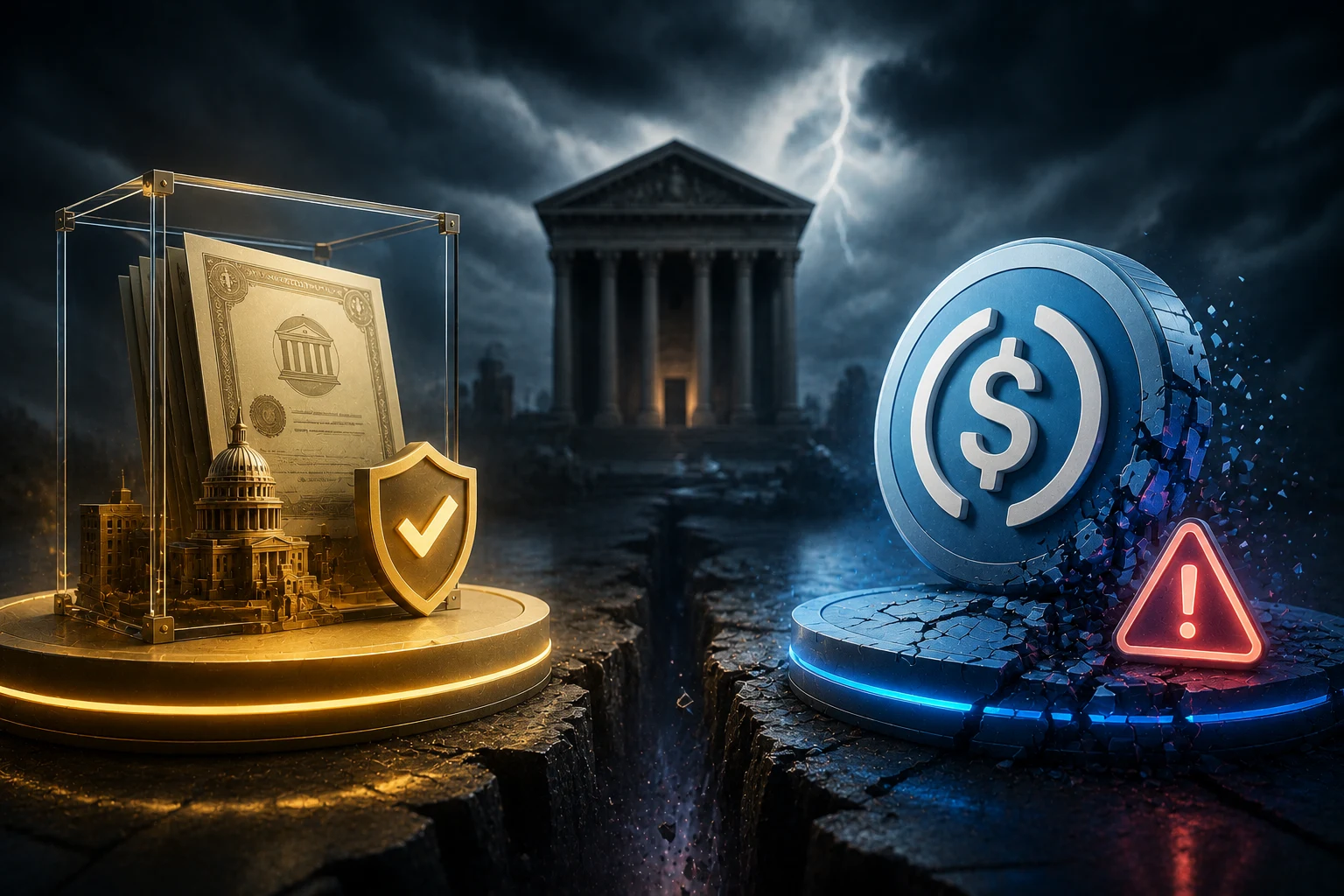
What does bankruptcy mean for each dollar token?
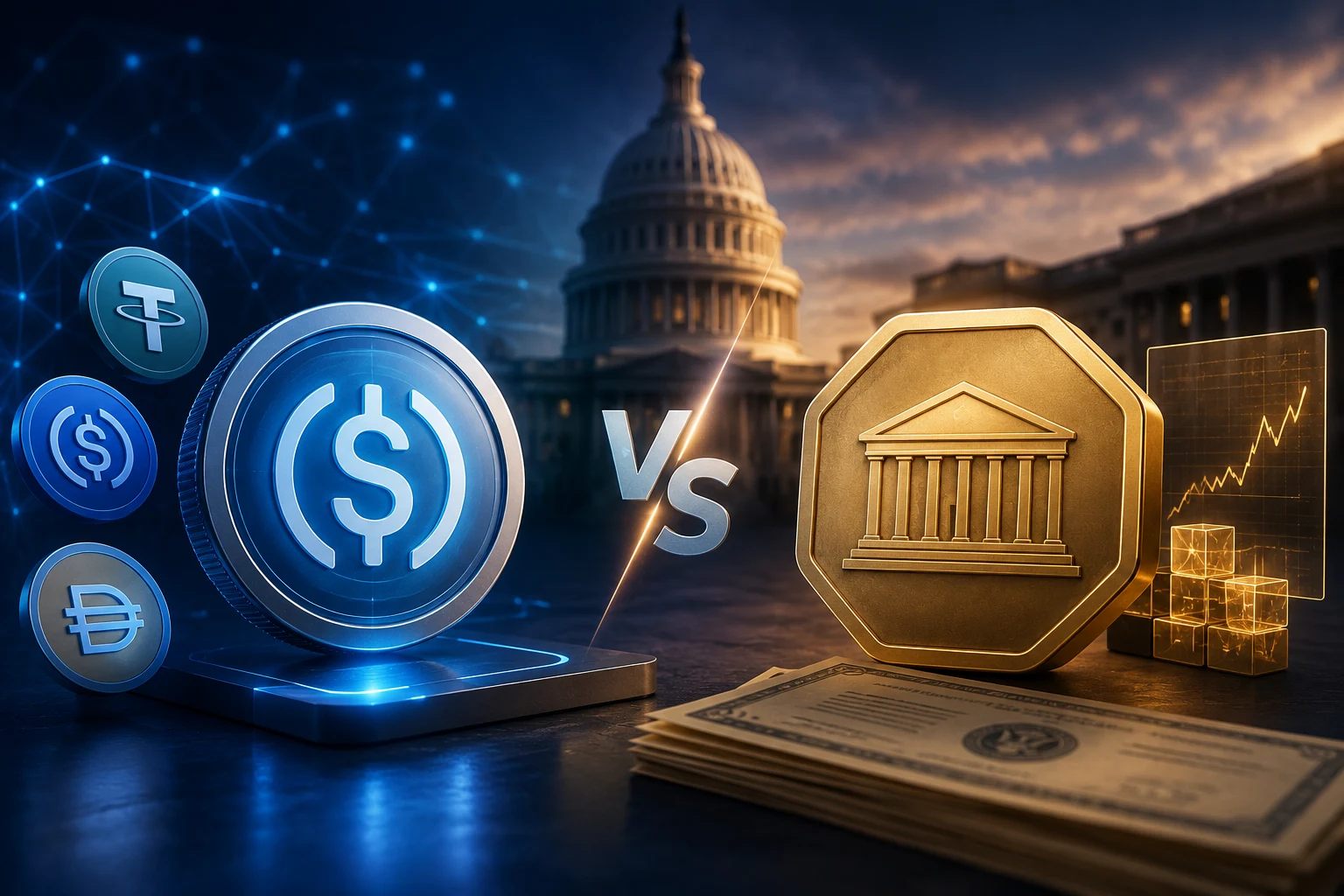
When people compare a tokenized Treasury with a stablecoin, they often begin with the same visible feature: both aim to stay near one US dollar. That similarity can hide a major legal difference. A tokenized Treasury fund may represent an interest in a registered investment vehicle that owns Treasury bills, repurchase agreements, cash, or other permitted assets. A stablecoin usually represents a promise by an issuer to redeem a token for one dollar, subject to that issuer’s terms, reserves, banking relationships, and applicable law.
The useful question is therefore not simply which token holds more dollars. It is: what claim would you have if the issuer, fund manager, custodian, reserve bank, or redemption agent failed? You need to know whether your interest is tied to a pool of assets, a segregated account, a bankruptcy-remote SPV, or a general creditor pool. You also need to know who can redeem, how quickly, at what price, and under which jurisdiction.
The products in this comparison are not identical. BUIDL is a tokenized share class of a BlackRock institutional Treasury fund structure. OUSG is an Ondo product providing tokenized exposure to short-term US government securities through a fund structure. USDY is an Ondo dollar-denominated note with backing and terms that differ from a registered money market fund. USDC and USDT are major stablecoins with different issuers, reserve disclosures, contractual terms, and operating histories. USD1 is another stablecoin, with a shorter public history than the largest established tokens.
That distinction matters for short-term cash management. A fund share can move with a daily net asset value, or NAV, which is the value of the underlying portfolio divided by outstanding shares. A stablecoin generally seeks a 1:1 redeemable-at-par claim, meaning the issuer promises one dollar per token under its redemption rules. One structure can show a small NAV loss while preserving a property interest in assets. The other can remain close to one dollar in trading while leaving holders dependent on an issuer’s ability and duty to redeem.
The risks come before the potential recovery
Neither structure is a guaranteed cash substitute. A tokenized Treasury fund can lose value if it holds securities that fall in market value, incurs fees, faces settlement problems, or suffers from a custodian, broker, administrator, or technology failure. Even a portfolio concentrated in short-dated US Treasuries can face interest-rate risk, liquidity friction, operational risk, and losses caused by parties handling the assets. A regulated label reduces some risks. It does not make every loss impossible.
Stablecoins have a different set of failure modes. An issuer may become insolvent, a reserve bank may fail, a reserve asset may be unavailable, or redemptions may be paused. A token can trade below one dollar if holders doubt the reserves, the banking rails, the issuer’s legal position, or the ability to redeem. A stablecoin can also lose its practical usefulness because an exchange, wallet, payment provider, or regulator blocks transfers even when the issuer remains solvent.
There are technical and fraud risks as well. A smart contract may contain an administrative freeze function, a token may be issued on a network with congestion or a contract error, and an address may be sanctioned or incorrectly blocked. Fake tokens, phishing sites, fraudulent yield offers, and copied issuer branding can cause losses that no reserve account will reimburse. The fact that a token symbol resembles USDC, USDT, USD1, BUIDL, OUSG, or USDY does not prove that it is an official token.
Finally, bankruptcy is not the only event that matters. A fund can have valuable assets but still impose a delay. A stablecoin can recover its market price after a depeg without every holder receiving immediate par redemption. Prime brokerage failures also show why the chain of custody matters. When a broker fails, segregated client assets may receive different treatment from collateral that was pledged, rehypothecated, or mixed with the broker’s own property. Legal documentation and records can matter more than the marketing description.
How tokenized Treasury fund structures can protect investors
A regulated money market fund is generally designed to hold a defined portfolio and calculate a NAV under investment-fund rules. In a tokenized version, the blockchain token is a digital representation of a fund interest, not a magic wrapper that changes the underlying legal ownership. The fund’s assets may be held by a custodian, while a transfer agent, administrator, investment manager, and token platform perform separate functions. If one party fails, the result depends on which entity failed and how the assets and records were maintained.
That is the key comparison with a stablecoin issuer’s reserve bank. In a regulated money market fund, the custodian is normally charged with holding the fund’s securities and cash for the fund, subject to custody rules and the fund documents. The custodian does not automatically own those assets for its own balance sheet. In a stablecoin arrangement, the reserve bank holds assets for the issuer or its reserve vehicle under account agreements. A token holder does not necessarily have a direct property claim to a particular Treasury bill or deposit account. The issuer’s terms determine whether holders have a direct, indirect, or merely contractual claim.
Some tokenized products may use a bankruptcy-remote SPV, or special purpose vehicle intended to isolate assets from the sponsor’s operating creditors. If that structure works as documented, an issuer’s corporate bankruptcy may not pull the vehicle’s assets into the sponsor’s general creditor pool. But bankruptcy remote does not mean bankruptcy proof. Courts can examine the documents, control of accounts, commingling, guarantees, fraudulent transfers, servicing arrangements, and the real economic substance of the structure.
BUIDL illustrates why investors must read the fund documents rather than rely on the token label. It is associated with a regulated institutional fund that invests in cash, US Treasury bills, and repurchase agreements and reports a NAV. Its institutional eligibility, transfer restrictions, minimums, approved wallet rules, and redemption mechanics can make it unsuitable for a typical retail wallet even if the underlying assets sound familiar. The regulated fund structure may improve asset-level clarity, but it does not promise instant access or a lossless outcome.
What daily NAV changes
Daily NAV gives a fund a valuation framework. If the portfolio is worth slightly less after rates rise or a permitted security becomes impaired, the fund can reflect that change instead of maintaining a permanent promise that every token is worth exactly one dollar. That transparency can be uncomfortable, but it may reveal a loss earlier. It also means the token’s market price, the fund NAV, and the redemption price can diverge briefly.
By contrast, a 1:1 redeemable-at-par stablecoin is designed to make the dollar claim simple. The simplicity is useful for payments and trading, but it shifts attention to whether redemption is available and whether the issuer has sufficient liquid assets. A par promise can be stronger than a market price during normal conditions, or weaker during a run if access is restricted. Neither daily NAV nor par redemption alone answers the bankruptcy question.
How stablecoin reserves and creditor claims differ
A stablecoin reserve normally supports the issuer’s promise to redeem tokens. The reserve can include bank deposits, Treasury bills, reverse repurchase agreements, money market funds, or other assets permitted by the issuer’s policy and local law. The mix, maturity, custody, and legal ownership all matter. A reserve report or attestation may describe what existed on a reporting date, but it is not the same as a court-tested guarantee that every holder owns a proportional slice of every asset.
The practical concern is the reserve bank and the issuer’s balance sheet. If a bank holds reserve cash in an account belonging to the issuer, the account may be protected by deposit rules or contractual arrangements, but it may not be a segregated trust for token holders. If the issuer fails, holders may need to make a redemption demand under the issuer’s terms or share in an estate process. Unless the legal documents provide a stronger property right, that can resemble a general creditor pool rather than a direct claim on Treasury bills.
USDC’s experience during the Silicon Valley Bank failure in March 2023 showed how a reserve-bank problem can transmit to a stablecoin. Circle disclosed that a portion of USDC reserves was held at SVB, and USDC traded materially below one dollar while markets waited for clarity. The token later returned toward its intended price after authorities and Circle addressed the reserve-access problem. That episode was not a final issuer bankruptcy recovery, but it demonstrated that reserve custody and banking access can matter even when the underlying assets are intended to be high quality.
USDT has a different history. Tether has repeatedly changed and disclosed its reserve composition over time, including a reduction in commercial paper and greater emphasis on Treasury holdings, cash, and other assets. Its reserve history, attestations, redemption conditions, and legal terms have been scrutinized and debated. A history of maintaining a market price near one dollar is evidence of operating resilience, not proof of a particular bankruptcy ranking or a guarantee that every holder can redeem at par during a crisis.
USD1 has less long-running stress history than USDT and USDC. Its reserve policy, issuer entities, banking partners, legal terms, redemption channels, and reporting should be evaluated directly rather than inferred from the behavior of older stablecoins. A newer product may have modern reserve practices, but it also has fewer years of evidence across bank failures, market runs, sanctions, technical incidents, and changing regulation.
What historical breaks tell us about recovery
Money market funds have experienced serious breaks before. In 2008, the Reserve Primary Fund fell below a one-dollar NAV after losses tied to Lehman Brothers commercial paper. The fund was liquidated, and investors received distributions over time, with recovery based on the remaining assets and liquidation process rather than an instant par guarantee. The lesson is not that every money fund will fail. It is that a regulated fund can still expose investors to delay, valuation loss, and service-provider risk.
Prime brokerage failures provide another warning. The collapse of Lehman Brothers and the failure of MF Global showed that client assets, collateral, margin, and records can become entangled in a complex insolvency. Segregation rules may help, but identifying and returning assets can take time, and the outcome can depend on the exact account structure. A tokenized Treasury fund can use a regulated custodian and still require careful analysis of any broker, repo counterparty, collateral agent, or lending arrangement.
Stablecoin depegs tell a different story because the market token is continuously traded. USDC’s 2023 decline below one dollar was driven by uncertainty about reserve-bank exposure and redemption access, then reversed as confidence returned. USDT has experienced past periods of trading below or above its target, including episodes connected to market stress and questions about liquidity. These events show that a depeg can be temporary, but they do not establish what holders would recover after a formal liquidation.
TerraUSD is a useful contrast, not a direct comparison. It relied on an algorithmic design and market incentives rather than the same reserve model used by USDC or USDT. Its collapse demonstrated that a token can fail permanently when its stabilization mechanism loses credibility. The broader point is that the word stablecoin describes a goal and a product category, not one uniform legal or economic structure.
Recovery has at least three stages. First, the token must keep operating or the fund must continue calculating value. Second, holders need a working redemption path or a legally recognized claim. Third, the assets must be located, valued, and distributed after fees and creditor disputes. A stablecoin can pass the first stage during ordinary trading and fail the second during a run. A tokenized fund can pass the second legally but take time at the third stage. Market stability and insolvency recovery are related, but they are not interchangeable.
A side-by-side bankruptcy scoring framework
Instead of choosing a universal winner, score the actual product and your use case. A useful framework has six categories. Give each category a low, medium, or high score for protection, and record the evidence behind the score. If the documents are unclear, treat that uncertainty as a risk rather than awarding the product the benefit of the doubt.
- Legal ownership: Does the holder own a fund interest, a beneficial interest in segregated assets, a note, or an issuer redemption claim?
- Bankruptcy priority: Are assets outside the sponsor’s general creditor pool, or would holders stand with ordinary unsecured creditors?
- Custody and segregation: Which regulated custodian or reserve bank holds the assets, whose name is on the accounts, and can assets be rehypothecated?
- Asset quality and liquidity: Are reserves short-dated Treasuries and cash, or do they include less liquid, volatile, or affiliated assets?
- Redemption mechanics: Who is eligible, what are the minimums, how long does settlement take, and can redemptions be suspended?
- Transparency and operational access: Are NAV, holdings, attestations, wallet controls, fees, and incidents disclosed clearly to the people who can actually use the token?
On this framework, a regulated fund such as BUIDL may score strongly on portfolio definition, custody oversight, and NAV reporting, while scoring poorly for ordinary retail access if eligibility and transfer rules are restrictive. OUSG may offer a similar government-securities orientation, but its wrapper, access conditions, fees, and redemption process require separate review. USDY should not be treated as identical to either fund because a note structure can create different issuer and collateral questions.
USDC may score well on payment liquidity, market depth, and a demonstrated ability to restore its target after the SVB episode. Those strengths do not automatically create a segregated property claim for every holder. USDT may score well on longevity and global liquidity, while reserve composition, legal jurisdiction, redemption access, and disclosure should remain part of the risk assessment. USD1 needs the same analysis, with extra attention to its shorter stress history.
The scoring result can change depending on the objective. Someone seeking a token for settlement may value broad exchange support and fast transfers more than daily NAV. Someone seeking a short-term Treasury exposure may prefer a fund structure but accept eligibility limits and settlement delays. Someone who needs immediate retail redemption may find that a theoretically strong legal structure is not practical if they cannot access the official redemption channel.
What this means before you park short-term dollars
Start by identifying the claim you are buying. Read the prospectus, offering memorandum, terms of service, reserve policy, custody description, and redemption rules. Look for the exact issuer entity and jurisdiction, not only the brand. Ask whether the token gives you a security, a fund share, a note, or a stablecoin claim. If you cannot explain the claim in one plain-English sentence, you probably do not yet understand the insolvency risk.
Next, separate three forms of liquidity. Trading liquidity is the ability to sell the token on a market. Issuer liquidity is the ability to redeem with the issuer. Legal recovery is the ability to receive value through a liquidation or court process. They can diverge sharply. A token can trade continuously while the issuer pauses redemptions, or an asset pool can be legally protected while a transfer agent takes time to process claims.
Retail access is also changing as regulation develops. The GENIUS Act creates a US framework for payment stablecoin issuers and reserve requirements, supervision, disclosures, and redemption expectations. Its protections depend on the final rules, the issuer’s license or status, the reserve arrangement, and enforcement. It does not turn every stablecoin into a deposit, eliminate operational failures, or make a tokenized Treasury fund equivalent to a bank account.
MiCA, the European Union’s Markets in Crypto-Assets framework, sets authorization, reserve, conduct, and disclosure requirements for certain stablecoin categories offered in the region. It can improve consistency and make some risks easier to compare, but authorization is not a promise of zero losses. MiCA also does not erase differences between a regulated money market fund, an asset-referenced token, an e-money token, and a private note.
For a retail user, the most important regulatory question is not whether a product carries the word regulated. It is whether the rules apply to your token, your jurisdiction, your wallet, and your redemption route. Some institutional tokenized funds may remain unavailable to retail investors. A stablecoin covered by a new framework may still be held through an exchange with its own insolvency and custody risk. Regulation can create tailwinds for clearer standards, but product-level documents still determine your practical exposure.
Use only official contracts and redemption channels, keep records of purchases and wallet ownership, and avoid offers that promise extra yield for depositing a dollar token into an unknown platform. Do not assume that a Treasury-backed product is principal-protected, that a stablecoin is a bank deposit, or that a temporary depeg guarantees eventual recovery. This is education, not financial advice. The right allocation depends on your jurisdiction, time horizon, liquidity needs, tax position, and tolerance for loss.
Read tokenized Treasury and stablecoin news critically
Tokenized Treasuries and stablecoins move fast, and the important details are often buried in reserve reports, court filings, regulatory releases, and changes to redemption terms. Manually tracking every headline, depeg, custody event, and regulatory development is difficult. Zippfeed brings together coverage of BUIDL, OUSG, USDY, USDC, USDT, USD1, and the wider real-world-asset market with sentiment scoring marked bullish, neutral, or bearish and an importance rating, helping you separate a material solvency signal from routine market noise.
Use that context to ask better questions, not to outsource a decision. A headline about Treasury backing may say little about your creditor priority, while a headline about a bank may reveal a major redemption or custody risk. Follow the underlying documents and compare the signal with the product’s legal structure before acting.






 CoinDesk
 CryptoSlate
 WuBlockchain
 TheBlock