The setup: a 2021 bull that left a lot of leverage behind
By late 2021, the crypto market was at the end of a euphoric multi-year bull. BTC had peaked at roughly $69,000 in November 2021, ETH at roughly $4,900, and the broader market at over $3 trillion in total capitalisation. The bull had been driven by zero-interest-rate macro conditions, retail adoption, NFTs, DeFi growth, and a wave of leveraged platforms (centralised lenders, exchanges, hedge funds) that had borrowed and lent against crypto collateral at scale. Those platforms looked profitable in the bull; their hidden risk was that their solvency depended on prices not falling far.
The conditions that ended the bull were structural and policy-driven. The US Federal Reserve signalled the end of cheap money in late 2021 and began raising rates aggressively from March 2022 onwards. Inflation was running near 9% in the US and similar levels elsewhere. Risk assets re-rated everywhere — tech stocks, growth, and crypto more sharply than most.
This is educational, not financial advice. The 2022 crypto winter is the closest thing to a textbook deleveraging cascade the industry has produced.
What actually happened: a year of cascading failures
The winter is best understood as a sequence of triggers, each one feeding the next.
- November 2021 - April 2022. Quiet decline. BTC drifted from $69,000 toward the high $30,000s and low $40,000s. Sentiment soured but no major platform had broken.
- May 2022: Terra collapse. The Terra/UST algorithmic stablecoin lost its peg and entered a death spiral with sister token LUNA. Roughly $60 billion of market value was wiped out in days. Funds and lenders with Terra exposure took heavy losses. See the Terra Luna collapse.
- June 2022: Celsius and 3AC. Celsius froze withdrawals on 13 June. Within days, Three Arrows Capital — one of the largest crypto hedge funds — was revealed to be insolvent. The 3AC bankruptcy triggered cascading margin calls and counterparty losses across the lending sector.
- July 2022: Voyager and bankruptcy filings. Voyager Digital filed for bankruptcy on 5 July. Celsius filed on 13 July. Several smaller lenders followed.
- July-October 2022: relative calm and partial rally. BTC stabilised in the high teens of thousands. Rumours of macro pivot drove a brief rally to the low $20,000s. The bottom appeared to be in.
- November 2022: FTX collapse. A leaked Alameda Research balance sheet triggered a bank run on FTX. Within seven days, FTX — the second-largest crypto exchange in the world — filed for bankruptcy on 11 November. BTC fell to its cycle low near $15,500 on 21 November. See the FTX collapse.
- January 2023: Genesis. Genesis Global Capital, a major lender with FTX and 3AC exposure, filed for bankruptcy. This effectively ended the cascade — there were few major leveraged crypto institutions left to fail.
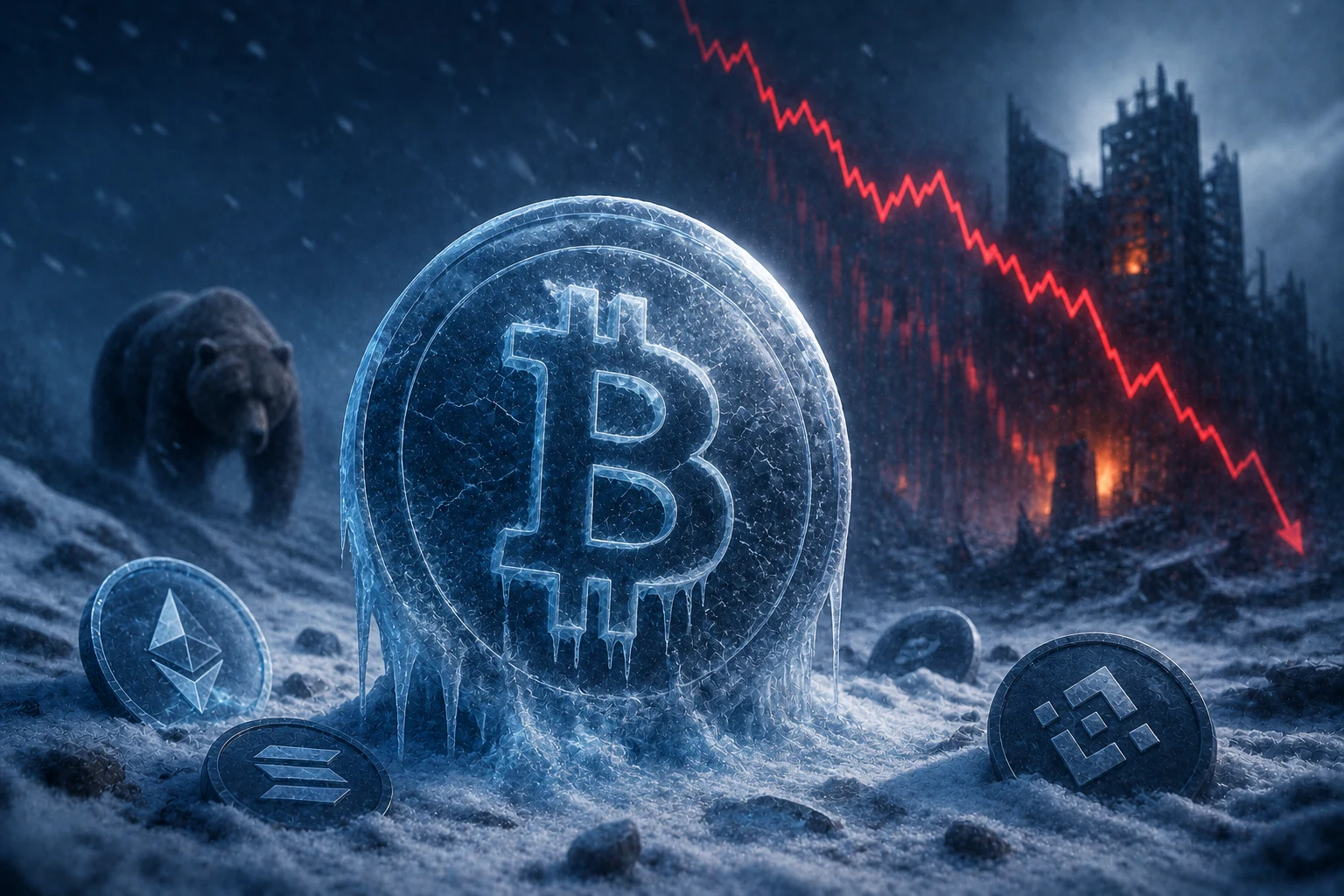
The peak-to-trough drawdown for BTC was approximately 78%. ETH fell from about $4,900 to about $880 — roughly 82%. Many altcoins fell 90-99% or to effectively zero. Total crypto market capitalisation fell from over $3 trillion to under $800 billion.
Who was involved
- Macro policymakers. The Federal Reserve, ECB, Bank of England and others sharply raised interest rates through 2022. The repricing of risk assets globally was the precondition for the crypto decline; without the macro context, the platform failures would have been smaller.
- Leveraged crypto institutions. Three Arrows Capital, Celsius, Voyager, BlockFi, FTX, Alameda Research, Genesis. Each was a separate failure but the structural pattern — high leverage, opaque balance sheets, customer-fund commingling, counterparty entanglement — was shared.
- Retail holders. Millions of retail crypto users took mark-to-market losses. Many users had deposits trapped in collapsed platforms; the bankruptcy processes that followed extended losses over years.
- Surviving platforms. Coinbase, Kraken, Binance, MetaMask, Ledger, Trezor and a handful of others continued operating throughout. Their survival shaped the post-winter market structure.
The aftermath: bankruptcy processes, recovery, and an unexpected rally
The winter's wreckage extended for years, but the bottom in November 2022 was also the start of an unexpected recovery.
- Bankruptcy proceedings. Mt. Gox-style multi-year proceedings followed for Celsius, Voyager, FTX, BlockFi, Genesis, 3AC, Terra. Most produced partial recoveries spread over years, with creditor outcomes heavily dependent on whether assets were distributed in crypto or in fiat at frozen 2022 prices.
- Criminal cases. Sam Bankman-Fried was convicted of fraud in November 2023 and sentenced to 25 years in March 2024. Alex Mashinsky pleaded guilty in late 2024. Do Kwon was extradited to the US in late 2024. Caroline Ellison, Gary Wang and Nishad Singh of FTX/Alameda cooperated and received reduced sentences.
- Layoffs and industry contraction. Crypto exchanges, miners, NFT studios and startups laid off tens of thousands of employees through 2022 and 2023. Surviving teams ran on much smaller burn rates.
- The 2023 recovery. BTC began climbing in January 2023 and ran through the year. The proximate driver was the anticipation of US spot Bitcoin ETFs. BlackRock filed for a spot BTC ETF in June 2023, signalling that the largest asset manager in the world expected approval. Approval came on 10 January 2024, marking the definitive end of the winter.
- Lessons baked into the post-winter architecture. Proof-of-reserves disclosures, segregation of customer assets, and on-chain auditability became table-stakes for credible exchanges. Algorithmic stablecoins largely disappeared. Custody discussion became unavoidable in every retail conversation.
The lessons
The 2022 crypto winter is the most comprehensive recent case study of what a cycle ending looks like. The honest lessons:
- Crypto is correlated with risk assets, especially under stress. The myth that BTC is an uncorrelated hedge to traditional markets has not survived empirical testing through major sell-offs. In 2022, BTC moved with the Nasdaq during the worst weeks. Diversification claims should be evaluated against actual data, not narrative.
- Leverage is the proximate killer. Every major collapse — Terra, 3AC, Celsius, FTX — involved hidden or excessive leverage. Healthy underlying projects can survive a drawdown; over-leveraged ones cannot. Watching for leverage on platforms you use is the cheapest form of risk management.
- Counterparty exposure cascades. No major platform fell in isolation. Each failure damaged the next via lending relationships, treasury exposure or shared insolvency dynamics. Holding crypto on a platform means accepting that platform's web of counterparty risk, not just its own balance sheet.
- The bottom is invisible at the bottom. Nobody knew on 21 November 2022 that they were looking at the cycle low. Sentiment was uniformly bearish. The clearest sign of a bottom historically has been the absence of bullish catalysts and the visible washing-out of leverage — not a positive narrative.
- Cycles repeat in shape, not in detail. The 2018 bear, the 2014 bear and the 2022 bear shared structural features — macro headwind, leveraged-platform failure, narrative collapse, multi-year recovery — even though the specific actors and proximate triggers differed. Pattern recognition across cycles is more useful than analysis of any single cycle.
It is worth being clear about what the winter does not prove. It does not prove crypto is a bubble or that it cannot recover. The 2023-2024 rally and the subsequent ETF era are direct evidence that the underlying technology and demand persisted. The lesson is structural: every cycle exposes the platforms and projects that were leveraged into the previous one.
Watch for the structural signs of the next cycle ending
No specific date is predictable, but the structural signs — elevated leverage, opaque balance sheets, narrative-driven valuations, retail euphoria — are visible. Zippfeed tracks crypto headlines across many sources with sentiment and importance scoring, so you can watch cycle dynamics — narrative momentum, platform stress, macro shifts — as they unfold, rather than after the fact. This is educational, not financial advice.