The setup: a star founder and a tightly woven empire
Sam Bankman-Fried ("SBF") founded Alameda Research in 2017 as a quantitative trading firm. In 2019 he and several collaborators — Gary Wang, Nishad Singh and others — founded FTX, a crypto exchange initially headquartered in Hong Kong and later in the Bahamas. FTX grew rapidly. By 2021 it was one of the largest crypto exchanges in the world. By early 2022, it was valued at $32 billion in private funding rounds, with major venture firms — Sequoia, BlackRock, Temasek, SoftBank, Tiger Global — as backers. SBF was on magazine covers, donating millions to political candidates and effective altruism, and treated as a generational founder.
Two structural facts mattered. First, Alameda and FTX were operated by overlapping people from overlapping offices, despite being supposedly separate companies. Second, FTX issued its own exchange token, FTT, which Alameda held in size on its balance sheet. Those two facts would later turn out to be the entire story.
This is educational, not financial advice. The lesson of FTX is about structural conflicts and the specific failure of treating customer deposits as fungible with proprietary risk capital.
What actually happened: a bank run in seven days
The collapse moved with extraordinary speed.
- 2 November 2022. CoinDesk publishes an article based on a leaked Alameda Research balance sheet. The balance sheet shows that Alameda's largest asset, by a wide margin, is FTT — FTX's own exchange token. This raises an obvious question: if FTT's value depends on FTX, and Alameda is essentially backed by FTT, what happens to either if FTT falls?
- 6 November 2022. Binance CEO Changpeng Zhao ("CZ") tweets that Binance will sell its entire FTT holding, citing "recent revelations". The market reads this as Binance signalling that FTX is in trouble. A bank run on FTX begins as users try to withdraw their crypto deposits.
- 7-8 November. Withdrawals exceed what FTX can satisfy. Within hours, withdrawal delays appear. SBF publicly insists that FTX is fine and that user assets are "safe".
- 8 November. FTX halts withdrawals.
- 9 November. Binance announces it has signed a non-binding letter of intent to acquire FTX, framing it as a rescue. The crypto market briefly relaxes. Hours later, Binance withdraws the offer, citing "corporate due diligence" findings and allegations of mishandled customer funds.
- 10 November. The Bahamas Securities Commission orders FTX's Bahamas entity to suspend operations. FTX is now in regulatory and financial freefall.
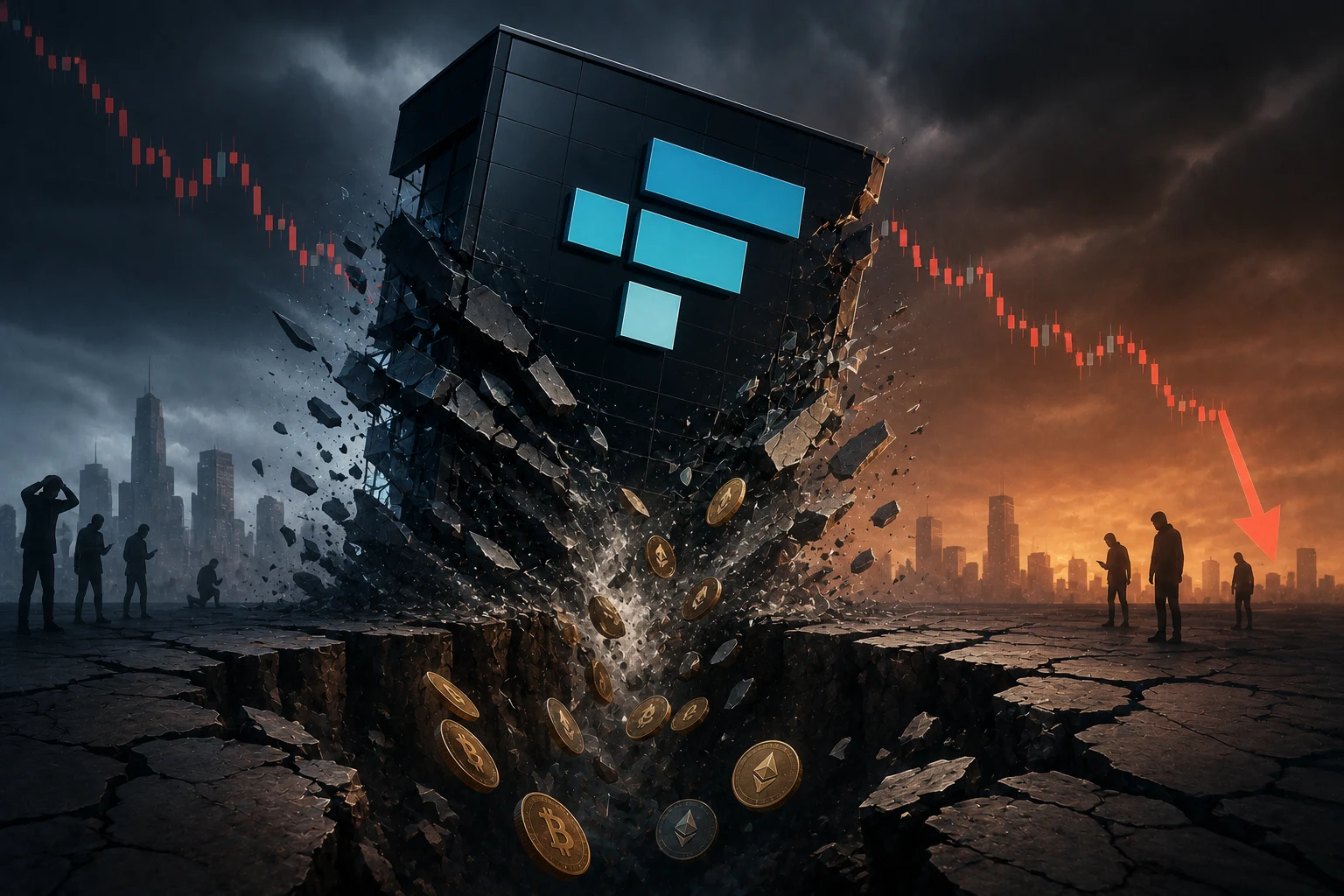
- 11 November 2022. FTX Trading Ltd., Alameda Research and over 130 affiliated entities file for Chapter 11 bankruptcy protection in the United States. SBF resigns as CEO. John J. Ray III — the restructuring veteran who previously oversaw Enron — is appointed CEO to manage the liquidation.
Within days of the bankruptcy filing, hundreds of millions of dollars in crypto were drained from FTX wallets by an as-yet-unidentified actor — possibly an insider — adding to the chaos.
Who was involved
- Sam Bankman-Fried. Founder and CEO of FTX and majority owner of Alameda. Arrested in the Bahamas on 12 December 2022 and extradited to the United States. Convicted on 2 November 2023 of seven counts of fraud and conspiracy by a Manhattan federal jury. Sentenced on 28 March 2024 to 25 years in prison.
- Caroline Ellison. Co-CEO of Alameda Research and SBF's sometime partner. Pleaded guilty to fraud and conspiracy charges, cooperated extensively with prosecutors, and was sentenced to 24 months in prison.
- Gary Wang. FTX co-founder and CTO. Pleaded guilty to fraud charges, cooperated and received a sentence of time served plus three years of supervised release.
- Nishad Singh. Head of engineering at FTX. Pleaded guilty, cooperated and received a sentence of time served plus three years of supervised release.
- John J. Ray III. Court-appointed CEO who took over after the bankruptcy filing. Said in court filings that FTX had "a complete failure of corporate controls" and that this was the worst situation he had seen in his career.
- Customers and investors. Over a million account holders worldwide. Over $8 billion in customer fund shortfalls were identified by the bankruptcy team.
The aftermath: prosecutions, recoveries and an unexpected ending
The FTX story produced both the criminal conclusion many expected and a financial outcome many did not.
- Criminal conviction. SBF's trial in 2023 was unusually fast and unambiguous. Cooperators Ellison, Wang and Singh testified that customer funds had been transferred to Alameda and used for high-risk proprietary trades, real-estate purchases, political donations and venture investments. The jury convicted on all seven counts.
- Civil and regulatory action. The SEC, CFTC, DOJ and Bahamas authorities all brought parallel actions. Insiders who had not yet pleaded guilty by mid-2023 faced ongoing investigations.
- A wave of contagion. Crypto lenders BlockFi, Genesis and others that had exposure to FTX or Alameda followed into bankruptcy or restructuring in late 2022 and 2023.
- An unexpected creditor recovery. By 2024, helped by a sharp crypto rally, the FTX bankruptcy estate was able to project recoveries equivalent to 100%+ of creditors' November 2022 claim values. Many customers will receive their full dollar claim back, plus interest — though almost none will recapture the crypto gains they would have had if they had held their own coins through the rally.
- A regulatory turning point. The FTX collapse became the policy event that gave political momentum to stricter exchange regulation, audit standards, and proof-of-reserves disclosure across multiple jurisdictions.
The lessons
The FTX collapse is not a story about an unforeseeable accident. It is a story about a specific failure mode that crypto had already seen — at Mt. Gox, Celsius, Voyager and others — and that FTX repeated at scale. The honest lessons:
- Conflicts of interest matter. A trading firm and a customer-facing exchange should not be operated by the same people from the same office, with overlapping risk and access to customer funds. FTX's collapse came from that structural conflict, not from a single trade gone wrong.
- An exchange's own token is not collateral. FTT existed because FTX existed. Treating large FTT holdings as a meaningful asset on Alameda's balance sheet was always circular. Most exchange-issued tokens carry some version of this risk.
- Charisma and philanthropy are not audit reports. SBF had magazine covers, political access and a public effective-altruism brand. None of that produced reliable financial controls. The presence of celebrity-grade reputation should never be treated as evidence of solvency.
- Customer fund commingling is fatal. The single most damning fact in the trial was that FTX customer deposits were transferred to Alameda for use. That is a bright line. Any platform that blurs that line — under any rationale — is taking customer-fund risk at the platform level.
- Bank runs in crypto are extraordinarily fast. FTX went from "healthy major exchange" to bankruptcy in seven days. By the time most retail users tried to withdraw, withdrawals were already paused. There is no "I'll wait and see" window in a crypto bank run.
It is worth being clear about what FTX does not prove. It does not prove that all centralised exchanges are fraudulent. It proves that the absence of segregation, audit, and transparent reserves is dangerous regardless of brand strength. Reputable exchanges in 2024 publish proof-of-reserves and segregate customer assets specifically because of what happened here.
Watch for the next "healthy major exchange" story
Every cycle produces a fast-growing platform whose risk only becomes visible under stress. The early signs — opaque reserve disclosures, heavy use of an exchange's own token in related-party balance sheets, denials that sound a beat too quick — are usually visible before the run. Zippfeed tracks exchange and custody headlines across many sources with sentiment and importance scoring, so you can watch the story unfold — and reduce exposure before the moment when reducing exposure is no longer an option. This is educational, not financial advice.