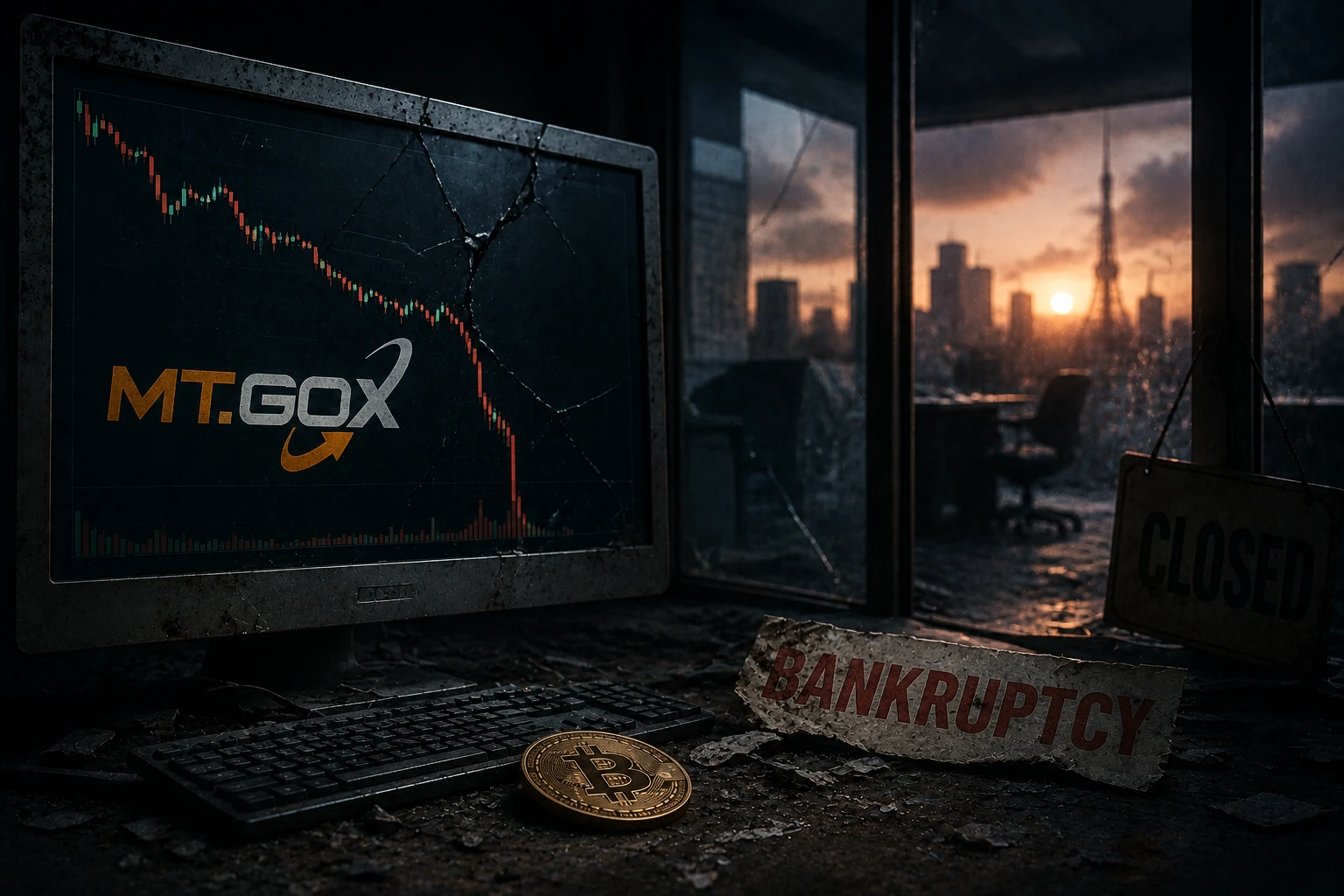
The setup: a card-game site that became Bitcoin's main exchange
Mt. Gox started in 2010 as "Magic The Gathering Online Exchange" — a site for trading collectible card-game tokens — built by US programmer Jed McCaleb. Bitcoin was a tiny project then, and McCaleb repurposed his existing website for Bitcoin trading. In 2011 he sold the platform to French developer Mark Karpelès, who moved operations to Tokyo and grew it rapidly. By 2013 Mt. Gox was processing roughly 70% of all Bitcoin transactions worldwide. For most users buying their first BTC between 2012 and 2014, Mt. Gox was the exchange.
This is educational, not financial advice. The story matters because the same patterns — opaque operations, weak controls, single points of failure — have reappeared in every later crypto collapse from the FTX collapse to the Celsius collapse.
What actually happened: a slow-motion disaster
Mt. Gox did not collapse overnight. The losses accumulated quietly over years, masked by trading volume and a leadership unable or unwilling to confront the gap.
- 2011. The first known security incident. An attacker compromises an account and triggers a flash crash, briefly printing 0.01 USD/BTC prices. Mt. Gox reverses the trades and continues operating. Roughly 25,000 BTC are reportedly stolen around this period.
- 2011–2013. Steady, undetected loss of BTC from Mt. Gox's hot wallets. Forensic investigations later show coins being slowly siphoned out and laundered through other exchanges, notably BTC-e.
- 2013. Mt. Gox dominates trading but runs into severe technical and operational problems — withdrawal delays, customer service breakdowns, US regulatory scrutiny over a Dwolla account, and persistent rumours that something is wrong.
- February 7, 2014. Mt. Gox halts BTC withdrawals, blaming a Bitcoin protocol bug (transaction malleability). The price drops sharply.
- February 24, 2014. Trading is suspended. The website goes blank.
- February 28, 2014. Mt. Gox files for bankruptcy protection in Japan. The filing reports the loss of approximately 750,000 customer BTC plus 100,000 of the company's own — about 850,000 BTC total.
- March 2014. Karpelès announces that an old digital wallet has been found containing about 200,000 BTC. The recovered coins reduce the net loss but do not change the picture: hundreds of thousands of BTC are simply gone.
The proximate cause was theft over years from Mt. Gox's hot wallets, eventually attributed in part to Russian operator Alexander Vinnik via BTC-e. The deeper causes were operational: weak custody practices, no real reconciliation between customer balances and on-chain holdings, and a single person — Karpelès — controlling far too much without adequate checks.
Who was involved
- Mark Karpelès. CEO and majority owner of Mt. Gox from 2011 to collapse. Arrested in Japan in 2015 and charged with embezzlement and data manipulation. In 2019 a Tokyo court acquitted him of embezzlement but convicted him of data manipulation, imposing a suspended sentence.
- Jed McCaleb. Original creator of the platform; sold it before the losses and went on to co-found Ripple and Stellar. Not implicated in the fraud.
- Alexander Vinnik. Russian operator of BTC-e, later charged with laundering large amounts of Mt. Gox-stolen BTC. Extradited and convicted in France and the United States.
- Nobuaki Kobayashi. The bankruptcy trustee appointed by the Tokyo court. Spent years sorting through the wreckage, eventually shifting from bankruptcy to civil rehabilitation in 2018 — a change that would matter enormously for creditor recoveries.
- Hundreds of thousands of customers. Mostly retail Bitcoin users worldwide, many of them losing significant savings, with no recourse beyond the slow Japanese legal process.
The aftermath: a decade of bankruptcy, then unexpected recoveries
The collapse shaped the next several years of crypto.
- The 2014–2015 bear market. Bitcoin's price fell from over $1,000 in late 2013 to under $200 by early 2015. Mt. Gox was not the only cause, but it was the proximate trigger of broader collapse in confidence.
- A regulatory wake-up call. Mt. Gox prompted serious regulatory attention to exchanges in Japan and elsewhere. Licensing regimes, capital requirements and audit standards in many jurisdictions trace back to its failure.
- A custody discipline was born. The phrase "not your keys, not your coins" predates Mt. Gox but became real after it. The hardware wallet industry — Trezor, Ledger and others — grew out of the lesson that exchange custody is not the same as ownership.
- The legal process took a decade. The trustee initially planned to liquidate Mt. Gox's remaining BTC for fiat and distribute it to creditors at 2014 prices. In 2018, after creditor pressure, the case was converted to civil rehabilitation — meaning creditors would be paid back in BTC, not fiat at 2014 valuations.
- Repayments finally started in 2024. More than ten years after the collapse, creditors began receiving BTC distributions through exchanges including Kraken and Bitstamp. Because the price had risen by orders of magnitude, many creditors received more value than the original deposit was worth in 2014 — though most also went through years of stress, partial settlements and uncertainty.
The lessons
Mt. Gox is the original case study of a failure that crypto has spent a decade trying to learn from. The honest lessons:
- Custody risk is real, even at a market leader. Mt. Gox handled most of the world's BTC trading. Size was not safety. Any exchange that holds your coins is your counterparty — and exchange counterparty risk is one of the largest you can take in crypto.
- Operational opacity is a warning, not a quirk. Mt. Gox's withdrawal delays, customer-service breakdowns and inconsistent communication were the visible symptoms of a deeper problem. When an institution becomes hard to interact with, the right response is to reduce exposure, not to wait.
- Hot wallets are dangerous at scale. Concentrating large amounts of customer BTC in always-online wallets, without adequate auditing or reconciliation, is what allowed the losses to accumulate undetected.
- Concentration risk in leadership is concentration risk in the platform. A single founder controlling operations, custody and accounting, without external checks, is a structural vulnerability.
- The pattern repeats. FTX, Celsius, Voyager, Mt. Gox — different scale, different jurisdiction, similar failure modes. "Trust me, I'm bigger than the others" has never been a defence.
It is worth being clear about what Mt. Gox does not prove. It does not prove that all exchanges are unsafe; reputable, audited, regulated exchanges with cold-storage practices are very different from 2013 Mt. Gox. It does prove that the question "who actually holds my coins?" is not paranoid — it is the foundational question of crypto custody.
Watch where the next stress shows up
Every cycle, the same dynamic repeats: a fast-growing platform attracts users with attractive features, then runs into operational, financial or custody stress. The early signals — withdrawal delays, missed disclosures, anomalous on-chain flows — are usually visible before the full collapse. Zippfeed tracks exchange and custody headlines across many sources with sentiment and importance scoring, so you can watch how the story unfolds — and reduce exposure before the moment when reducing exposure is no longer possible. This is educational, not financial advice.

 CryptoSlate
 WatcherGuru
 Lookonchain