What a tokenized stock actually is
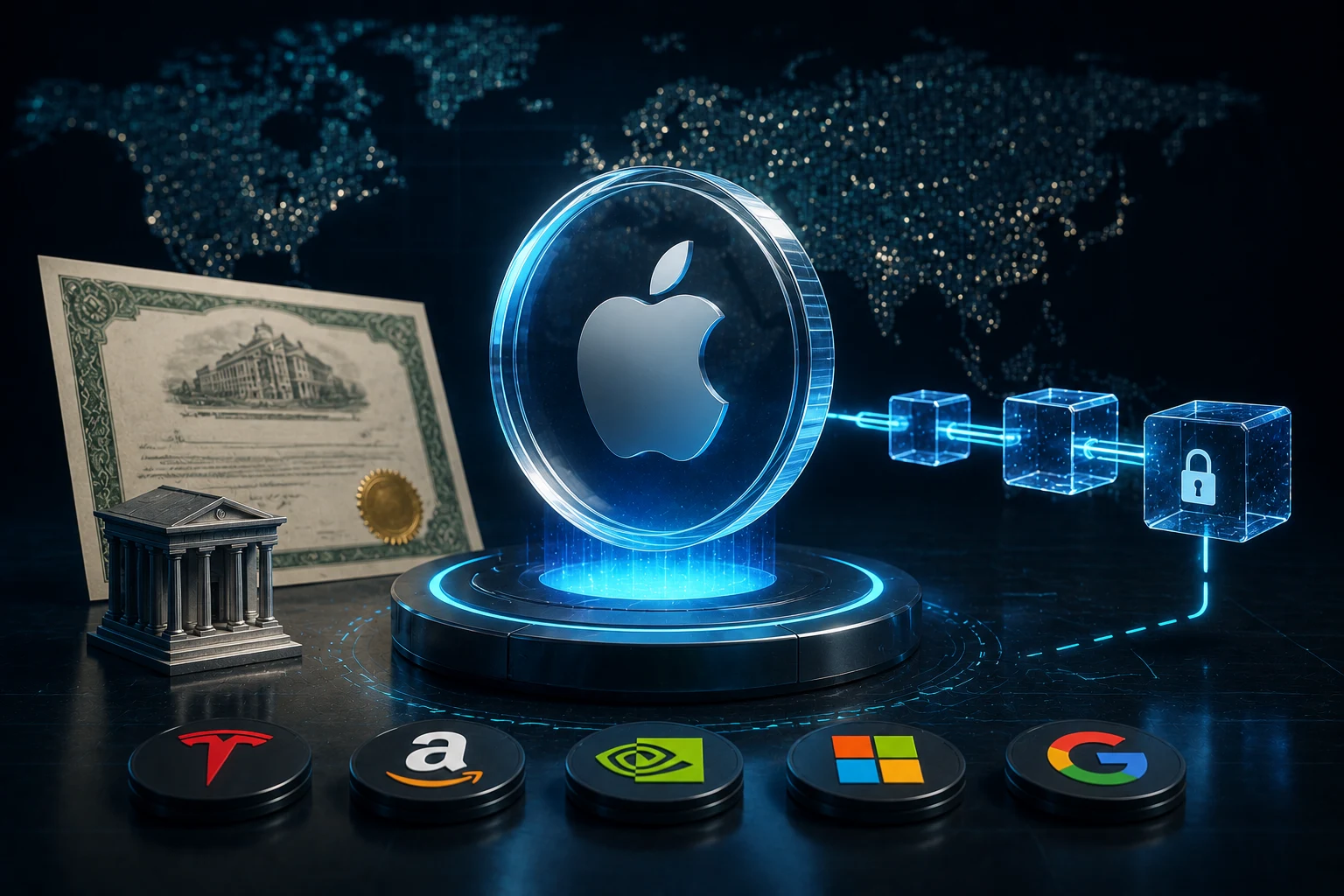
When a crypto platform advertises a token that lets you trade 'Apple 24/7' or 'Tesla on-chain,' it sounds like the share itself has been moved onto a blockchain. It has not. In nearly every product on the market today, the underlying shares still sit in a brokerage or custodian account owned by a regulated entity. The token you hold is a claim on those shares, structured as a debt instrument or a derivative wrapper, issued by a fintech that sits between you and the custodian.
This distinction is not a technicality. A shareholder at a brokerage owns a beneficial interest in the stock, with voting rights, dividend entitlements, and protections from securities regulators. A token holder owns a token issued by a company that, in turn, owns or hedges the exposure. Your legal relationship is with the issuer of the token, not with Apple or Tesla. That changes everything about what happens if something goes wrong.
The marketing rarely emphasizes this. Phrases like 'fully backed,' '1:1 redeemable,' and 'on-chain equity' are designed to imply the equivalence. The legal documents almost always tell a more cautious story, and reading them is the only way to know whether you hold a structured note, a synthetic exposure through derivatives, or, in rare cases, actual shares held by a regulated custodian on your behalf.
The real risks of tokenized equity
Tokenized stocks concentrate several failure modes in one product, and most of them are invisible until stress hits. The categories below cover what has actually broken, not what could theoretically break.
Issuer default and insolvency. The token is a liability of the issuer. If that issuer runs into financial trouble, becomes insolvent, or simply disappears, your claim sits in line with other unsecured creditors. The token does not give you a direct claim on the underlying shares held by the custodian. Recovery can take months or years, and during that time the price of the token can drift far from the underlying stock because the redemption channel is closed.
Custodian and jurisdictional risk. The shares that 'back' the token are typically held by a custodian in a specific jurisdiction. That custodian's rules, its regulators, and its bankruptcy regime all apply. If the custodian fails, the shares may be ring-fenced or distributed to clients of the custodian rather than to token holders. Cross-border structures add another layer of legal complexity, because the rights of a token holder in one country against a custodian in another are not always clear.
Redemption friction and gating. Most tokenized equity products impose minimum redemption sizes, KYC checks, processing delays, and cutoff times. You cannot simply walk to an ATM and swap your tokenized AAPL for cash at 3 a.m. on a Sunday. Some products require redemption to be requested during business hours, and settlement can take several business days. During high-volatility periods, redemptions may be paused entirely.
Operational and smart-contract risk. On top of the legal structure, you also depend on the smart contract that mints, burns, and transfers the token. Bugs, oracle failures, paused contracts, or compromised admin keys can all prevent you from exiting your position even when the underlying shares are perfectly fine. Examples from Backed Finance, Securitize-issued products, and smaller on-chain equity platforms have all experienced temporary pauses or migrations that locked user funds for days at a time.
Synthetic exposure versus direct share custody
There are essentially two ways a tokenized equity product can give you 'exposure' to a stock. The first is by holding the actual share, or a basket of shares, with a custodian and issuing tokens against them. The second is by holding nothing at all and creating a synthetic position through total return swaps, CFDs, or other derivatives. Both can be called 'tokenized stocks' on a landing page, but they carry very different risks.
Direct backing means the issuer buys or already holds the shares and tokens represent a pro-rata claim on that pool. If structured correctly and supervised by a securities regulator, this is closer to a traditional fund wrapper. The investor's claim is on specific assets held by a custodian, and the prospectus should describe how those assets are held, audited, and segregated. The downside is that you are still relying on the issuer's solvency and the integrity of the segregation arrangement.
Synthetic exposure means the issuer holds no shares at all and instead uses derivatives to replicate the price return. Counterparty risk shifts from 'do they have the shares' to 'will the derivatives counterparty pay.' If the swap provider fails, your token becomes a claim against an insolvent issuer with no underlying collateral. This is essentially the same risk architecture as a synthetic ETF, but without the same regulatory oversight in many jurisdictions.
For a retail user, the practical question is which model you are buying. The product page rarely tells you outright. The legal documents, the whitepaper, the issuer's regulatory status, and the audit reports are where this information lives. If you cannot find any of those, you are trusting marketing copy over financial structure, and that is a dangerous place to be with your money.
Pre-market hours, dividends, and corporate actions
Real stocks trade on a regulated exchange with defined hours, and shareholders receive dividends, voting rights, and the benefit of corporate actions like splits and mergers automatically. Tokenized versions replicate some of these and quietly skip others, and the gaps are where users lose money or miss out.
Trading hours. Equities trade roughly 9:30 a.m. to 4:00 p.m. Eastern, with limited pre-market and after-hours sessions. Tokenized versions often advertise '24/7 trading,' but that usually means you can transfer the token on-chain at any time, not that the underlying price feed updates continuously. Some platforms freeze the price reference outside market hours, so you can move a token but the price stays pinned. Others use synthetic pricing that can diverge sharply from the next session's opening print.
Dividends. When a real company pays a dividend, shareholders receive cash proportional to their holdings. Tokenized products sometimes pay an equivalent amount in stablecoins like USDT or USDC, sometimes reflect it in the token's net asset value, and sometimes do nothing at all. The treatment is disclosed in the product documentation, but it is rarely highlighted in the marketing. If you are holding tokenized AAPL for income, this is the section to read carefully.
Corporate actions. Stock splits, mergers, spin-offs, and tender offers are processed automatically by custodians and brokers for real shareholders. Tokenized versions need to be handled manually by the issuer, and the timeline is not always predictable. In some cases, the token is paused during a corporate action and reopened at an adjusted price. In others, the issuer passes through the economic effect but the timeline lags the real market.
Jurisdictional restrictions on US persons and others
Almost every tokenized equity product on the market today explicitly excludes US persons, and often also excludes residents of other restricted jurisdictions like the UK, Canada, or specific EU countries. The reason is that offering a security-like instrument to retail investors in those jurisdictions requires registration, prospectus approval, or other regulatory steps that the issuer has not taken.
The exclusions matter because your crypto wallet does not check your nationality. You can connect from anywhere and buy the token. The issuer's terms typically reserve the right to force redemption or even blacklist addresses if they determine the holder is restricted. In practice, this means a US user who buys a tokenized stock today may find their tokens redeemed at an inconvenient price, frozen pending KYC, or simply inaccessible if the issuer tightens its compliance program.
Even users in permitted jurisdictions should check whether the product is registered locally. Some platforms operate under a license that covers the issuer but not the distribution to retail users, and the legal status of the token can vary by country. The 'available in your country' badge on a website is not a legal opinion, and regulators have shown little patience for platforms that treated it as one.
Practical implications for retail users
If you are still considering a tokenized equity product, the goal is not to avoid the category entirely but to understand what you are buying and price the risks accordingly. A few practical steps reduce the chance of an expensive surprise.
Read the legal wrapper, not the landing page. The prospectus or offering document describes whether you hold a structured note, a synthetic derivative, or a direct claim on shares. If the document uses words like 'tracked,' 'mirrors,' or 'replicates' without specifying the legal structure, treat that as a flag.
Check the issuer's regulatory status and the custodian's identity. A product issued by a regulated entity in a jurisdiction with strong securities oversight is meaningfully different from one issued by an offshore company with no licensed custodian. Audited reports, segregated client accounts, and named custodians are positive signals, but they are not guarantees.
Size the position for the worst case. Because redemption can be delayed, paused, or routed through a winding-up process, tokenized equity positions should be sized smaller than equivalent positions in liquid stocks. Treat them as a higher-friction substitute, not a drop-in replacement for a brokerage account.
Be alert to the 'just equities, on-chain' framing. Tokenized stocks are a hybrid product with hybrid risks. They are not equivalent to holding the underlying share, they are not equivalent to holding a regulated ETF, and they are not equivalent to holding a derivative on a centralized crypto exchange. They are their own thing, and the marketing has an incentive to flatten that distinction.
How to follow tokenized equities the smart way
Tokenized equities move fast, and the news cycle around them is louder than the disclosure cycle. Headlines about new issuers, new chains, and new backing arrangements outpace the actual legal and operational changes in these products. Tracking issuer solvency, jurisdictional changes, and redemption status manually is a losing game. Zippfeed surfaces tokenized-equity headlines with sentiment scoring, bullish, neutral, or bearish, and an importance rating, so you can separate real structural changes from launch announcements and act on the ones that actually affect your position.




 CoinDesk
 CryptoSlate
 Crypto Rank News