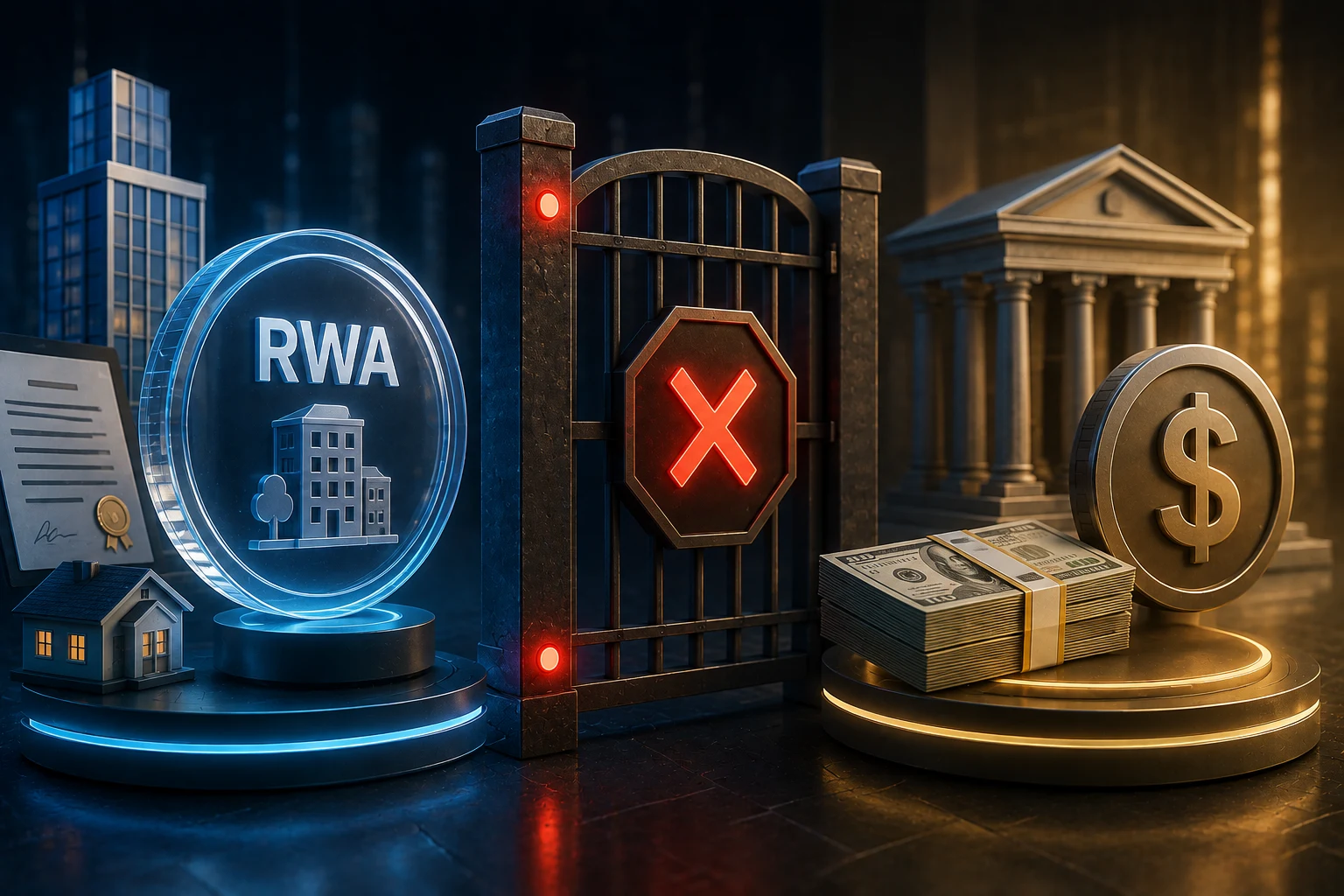
How both products actually make money
At the most basic level, every tokenized Treasury product on the market, including BUIDL (BlackRock), OUSG (Ondo), USDY (Ondo), USYC (Circle's Hashnote subsidiary), JTRSY (Janus Henderson), and JAAA (Janus Henderson), does roughly the same thing as a US Treasury money-market fund. They buy short-dated US government debt (Treasury bills with maturities under 13 weeks), reverse repurchase agreements collateralized by Treasuries, and sometimes very short-duration Treasury notes. The yield is essentially the short-rate environment plus a haircut for fees.
The structural difference is where the ownership lives. A money-market fund is a regulated investment company (usually a 2a-7 fund in the United States) that issues registered shares held in brokerage or fund accounts. Settlement happens through the traditional banking system: ACH, Fedwire, or the DTCC book-entry system. A tokenized Treasury product, by contrast, issues a blockchain token (most often on Ethereum or another smart-contract chain) that represents a claim on the same kind of underlying assets, but the token itself moves on-chain 24/7.
This is why the comparison is genuinely interesting. On a yield chart, BUIDL and JAAA often track within a few basis points of each other, because they're competing for the same short-end paper. The differences show up in everything else: who can subscribe, when they can exit, what the fees look like, and what rights the issuer reserves over your collateral.
The risk picture most comparisons skip
Both products carry credit risk on the underlying US government, which is the lowest-risk credit in the world but still not literally zero. Beyond that, the risk profile diverges in ways that matter for anyone parking meaningful cash.
Bank-rail risk on the way out. Even if you can sell a tokenized Treasury token to a secondary buyer in seconds on a DEX, the issuer's primary redemption mechanism is almost always a wire transfer back to your bank. That wire happens during banking hours, on banking days. If a US bank holiday lands inside your redemption window, settlement slips. If the issuer's banking partner has an outage (it has happened with multiple RWA issuers during the 2023 banking stress), your redemption queues behind everyone else.
Sequencing risk on-chain. Tokenized products introduce a new failure mode that money-market funds do not have: smart-contract risk. A bug in the mint or burn logic, a reentrancy vulnerability, or an oracle failure can freeze assets. Audits reduce but do not eliminate this risk, and there is no SIPC or FSCS backstop if a contract is exploited.
Rehypothecation rights. Several tokenized Treasury issuers retain the right to re-use (rehypothecate) the underlying Treasuries held in custody. This is common in prime brokerage, but it's not transparent on-chain. A money-market fund's portfolio holdings are disclosed in detail in its prospectus and monthly reports. Rehypothecation rights in tokenized products are typically buried in the issuer's subscription documents.
Regulatory and de-pegging risk. Money-market funds in 2023 broke the buck during the regional banking crisis, and the SEC responded with new rules to push institutional prime and tax-exempt MMFs toward government-only portfolios. Tokenized products are not currently subject to the same disclosure regime. If a major tokenized Treasury issuer faced a run, there's no equivalent of the Fed's temporary backstop facility that helped MMFs in March 2023.
Redemption windows and what they really mean
This is where the products part ways most concretely, and where the marketing language tends to mislead.
A US Treasury money-market fund for institutional investors (the kind you'd buy at Fidelity, Vanguard, JPMorgan, or BlackRock) typically offers T+0 or T+1 settlement. You place a redemption order before a cutoff time (often 4pm or 5pm Eastern), and cash lands the same day or next business day. Retail money-market funds usually settle T+1 or T+2. There is no minimum holding period and typically no minimum redemption size.
Tokenized Treasury products look very different. Most require minimum subscriptions of $100,000 or more, and redemptions happen on weekly or monthly cycles rather than daily. BUIDL, for example, requires minimum subscriptions and processes redemptions on a defined schedule (the exact terms depend on the share class and the off-chain subscription agreement). OUSG has historically operated on a weekly redemption cadence. USDY was designed for non-US investors and has its own eligibility and redemption structure.
The phrase "instant redemption" that you see in tokenized Treasury marketing almost always refers to secondary-market trading on a DEX or a partner like Ondo's OUSG liquidity, not to primary redemption from the issuer. If liquidity on that DEX dries up (as it did briefly for several RWA tokens in March 2023), "instant" becomes hours or days while the order book thins.
The practical implication: if you need to move $100,000 within 24 hours, an institutional money-market fund is almost certainly faster than a tokenized Treasury. If you need to use that $100,000 as on-chain collateral for a DeFi position at 2am on a Sunday, the tokenized Treasury wins handily.
Fee structures compared
Money-market fund fees are simple to read but easy to underestimate. The fund charges an expense ratio (often 5 to 30 basis points for institutional government MMFs) and passes through the yield net of that fee. There are no subscription or redemption fees in the traditional sense. The yield you see is the yield you get, minus the small expense ratio.
Tokenized Treasury products layer fees differently. The issuer charges a management fee (often 5 to 15 basis points), and on top of that, the structure typically carries:
- A subscription fee or "mint" fee, sometimes zero for direct subscriptions but non-zero through partner platforms.
- A redemption fee, which can range from zero to several basis points and may step down the longer you hold.
- A spread between the on-chain NAV (typically $1.00 per token) and the actual issuance or redemption price, which can effectively be a hidden fee.
- Gas costs to mint or burn, which matter for small positions but become negligible for institutional sizes.
The headline yield on a tokenized Treasury product is often 10 to 30 basis points lower than a comparable money-market fund once all fees are accounted for. The on-chain composability is supposed to make up the difference, but only if you actually use that composability. If you simply hold the token in a wallet and wait for yield, you're paying a premium for a feature you're not using.
Eligibility gating and who can actually buy
Money-market funds are open to virtually any investor in the US, with some differences between retail and institutional share classes. KYC happens once when you open the brokerage or fund account. Minimums are typically zero to a few thousand dollars.
Tokenized Treasury products are gated differently. BUIDL is restricted to qualified purchasers and accredited investors who go through KYC and AML with the issuer (Securitize). OUSG has historically been limited to non-US persons and accredited investors, though Ondo has expanded access over time. USDY was specifically designed for non-US investors, partly to avoid US securities-law complications. USYC has its own eligibility criteria.
The gating exists for real reasons: the issuers want to avoid running afoul of US securities laws, and they want investors who can absorb the loss if something goes wrong. The practical effect, though, is that the headline "tokenize your Treasuries" pitch is not available to most retail US investors without going through a partner platform that wraps its own compliance layer around it.
What GENIUS and MiCA actually change
Two regulatory developments are worth tracking if you're holding either product. In the United States, the GENIUS Act (Guiding and Establishing National Innovation for US Stablecoins) creates a federal framework for payment stablecoins but does not directly regulate tokenized Treasuries. What it does do is establish clearer rules around what counts as a permissible reserve asset for stablecoins, which indirectly affects how issuers structure tokenized Treasury products that sit behind stablecoins.
MiCA, the European Union's Markets in Crypto-Assets regulation, is more directly relevant. MiCA distinguishes between asset-referenced tokens (ARTs) and electronic money tokens (EMTs), and tokenized Treasury products that meet certain criteria may need to be authorized as ARTs. For European investors, this means MiCA-compliant tokenized Treasury products will eventually come with capital requirements, white-paper disclosures, and supervision by national regulators. Products that don't comply may not be lawfully offered to EU residents after the transition period.
The bottom line: regulation is moving toward more transparency, but the timeline is uneven across jurisdictions. US investors buying tokenized Treasuries today are largely buying under existing securities and commodities law, not under a dedicated tokenized-RWA framework.
How to choose between them in practice
For someone deciding where to park $100,000 of stable cash, the decision comes down to what you plan to do with it. If the cash needs to be available within hours, a money-market fund at a major broker is faster, simpler, and cheaper. If the cash is going to be deployed on-chain as collateral, lent out, or used in DeFi strategies, a tokenized Treasury makes sense despite the higher fee load, because moving MMF shares on-chain requires an extra conversion step (and an extra layer of fees and timing risk).
A reasonable hybrid approach is to keep operating cash in a money-market fund for speed, and to hold a separate allocation in a tokenized Treasury for the portion you intend to use on-chain. Treat the tokenized Treasury as infrastructure for a specific use case, not as a generic cash replacement.
Whichever you choose, read the subscription documents for rehypothecation rights, the redemption mechanics (frequency, minimums, cutoff times), and the identity of the custodian and banking partner. These details determine what actually happens when you try to get your money back on a Wednesday afternoon during a bank holiday.
Stay ahead of tokenized yield products
Tokenized Treasuries and tokenized money-market funds are evolving fast, with new issuers, new chains, and shifting fee structures arriving monthly. Tracking which products offer real liquidity versus marketing-deck liquidity is a full-time job. Zippfeed surfaces tokenized Treasury and RWA headlines with sentiment scoring (bullish, neutral, or bearish) and an importance rating, so you can spot the launches, the gating changes, and the redemption-policy shifts before they hit your portfolio.






 CoinDesk
 TheBlock
 Crypto News