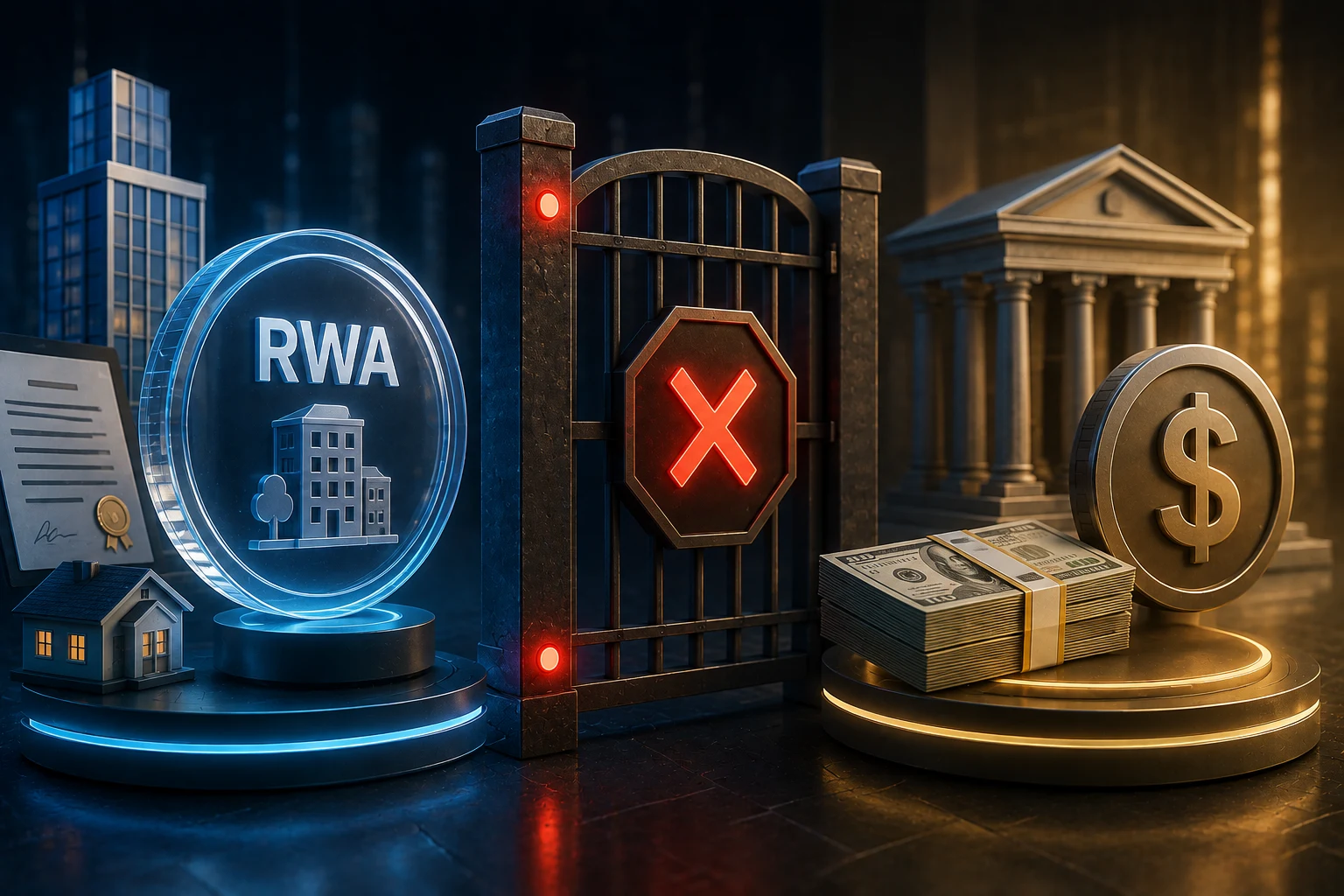
What does it actually mean to redeem a tokenized treasury?
The word redeem gets used loosely in the tokenized treasury market. When a fund like BlackRock's BUIDL, Ondo's OUSG, Maple's USYC, or Ondo's USDY publishes that its token is redeemable for one US dollar, the marketing usually skips the footnotes. The token itself never converts on-chain into dollars. The underlying token, whether an ERC-20 on Ethereum or a token on another chain, represents a share of a fund that holds short-duration US Treasury bills, and the fund settles redemptions through the traditional banking system.
To redeem, a holder typically has to submit an instruction to the issuer, an authorized participant, or a transfer agent, and then wait for the underlying fund to sell a slice of its T-bill portfolio and wire dollars to the holder's bank account. That is not very different from redeeming shares in a money market fund, except that the holder owns a blockchain token in the middle of the process.
The token is a wrapper, not a vault. When someone says the token is backed one-for-one, they mean a regulated fund holds Treasury bills equal to the circulating supply of tokens. The promise is that any holder can exchange the token back for a dollar claim, not that the token will instantly become a dollar on-chain.
What are the real risks of redeeming a tokenized treasury?
The risks fall into a few categories, and most retail holders underestimate them because the marketing focuses on the yield, not the plumbing.
Institutional minimums and lockouts. Direct redemption is almost never open to anyone with a $500 wallet. Most products require minimums of $250,000, and the largest institutional share classes go higher. A small holder who buys a tokenized treasury token on a DEX or through a retail broker is buying a restricted pass-through to a wholesale product. They cannot redeem directly. They rely on a secondary buyer, a market maker, or an authorized participant willing to absorb the position.
Settlement delays. Even when redemption is allowed, T+1 to T+3 settlement is standard. That means a holder who requests redemption on a Monday may not see dollars until Thursday or Friday, and a request submitted late on a Friday afternoon has to survive a weekend and a Monday holiday. This is normal for traditional money market funds, but it is not normal for crypto users who assume they can move value instantly.
Holiday and auction-day disruptions. US Treasury bills settle on a calendar that respects US bank holidays and Treasury auction schedules. If a redemption request lands on the day of a T-bill auction, or over the Christmas and New Year window when Treasury markets thin out, the fund may delay settlement. The 2024 and 2025 holiday calendars produced measurable backlogs at several issuers.
Operational and counterparty risk. Tokenized treasury funds depend on the issuer, the fund administrator, the custodian, and the bank wiring the dollars. A glitch at any of those links can stall redemption. Securitize, the transfer agent and tokenization platform behind BUIDL and several other products, experienced multi-day redemption delays in 2024 and 2025 that were documented by holders on-chain and in public forums. These were not bankruptcies or losses of principal, but they punctured the assumption that the redemption pipe runs 24/7.
Secondary-market discount risk. A holder who cannot meet the institutional minimum and needs to exit before a stress event may have to sell the token on a secondary venue. Tokenized treasury tokens have generally traded close to one dollar, but during episodes of crypto-wide de-risking the bid-ask spread has widened and the realized exit price has slipped below par. The token is supposed to be worth a dollar, but the only guaranteed one dollar is the one you collect through formal redemption, which most small holders cannot access.
How do redemption queues and cash drag work?
When holders talk about a redemption queue in the tokenized treasury world, they are usually describing the delay between submitting a redemption request and receiving dollars. The size of the queue depends on how the fund is structured.
Some funds hold cash alongside T-bills to absorb same-day redemptions. This is called a cash buffer, and it is what makes fast settlement possible. The cost is cash drag: cash earns less than T-bills, so a fund that holds ten percent cash is diluting the yield it can pass to holders. Issuers that advertise tight settlement usually hold more cash and earn slightly less. Issuers that advertise higher yield hold less cash and depend on T-bill maturities to fund redemptions, which is slower.
Other funds operate a daily or weekly redemption window. Holders submit requests by a cutoff time, the fund processes them in batches, and settlement happens a day or two later. If redemptions spike, the fund may need to sell T-bills before maturity to raise cash, and that creates a queue.
The practical effect is that tokenized treasuries are not the money-legos primitive they appear to be. They are a yield-bearing wrapper that converts into dollars on the issuer's clock, not the holder's. Treating them as a cash equivalent is a category error that the marketing does little to discourage.
What are the institutional minimums in practice?
The minimums vary by product, and they reveal who each fund is actually built for.
BUIDL, BlackRock's USD Institutional Digital Liquidity fund, requires a high minimum and is designed for institutional desks, treasury teams, and authorized participants. Retail buyers typically access BUIDL indirectly through partners or wrapped products, not through direct redemption. OUSG and OUSD from Ondo Finance offer lower minimums in some share classes but still price direct redemption for institutional accounts. USDY, also from Ondo, offers a yield-bearing token with redemption mechanics aimed at non-US institutional and accredited investors.
The honest framing is this: tokenized treasuries at the institutional level are a wholesale product with a blockchain wrapper. The retail buyer who picks up a small position on a DEX is a downstream user, often several layers removed from the redemption right itself. The token can still be sold, but that sale depends on someone else wanting to buy it, and the price may not be exactly one dollar.
There is nothing wrong with this structure, and it is normal for wholesale money market products. The risk is that retail buyers do not realize they are participating in a wholesale system. They see a token, see the yield, and assume they own a digital dollar. They do not. They own a claim on a fund that pays dollars under specific conditions.
What happened during Securitize redemption delays in 2024 and 2025?
Securitize is the tokenization platform and transfer agent behind BUIDL and several other tokenized treasury products. In 2024 and again in 2025, holders reported redemption delays that stretched past the published settlement window. The triggers varied: a mismatch between on-chain redemption requests and the off-chain banking handoff, a service provider outage, and at least one instance tied to a US holiday weekend that exposed gaps in the operational calendar.
The delays were not catastrophic. No principal was lost. Holders eventually received their dollars. But the episodes were revealing. The tokenized treasury industry has spent two years marketing itself as the 24/7, programmable, always-on alternative to traditional money market funds. When the redemption pipe stalled, the holders who needed liquidity discovered that the pipe runs on banker's hours.
For a retail or crypto-native holder, the lesson is straightforward. Do not assume that a yield-bearing token that pays a Treasury yield will behave like a stablecoin during a stress event. USDC and USDT are designed for fast redemption at retail scale, and even they have wobbled. Tokenized treasuries are designed for institutional cash management with a token overlay, and they will prioritize their largest clients during a crunch.
Why do most holders never test redemption until a stress event?
Tokenized treasury tokens are popular because they offer a yield that beats a savings account and integrate with on-chain protocols. Holders often buy them to use as collateral, to earn yield on idle stablecoins, or to plug into DeFi strategies. They do not plan to redeem them. They plan to hold them, or to use them as a building block.
This is fine until the building block is the thing that needs to be liquidated. If a DeFi position gets liquidated and the holder needs dollars fast, the tokenized treasury token has to be sold or redeemed. If the holder is below the institutional minimum, they cannot redeem. They have to sell on the secondary market, and the bid may not be at par. If the stress event is a crypto-wide de-risking, the bid will be worse than par.
This is why the question of whether a tokenized treasury is truly redeemable matters even for holders who never plan to redeem. The redeemable claim is what gives the token its price stability. If the claim weakens in the eyes of the market, the price wobbles. The 1:1 promise is load-bearing, and it depends on a redemption mechanism most holders never use.
What should a holder actually do with this information?
If you are considering a tokenized treasury token, the practical checklist is short. First, check the minimum for direct redemption. If you are below it, understand that you are a secondary-market buyer and your exit depends on liquidity, not on the issuer. Second, read the prospectus or offering documents for the fund, not the marketing page. The redemption window, the cutoff times, the holiday calendar, and the authorized participants are all in the fine print. Third, size the position so that you are comfortable holding it through a multi-day settlement delay. If you need same-day liquidity, this is the wrong product.
For DeFi users using tokenized treasuries as collateral, the same logic applies with extra weight. A token that settles in three days is not the same as a stablecoin that settles in seconds. If your position depends on fast liquidation, build in a buffer for the slower settlement, or use a product that wraps the tokenized treasury into something more liquid.
The honest summary is that tokenized treasuries are a useful product, not a magic one. They give on-chain users a way to earn a Treasury yield, and they let institutional desks manage cash with blockchain plumbing. But they are not digital cash, and they are not frictionless. The redemption right is real, but it is gated, delayed, and subject to operational risk. Anyone who treats the token as equivalent to a dollar in a wallet is going to be surprised the first time they try to convert.
Follow tokenized treasury flows the smart way
Tokenized treasury news moves fast, and the gap between marketing copy and operational reality is wider than most readers realize. New products launch monthly, minimums shift, redemption mechanics get revised, and stress events surface frictions that did not exist in the brochure. Tracking which issuers are widening access, which ones are tightening queues, and which ones have hit operational snags is a full-time job if you try to do it by hand.
Zippfeed surfaces tokenized treasury headlines with sentiment scoring, flagging whether the news reads as bullish, neutral, or bearish for the product and the broader RWA category, and assigns an importance rating so the material changes rise above the noise. That makes it easier to see when an issuer's redemption window has stretched, when an authorized participant has stepped back, or when a new product is opening retail access. For anyone treating tokenized treasuries as a real allocation, that signal is worth more than the headline yield.




 CoinDesk
 TheBlock
 Crypto News