What "institutional custody" actually means for an RWA token
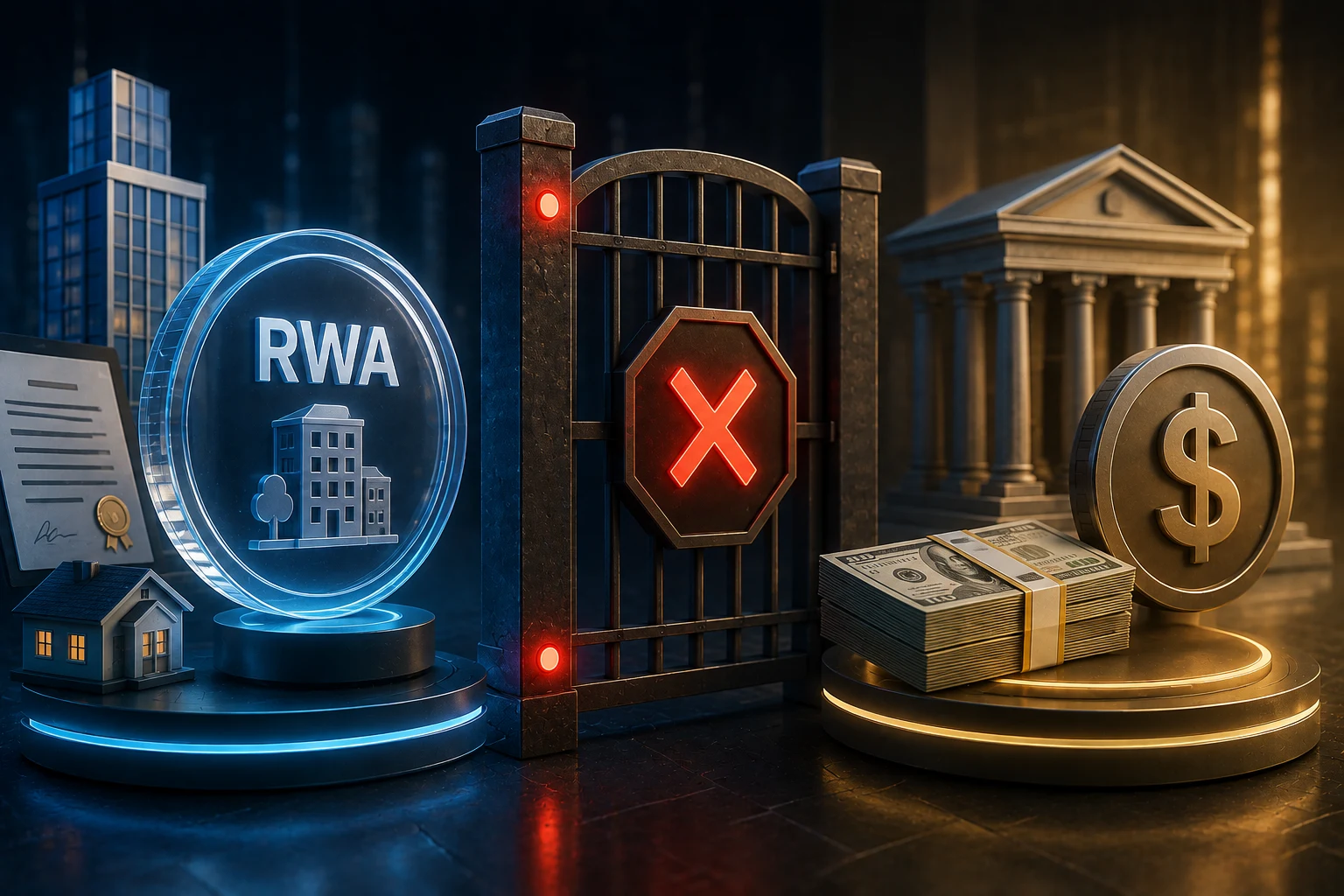
When a press release says an asset manager is "tokenizing Treasuries," the token is the smallest part of the system. The asset is a U.S. Treasury-bill fund, typically a Delaware statutory trust or a Cayman exempted company, run by an SEC-registered investment adviser and held by a qualified custodian such as BNY Mellon, State Street, Anchorage Digital Bank, or Coinbase Institutional. The token is a claim on shares of that fund, not on the underlying bills themselves. That distinction is the reason the contract can be paused, restricted, or rewritten without the underlying yield changing.
The token side usually lives on a permissioned or semi-permissioned EVM chain such as Ethereum mainnet, Arbitrum, Avalanche, or a private instance, and it conforms to a known token standard. BUIDL from BlackRock uses a wrapped structure that mints on Ethereum and is mirrored across other chains through LayerZero-style messaging. OUSG from Ondo Finance and USDY from Ondo use similar patterns, while USYC from Circle's Hashnote subsidiary settles on a permissioned environment with controlled redemption windows. In each case, the public ledger is the receipt system; the rule book sits in three off-chain documents: the fund's offering memorandum, the smart-contract admin policy, and the transfer-agent operating procedures.
For a sophisticated reader, the practical question is who can issue, freeze, burn, or transfer a token, and under what conditions. The answer is always the same: a small, named group of operators working under a written policy, with no single operator able to act alone.
Risks unique to the institutional RWA control surface
The control surface is also the attack surface. Anyone evaluating an institutional tokenized Treasury should be skeptical of any fund whose token contract is fully permissionless, whose admin keys sit in a single hot wallet, or whose redemption logic can be changed without multi-party approval.
Historical incidents show the pattern. The 2022 Wormhole exploit did not involve an RWA fund directly, but it showed that bridge admin keys can mint wrapped representations out of thin air. The Multichain incident in 2023 froze customer assets after its CEO disappeared with the operational keys to a cross-chain bridge that backed several dollar-pegged tokens. In RWA, the equivalent nightmare is an admin key being used to mint new shares against nonexistent collateral, or to drain the underlying custodian wallet into an unauthorized address. Funds mitigate this by combining on-chain allowlists with off-chain segregation of duties.
Other risks are less dramatic but more common. A misconfigured whitelist can lock out legitimate investors during a redemption window. A transfer-agent outage can pause issuance while the underlying bills continue to accrue interest, creating a NAV gap. A regulatory action against the underlying adviser can force a wind-down in which token holders become unsecured creditors of a fund in liquidation. None of these show up in the token contract itself. They live in the legal and operational paperwork that the token references but does not reproduce.
Qualified custodian vs segregated on-chain wallet
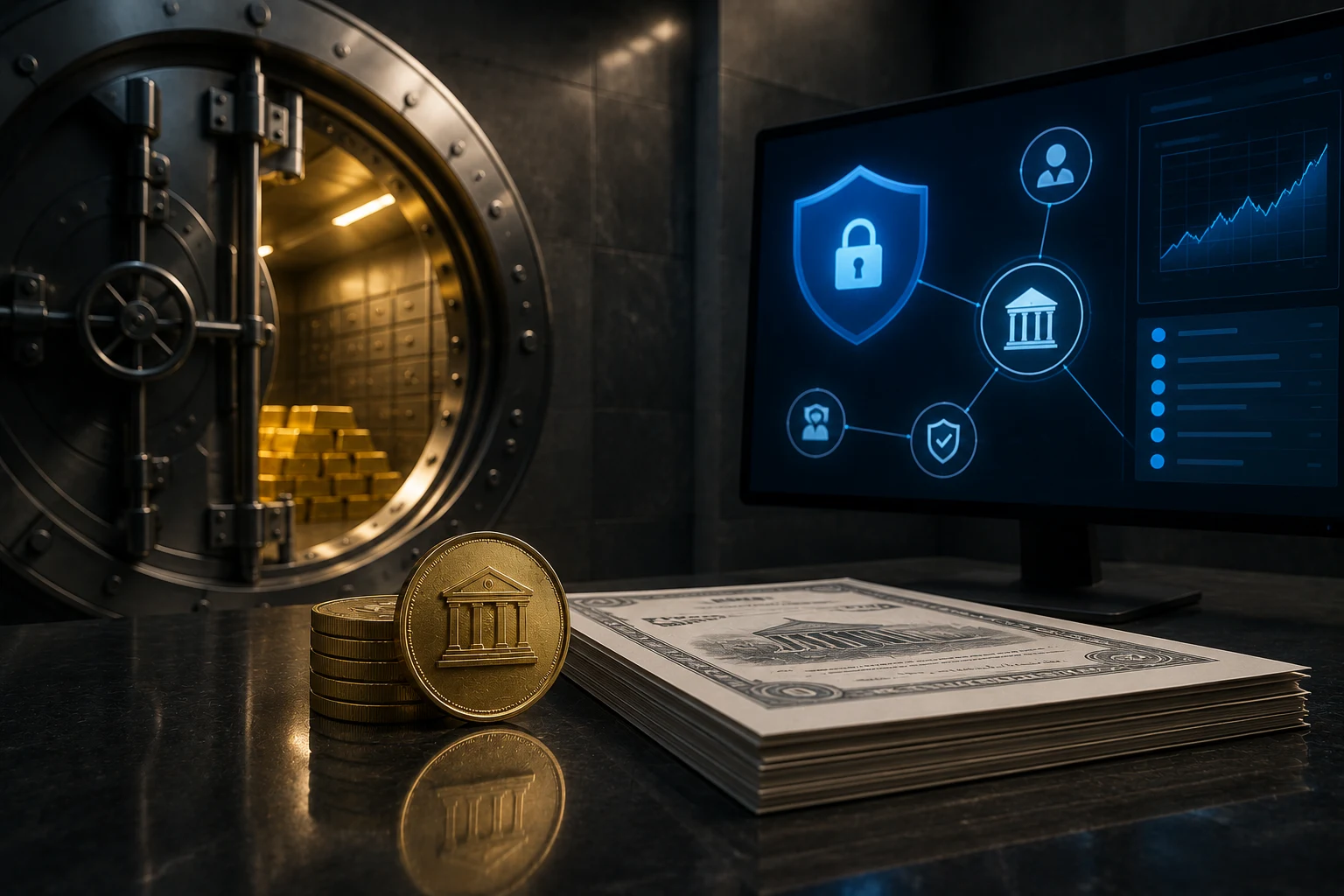
Two layers of custody sit on top of each other, and confusing them is the most common mistake in retail coverage. The first layer is the qualified custodian that holds the actual Treasury bills. This is a regulated bank or trust company subject to the Bank Secrecy Act, the Investment Advisers Act of 1940, and in the U.S. either the OCC, the FDIC, or a state trust charter. The qualified custodian holds the bills in a segregated account in the name of the fund, segregated from the custodian's own assets. If the custodian fails, the bills do not become part of the custodian's estate.
The second layer is the on-chain wallet that holds the token contract's reserve assets. For many funds, the on-chain wallet is itself operated by the qualified custodian or by a sub-custodian under contract. For others, the on-chain wallet is a multi-signature contract controlled by the fund's administrator, with signers drawn from the adviser, the transfer agent, and an independent technology vendor. In both cases, the on-chain wallet is segregated from the operating wallets of the issuer and is referenced in the fund's audited financial statements.
The risk to understand is that "tokenized" does not mean "self-custodied." Buying BUIDL or OUSG through a permissioned mint portal means accepting that the issuer, the qualified custodian, and the transfer agent all sit between you and your yield. The token in your wallet is a beneficial-interest receipt; the bills are held by a third party on your behalf through a chain of contractual relationships.
The transfer agent and what it actually does
A transfer agent in this context is the same role it plays in traditional mutual funds: the entity that maintains the official shareholder register, processes subscriptions and redemptions, and confirms who is allowed to own shares at any given moment. In a tokenized Treasury fund, the transfer agent's job is to reconcile the on-chain token holder list with the off-chain subscription records. When a new investor sends stablecoins to the mint address, the transfer agent's system matches the wallet address to a KYC-approved investor and tells the smart-contract admin to mint tokens to that address.
This is why permissioned tokens look slow compared with a Uniswap swap. There is no automated market maker matching buyers and sellers; there is a transfer agent running a workflow that may take several business hours. Redemptions work in reverse: the investor signs a redemption message from a whitelisted wallet, the transfer agent confirms identity and the available cash balance, and the smart contract burns the token while a wire or stablecoin transfer goes out the other side.
The transfer agent is also the party that signs the on-chain allowlist. Most institutional RWA tokens maintain a mapping of whitelisted addresses in contract storage. Only those addresses can hold, send, or receive the token. The transfer agent is typically one of the keys authorized to add or remove addresses, often alongside the fund's compliance officer and a third-party auditor as a witness signer.
KYC and AML gating at the smart-contract level
KYC and AML on retail crypto exchanges happen at the front door: you upload an ID, the exchange approves you, and from then on you can trade freely. On a permissioned RWA token, KYC and AML are enforced inside the token contract itself, which is why the contract is sometimes called a "regtoken" or a "compliant ERC-20." When a transfer is initiated, the contract checks both the sender and the recipient against the allowlist. If either address is not on the list, the transfer reverts.
The allowlist is the heart of the system. It is built from KYC records submitted by the investor, signed by the transfer agent, and committed to the contract by an admin signer. The same allowlist typically integrates sanctions screening, meaning addresses linked to OFAC-sanctioned persons or jurisdictions are rejected at the contract level rather than at the front-end.
This gating creates two practical consequences for sophisticated operators. First, secondary trading is structurally limited: a token can only be transferred to another verified address, which rules out most DEX liquidity and most over-the-counter desks that rely on anonymous counterparties. Second, recovery from a lost whitelisted address is hard. If your private keys are lost or stolen, recovering the underlying shares is a multi-party legal process, not a seed-phrase recovery on a fresh wallet. Several funds explicitly disclose in their offering documents that lost keys mean lost shares.
Whitelisting, blocklists, and the compliance perimeter
The allowlist is paired with a blocklist. The blocklist contains addresses flagged post-onboarding, usually because of subsequent sanctions hits, suspicious activity reports, court orders, or voluntary exit by the investor. When a blocklisted address tries to transfer, the contract blocks the transaction and may freeze the balance until the transfer agent can process a forced redemption.
Forced redemption is the most aggressive compliance tool. It allows the transfer agent, acting under contract, to burn a holder's tokens and return the proceeds to a verified bank account, bypassing the holder's wallet entirely. This is why holding a tokenized Treasury in your personal hot wallet, even after passing KYC, does not give you unconditional control. The fund's policy always wins.
For institutional allocators, the practical implication is that you should never mint directly into a wallet that is not operated under your firm's own custody policy. Most large buyers mint into wallets controlled by their own qualified custodian, so that the firm retains internal segregation while the fund retains its compliance perimeter.
Dual-control signing and key-ceremony governance
The on-chain admin keys are governed by dual-control signing, a model borrowed from traditional finance. The simplest version is a 2-of-3 multi-signature contract in which any single signer can propose an action but at least two must sign before the action executes. The signers are typically distributed across independent legal entities, often across jurisdictions, so that no single insider, no single company, and no single country holds enough keys to act unilaterally.
Key ceremonies formalize this. A key ceremony is a documented, audited process in which new signer keys are generated, distributed to their operators, and tested. Shamir's Secret Sharing or threshold signature schemes such as GG20 and Frost are increasingly common, because they allow a key to be split across hardware modules that never reconstruct the full key in any single place. After a ceremony, the resulting address set is published, the public keys are rotated into the contract, and the prior keys are destroyed or revoked.
For sophisticated operators, the questions to ask a fund's team are direct: how many signers, what threshold, what jurisdictions, what hardware, and what is the rotation schedule. A fund that cannot answer these questions, or that treats the answers as proprietary, is a fund whose control surface you cannot evaluate.
Operational reserves and why NAV stays close to one dollar
Tokenized Treasury funds claim to track the return of short-dated U.S. Treasury bills, which means the price of one share should stay close to one dollar while the accrued interest grows. To deliver this, the fund maintains an operational reserve in cash and overnight repurchase agreements that is larger than the expected daily redemption flow. When an investor redeems, the reserve pays out before the underlying bills mature, and the reserve is replenished as bills roll.
This is also why redemptions can have cut-off times, often 4 p.m. U.S. Eastern on T-plus-one, and why a redemption requested on a U.S. bank holiday settles on the next business day. The fund cannot pay out on days when the underlying custodian's cash account does not settle. Holding the token does not exempt you from the rhythm of the U.S. fixed-income market.
The on-chain reporting is the second half of the picture. Most institutional tokenized Treasury funds publish a daily net asset value either through a verifiable on-chain proof or through an attested report from an independent accounting firm. The on-chain price is what a smart contract can read to settle a derivative or a structured product. The attested report is what an auditor signs off on. The two should agree to within a few basis points on any given day.
Practical implications for operators and allocators
For a fund, a treasury, or a family office evaluating these products, the operational checklist is straightforward. Confirm the qualified custodian by name and by regulator. Confirm the transfer agent and confirm how investor onboarding translates into on-chain allowlist entries. Ask for the admin signer structure, the threshold, and the rotation policy. Ask for the operational-reserve policy and the daily NAV attestation. Treat any of these as proprietary and you have learned what you need to know.
For a protocol builder wrapping tokenized Treasuries into a structured product, the deeper question is what happens when a fund pauses redemptions. Several funds reserve the right to suspend redemptions during market stress, in which case your wrapper becomes illiquid even though the underlying bills are still accruing. Build your product to handle that contingency rather than assume 24/7 liquidity that the underlying fund does not offer.
For a trader, the honest summary is that these tokens trade more like money-market fund shares than like Bitcoin. The yield is real and the credit quality is high, but the upside is bounded by the underlying bill rate and the liquidity is bounded by the fund's redemption windows. They are a building block, not a bet.
How to follow tokenized-Treasury custody the smart way
Tokenized-Treasury custody evolves quietly, through updated offering memoranda, new auditor letters, and rotated signer sets, rather than through headline launches. Tracking which funds upgrade their admin keys, add new jurisdictions, or publish on-chain proof of reserves is the kind of signal that gets buried in PDFs. Zippfeed surfaces tokenized-RWA headlines with sentiment scoring (bullish, neutral, or bearish) and an importance rating, so you can spot custody changes before they reshape the product landscape.




 CoinDesk
 TheBlock
 Crypto News