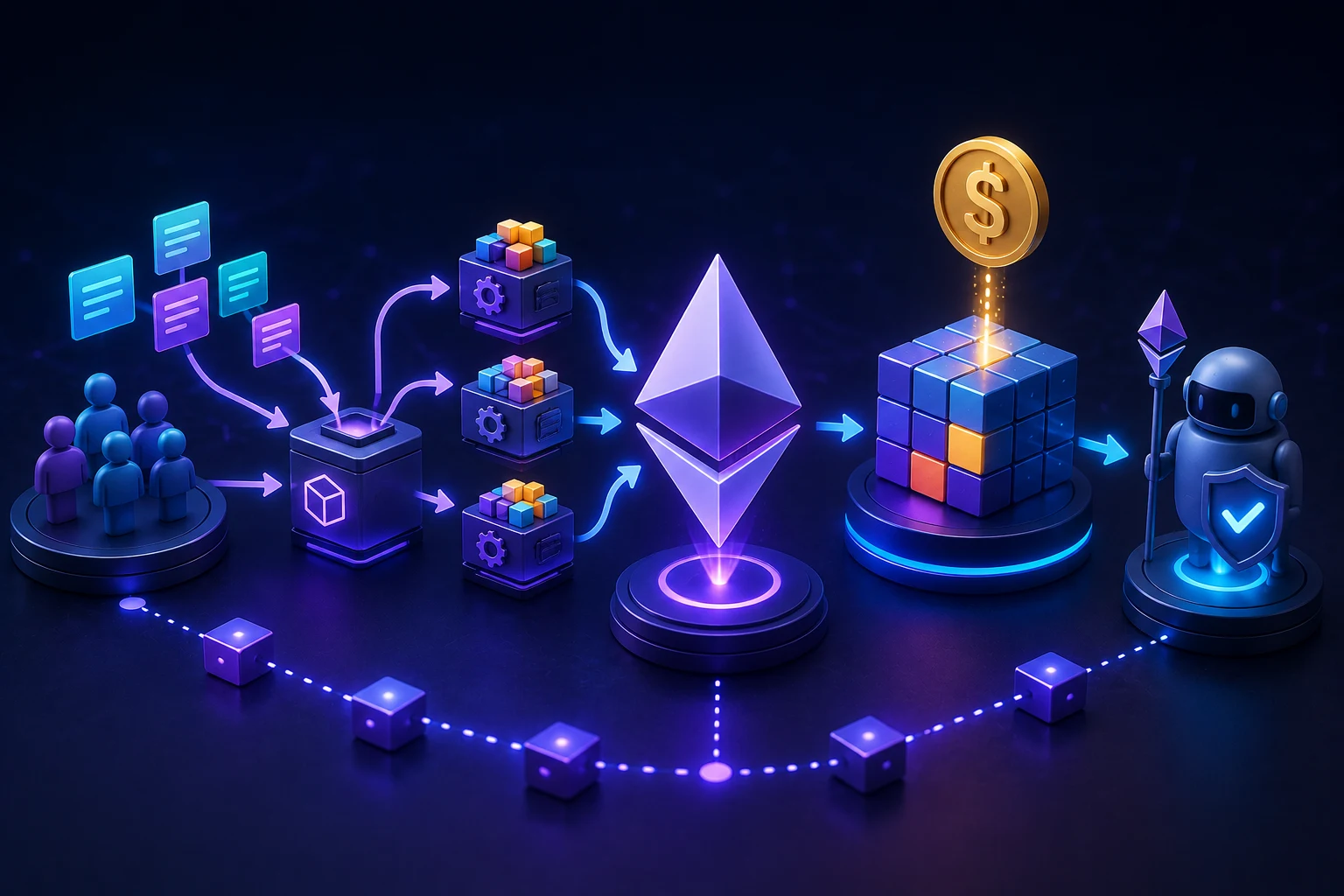
What problem a based rollup is trying to solve
Every rollup needs someone to decide which user transactions land first. That job is called sequencing, and the actor doing it is the sequencer. In 2024 and 2025, almost every major Layer 2 network, including Arbitrum, Optimism, Base, and most ZK rollups, runs a sequencer that its own team controls. That sequencer receives transactions, orders them, batches them, and posts the batch to Ethereum.
This works, but it concentrates power in one place. A centralized sequencer can censor your transaction, reorder trades to extract value from you, or simply go offline. Arbitrum and Optimism have escape hatches that let users bypass the sequencer and post directly to L1, but those escape hatches are slow, expensive, and rarely used in practice. For most users, the sequencer is a trusted intermediary they never see.
A based rollup is the simplest possible answer to that problem: delete the sequencer entirely. Let Ethereum's block proposers do the job. The rollup's blocks are simply the transactions that L1 proposers choose to include, ordered however L1 orders them. No new operator, no new trust assumption, no new failure mode. The rollup is, in a literal sense, 'based' on its base layer for ordering.
This idea was first articulated clearly by researcher Justin Drake in 2023, and the term stuck. By mid-2025, based sequencing had become one of the most discussed architectural questions in Ethereum scaling, with serious teams shipping production code around it.
How sequencing actually works in a based rollup
To understand the design, you need to picture the normal flow. In a typical rollup, a user signs a transaction and sends it to the rollup's mempool, which is a waiting room for unconfirmed transactions. The sequencer picks transactions from this mempool, orders them into a block, executes them, and posts a compressed summary plus a validity or fraud proof to Ethereum. Finality, meaning the point at which reversing the transaction would require rewriting Ethereum itself, is reached only after the L1 batch settles.
A based rollup removes the first three steps. There is no separate rollup mempool and no separate sequencer. Users still submit transactions, but they go into a rollup-specific transaction queue that L1 block proposers can read. When an Ethereum validator is building the next L1 block, they include rollup transactions directly in that block, alongside normal ETH transfers and contract calls. The rollup node watches the L1 chain, extracts those transactions, executes them in order, and writes the resulting state root back to L1.
This pattern is called sequencer inheritance from L1, or shared liveness with Ethereum. The word 'liveness' here means the guarantee that the system keeps producing blocks. A based rollup inherits Ethereum's liveness: if Ethereum is producing blocks, the rollup is producing blocks. There is no separate service that can go down.
The practical consequence is striking. With no central sequencer, there is nothing to censor against and nothing to take down. If you can transact on Ethereum, you can transact on a based rollup, with the same censorship resistance properties. For users in jurisdictions where rollups have been geofenced, or for protocols that worry about a sequencer freezing their application, this is a meaningful upgrade.
The trade-off: you give up control of MEV
Every design choice in crypto has a cost, and based sequencing is no exception. The cost is control over Maximal Extractable Value, usually shortened to MEV. MEV is the profit a block producer can make by reordering, inserting, or censoring transactions inside the blocks they build. On a centralized rollup, the sequencer captures most of this profit and can return some of it to the protocol or users.
On a based rollup, MEV flows to L1 block proposers. They are the ones building the blocks, so they are the ones choosing transaction order. A rollup searcher, which is a bot that hunts for MEV opportunities like arbitrage or liquidations, now has to compete in the Ethereum mempool rather than a private rollup mempool. The rollup team does not get a cut, and neither do users, unless the rollup adds extra mechanisms to redirect MEV later.
This is the explicit trade-off the ecosystem is debating. You give up MEV control in exchange for credible neutrality. There is no single sequencer that can be pressured, bribed, hacked, or coerced. The ordering rules are Ethereum's ordering rules, and Ethereum's ordering rules are the most credibly neutral set of rules any smart-contract platform has.
Defenders argue this trade-off is worth it. They point out that MEV on a centralized rollup often leaks to a small team or a few sophisticated searchers anyway, and that the censorship resistance gain is far more valuable in the long run. Critics counter that without MEV revenue, based rollups will struggle to fund themselves, and that L1 proposers capturing rollup MEV is a form of value extraction that should worry Ethereum itself.
Preconfirmations and preconf protocols
If based rollups rely on L1 proposers for sequencing, a new problem appears: latency. On Ethereum, a new block lands roughly every 12 seconds. Users are used to sub-second feedback from centralized rollups. Waiting a full slot for confirmation feels slow, especially for traders and market makers.
The proposed fix is preconfirmations, often shortened to preconfs. A preconf is a soft promise from an L1 proposer that a transaction will be included in the next block they build. It is not a final guarantee, because proposers can equivocate and build on a competing block, but it is good enough for most practical purposes if the proposer is economically staked and slashable for breaking the promise.
Preconf protocols are the software layer that issues and settles these promises. The rough design is: an L1 proposer commits to including your transaction, posts a bond on-chain, and if they later build a block without your transaction, the bond is slashed. Users get fast feedback, proposers earn a tip, and the system as a whole stays based because ordering is still done by L1, just with a faster signaling layer on top.
This is an active area of research in 2025. Ethereum researchers, including the team behind the EigenLayer-based preconf schemes and several independent proposals, are racing to ship a workable design. If preconfs land cleanly, based rollups may match centralized rollups on user experience while keeping their censorship resistance edge.
Centralized vs based sequencers: a direct comparison
Centralized sequencers are fast and flexible. A team can run upgrades, push emergency fixes, and capture MEV to fund development. The downside is that the team is a single point of failure and a single point of censorship. Users have to trust that the sequencer will behave, and the escape hatches most rollups ship today are too slow and too expensive for normal users.
Based sequencers are slow without preconfs, and they leak MEV, but they inherit Ethereum's security and liveness. They cannot be taken down by a regulator targeting one team, cannot be coerced to censor one application, and cannot rug users by changing the rules mid-stream. For some applications, especially DeFi protocols, stablecoin rails, and censorship-sensitive use cases, that property is the whole point.
There is also a hybrid path. Some teams are designing rollups that are based by default but allow opt-in centralized sequencing for applications that want it. A high-frequency trading venue, for example, might run its own sequencer for speed, while the rest of the rollup stays based. These designs are early, but they point toward a future where 'based' is not an all-or-nothing label.
Real examples: Taiko, RISE, and Surge
Taiko is the most prominent based rollup in production. It launched its mainnet as a based, Type-1, equivalent EVM rollup, which means it tries to reproduce Ethereum's execution environment as faithfully as possible on L2. Taiko's design treats L1 block proposers as the sequencers for the rollup, with no separate operator in between. The team has been explicit that MEV is not captured by the rollup, and that credible neutrality is the value proposition.
RISE, previously known as RISE Chain, is another based rollup that emphasizes performance alongside base sequencing. It uses a custom execution environment and parallelization techniques to push throughput higher than typical EVM rollups, while still relying on L1 for ordering. RISE frames itself as a test bed for what based sequencing looks like when you remove the EVM compatibility constraint.
Surge is a newer entrant that focuses on the preconfirmation layer. Rather than competing on execution, Surge is building infrastructure that lets L1 proposers issue and honor preconfs at scale. The bet is that the preconf market matters more than any single rollup, and that whoever supplies it well will earn a central role in the based rollup ecosystem.
None of these projects are household names yet, but they share a clear thesis: the next generation of rollups will look less like independent chains with their own politics, and more like specialized execution environments that draw their security and ordering from Ethereum directly.
What this means for users, builders, and ETH holders
For users, based rollups should feel more like Ethereum and less like a separate network. There is no bridge of trust in the sequencing layer, and the same censorship resistance guarantees apply. The user experience today is rougher than Base or Arbitrum, but if preconf protocols land, that gap should close.
For builders, the choice is no longer just 'which L2 do I deploy on'. It is 'do I want a rollup that captures MEV and can fund ecosystem grants from it, or one that gives that revenue away in exchange for credible neutrality'. Different applications will answer that question differently.
For ETH holders, based rollups have an indirect effect. They funnel rollup MEV to L1 proposers, which means more revenue for stakers and validators. They also strengthen Ethereum's position as the settlement layer for value, rather than letting that role leak to alt-L1s or app chains. Whether that strengthens ETH's price over time is a separate question, but the structural argument is real.
How to follow based rollups without the hype
Based rollups are moving fast, and so is the marketing around them. Tracking Taiko, RISE, and Surge manually across Discord threads, governance forums, and research papers is a losing game. Zippfeed surfaces based rollup headlines with sentiment scoring (bullish, neutral, or bearish) and an importance rating, so you can spot the architectural shifts before they hit your timeline.

 WuBlockchain
 Crypto Capital Venture
 Lookonchain
 TheBlock