What is a ZK coprocessor?
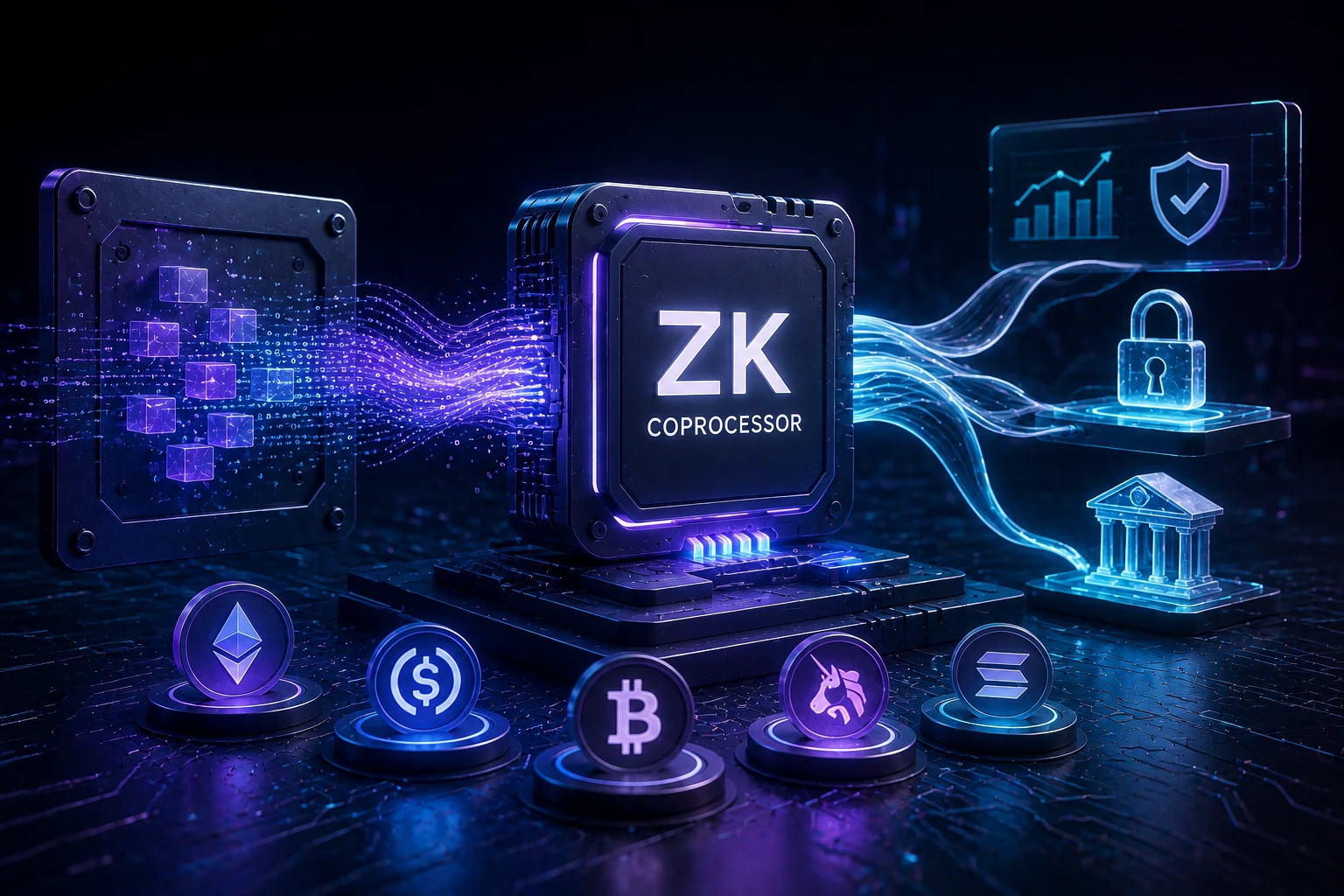
A ZK coprocessor is a system that performs computation away from a blockchain and then produces a proof that the computation was carried out correctly. ZK means zero-knowledge, a family of cryptographic techniques that can prove a statement without revealing every piece of information used to establish it. In many coprocessor designs, the useful property is not secrecy alone. It is verifiability.
Imagine a smart contract asking: was this wallet among the top users of a protocol at block N? Did an account hold at least a certain balance during a past period? Did a pool remain below a risk threshold over thousands of blocks? A conventional contract may not be able to answer these questions cheaply because blockchains are designed to execute current state transitions, not repeatedly scan their entire history.
A ZK coprocessor reads or receives historical blockchain data, performs the requested computation off-chain, and returns a result with a proof. A verifier contract checks that proof using cryptographic rules. If the proof is valid, the contract can act on the result without accepting a simple assertion from a server operator.
This is best understood as a verifiable outsourced computer for blockchain data. It does not make a contract omniscient, and it does not automatically make an application private, decentralized, or cheap. Those properties depend on the data source, circuit or virtual machine, proving system, verifier, and economic design around the service.
The main risks and failure modes
The word proof can sound more absolute than it is. A valid proof generally establishes that a defined computation was performed correctly on defined inputs under a defined proving system. It does not prove that the developer chose the right question, fetched the right chain, interpreted a contract correctly, or built a safe application around the answer.
The central technical assumption is proof-system soundness. Soundness is the property that makes it infeasible to create a valid-looking proof for a false statement. If the cryptography, implementation, circuit, verifier contract, or trusted setup has a serious flaw, an attacker may be able to submit an incorrect result that the contract accepts. A zero-knowledge label is not a substitute for auditing these components.
There are also ordinary infrastructure risks. A prover may become unavailable, a data provider may return incomplete history, a service may support only selected chains, or a contract may rely on a coordinator to submit proofs. Some systems reduce trust in a multisig while still depending on operators for uptime, data availability, fee payment, or software updates. Governance keys and upgrade permissions deserve the same scrutiny as the proof system.
The financial failure mode is especially important in DeFi. A flawed historical calculation could misprice collateral, distribute rewards to the wrong accounts, trigger liquidations, or approve a bad loan. A proof can show that code ran as written, while the code itself contains an economic mistake. Users should therefore inspect audits, verifier addresses, upgrade controls, supported data sources, and emergency procedures before treating a coprocessor-backed application as safer than a conventional one.
How it proves historical chain data
The basic flow has several stages. First, an application defines a query and the data it needs. The query might involve balances, swaps, liquidity positions, lending activity, or state commitments recorded at earlier Ethereum blocks. The system then obtains the relevant block headers, transaction data, receipts, and state information, depending on what the computation requires.
Next, an off-chain worker runs the requested program. That program may be a specialized circuit or a general-purpose zero-knowledge virtual machine, often called a zkVM. A zkVM lets developers express logic in a more familiar programming environment, while the system converts execution into a form that can be proven. The result includes both an answer and a proof tied to the input data and program.
The on-chain verifier does not normally replay every historical transaction. It checks a compact proof using a verification key and public inputs such as a block identifier, a data commitment, the query parameters, and the claimed result. If the proof passes, a contract can store the result or use it immediately. The contract must still validate that the block and state commitment mean what the application expects.
Historical data access is more complicated than simply asking a node for a number. A balance can depend on contract storage at a particular block. A time-weighted metric may require many state snapshots. A result based on logs may miss information that was not emitted as an event. The system must define whether it proves archive-node data, an indexed representation, a block commitment, or some other source. Those choices affect both correctness and trust.
What a proof actually says
Suppose a contract receives a claim that an address supplied liquidity for at least 100 days before a chosen block. The proof can establish that a specified program examined specified inputs and reached that result. It does not independently establish that the question is a useful measure of loyalty, that the address is controlled by one person, or that the application should pay a reward.
This distinction is why reproducible queries and transparent input commitments matter. Developers should be able to identify the chain, block range, contract addresses, program version, and assumptions behind a result. Without that context, a proof may be mathematically valid but difficult for users to interpret.
Coprocessor versus rollup
A rollup is a scaling system that executes batches of transactions outside the main chain and posts enough data or commitments for the base chain to verify or reconstruct the resulting state. Its primary role is to provide a place where users can transact, with the rollup maintaining an account and application state of its own. A ZK rollup uses validity proofs to show that its state transition was executed according to its rules.
A coprocessor has a different job. It usually does not maintain the canonical account state for a new transaction environment, and it is not mainly a venue where users deposit assets and execute ordinary application calls. It performs selected computations over data that already exists on a blockchain, then sends a result and proof back to a contract on that chain.
The boundary can blur. A rollup may use a coprocessor-like service for analytics, and a coprocessor may use rollup-style proving infrastructure or a zkVM. The practical question is not which label appears in a pitch deck. Ask whether the system is responsible for ordering and settling user transactions in its own execution environment, or whether it is answering verifiable queries about another chain's history.
For users, this difference changes the risk surface. A rollup raises questions about bridge custody, data availability, sequencer behavior, withdrawals, and state correctness. A coprocessor raises questions about query inputs, proof soundness, historical data coverage, prover availability, and whether the destination contract handles the result safely. Neither category removes all trust or operational risk.
How it differs from an oracle
An oracle supplies information to a smart contract that the contract cannot obtain directly. Price feeds are the familiar example. An oracle network may aggregate ETH prices from exchanges and publish a value for lending markets. The contract trusts the oracle's design, participating reporters, aggregation method, and safeguards against manipulation.
A ZK coprocessor usually proves a computation from specified blockchain data. It might prove that an address interacted with a protocol, that a vault's historical exposure crossed a threshold, or that a set of transactions satisfies a rule. The proof answers whether a computation followed its inputs correctly. It does not automatically prove that an external market price, real-world identity, or legal fact is true.
The two systems can work together. An oracle may provide a signed or otherwise authenticated price input, and a coprocessor may prove a risk calculation that uses that input alongside historical on-chain positions. In that design, the proof can protect the computation while the oracle remains a trust point for the outside-world data.
There is also a useful warning about the phrase trustless. A proof can reduce reliance on a multisig or a single server for computation, but it cannot prove facts that were never represented in its inputs. If an application needs a real-world credential, a current exchange price, or a legal claim, it still needs an appropriate attestation or oracle mechanism.
What can developers build with one?
The most immediate benefit is cheaper or more expressive computation. Ethereum contracts pay for execution with gas, and scanning long histories or processing large datasets directly on-chain can be impractical. A coprocessor shifts the heavy work off-chain while leaving a compact verification step on-chain. The total cost still includes proving, data retrieval, proof submission, and sometimes a service fee, so cheaper does not mean free.
DeFi risk engines
A lending protocol could use historical positions to estimate concentration, liquidation behavior, or a borrower's relationship with other markets. A vault could check a longer risk window than its on-chain code can efficiently process. A rewards system could calculate participation across many blocks without storing every intermediate value on-chain.
These uses are valuable because DeFi applications often need context rather than one current number. But risk models are not made correct by being proven. Developers still need to choose robust assumptions, account for missing data and flash-loan behavior, and define how the protocol responds when a proof is delayed or unavailable.
Private identity and eligibility
A user could prove a narrow claim about a larger credential without revealing the credential itself. For example, an application might verify that a person meets an age or jurisdiction requirement, or that a wallet satisfies a participation rule, while limiting the information exposed to the contract. Whether this is genuinely private depends on the credential issuer, wallet, metadata, revocation process, and what the application records publicly.
On-chain activity is often linkable even when a proof hides some inputs. A private proof does not guarantee private transactions, anonymous networking, or protection from every form of analysis. Identity systems also face the problem of proving that one person controls only one eligible identity, which cryptography alone does not solve.
Cheap compute and complex queries
General computation is another target. A developer may want to run reputation logic, portfolio analytics, governance calculations, or game rules over blockchain history. A general-purpose system can lower the barrier to expressing these tasks compared with writing every operation as an on-chain contract.
Axiom focuses on verifiable queries over blockchain data. RISC Zero provides a general-purpose zkVM approach that can prove programs running in a RISC-V environment. Succinct develops proving infrastructure and tools, including its SP1 zkVM. These projects illustrate a broad design space rather than one standardized product. Their performance, supported inputs, deployment models, and production guarantees can differ substantially, so a project name alone is not evidence that a particular integration is secure or mature.
Current limits: proving cost, latency, and adoption
Proving computation is resource-intensive. A query that is cheap for a normal server may require substantial hardware, memory, and engineering work when every relevant step must be represented in a proof. Larger historical ranges, complex programs, cryptographic operations, and many simultaneous users can increase proving time and operating cost.
Latency matters as well. A contract call that needs an immediate answer may not be compatible with a proof that takes minutes or longer to generate. Some applications can tolerate asynchronous updates. Others need a fallback, cached result, optimistic period, or conservative action while a proof is pending. Those workarounds introduce new design choices and sometimes new trust assumptions.
Data availability and indexing remain practical bottlenecks. A prover may need archive access, specialized indexes, or preprocessed commitments. If a chain reorganizes, changes a data format, or has incomplete historical coverage, the application needs a clear policy. The proof is only as useful as the data that the program was actually able to consume.
Developer experience is improving, but writing circuits or zkVM programs still requires specialized knowledge. Bugs can arise from the application code, the translation into a provable form, the handling of public and private inputs, or the verifier integration. Audits help, but they are not guarantees. Open-source code, reproducible builds, independent verification, bug bounties, and conservative limits are meaningful signals to examine.
What this means for users and builders
For builders, start with the exact claim the contract needs to verify. Define the block, chain, data commitments, program version, acceptable staleness, and behavior if the proof cannot be produced. Then compare a coprocessor with simpler options such as storing a rolling aggregate, using an established oracle, or doing computation directly on-chain. The most advanced architecture is not automatically the best one.
For users, look past the phrase ZK-powered. Find out whether the product has real mainnet usage or mainly a demonstration. Check which parts are open source, who can upgrade the verifier, whether a coordinator can censor or delay proofs, how historical data is sourced, and what happens after an incorrect result. If a protocol accepts large deposits, examine audits and incident history rather than relying on cryptographic branding.
It is also useful to separate three questions. Can the system compute the requested result? Can it prove the result soundly? Will the application use that result safely under adversarial conditions? A convincing answer to the first question does not settle the other two.
As an advanced reader, you may also want to compare this topic with how Ethereum scaling works and what zero-knowledge proofs are. Those concepts explain why proof generation can reduce on-chain verification work while still requiring careful choices about data, computation, and trust.
Read ZK coprocessor claims critically
ZK coprocessors move fast, and the claims around them often move faster. Tracking technical releases, integrations, and security news manually is difficult. Zippfeed surfaces relevant headlines with bullish, neutral, or bearish sentiment scoring and an importance rating, helping you distinguish a meaningful production deployment from a prototype, partnership announcement, or unresolved risk. Use that context to follow the technology without treating coverage as a recommendation to buy or use any project.

 WuBlockchain
 Crypto Capital Venture
 Lookonchain
 TheBlock