A countdown built into the code
Most money can be printed at will. Bitcoin was designed to be the opposite — a digitally scarce asset with a fixed, predictable supply that no government, company, or person can inflate. The mechanism that enforces this scarcity is the halving, and it is one of the most distinctive features of how Bitcoin works.
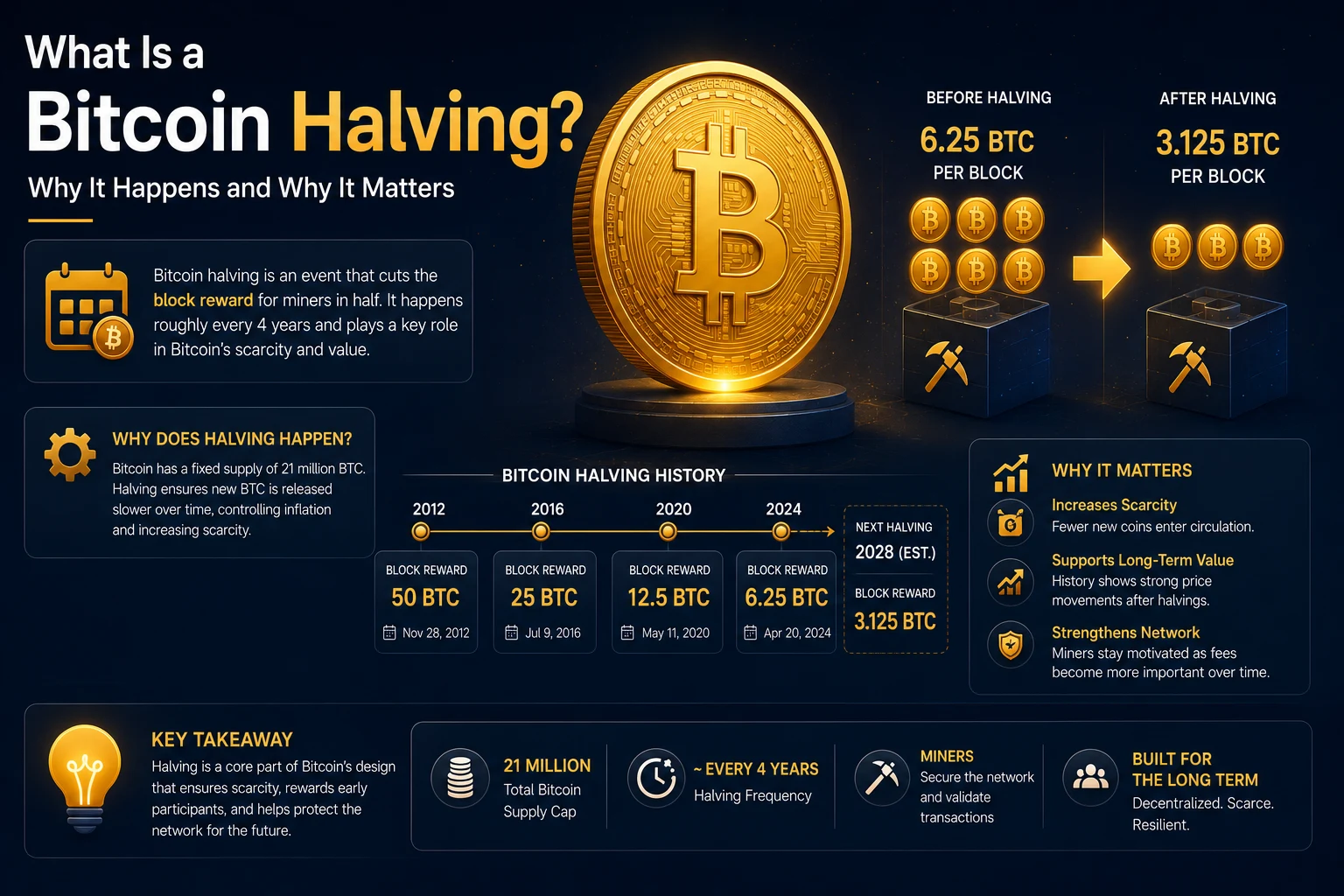
A halving is a scheduled event that cuts in half the reward miners receive for producing a new block. It happens automatically, roughly every four years, and it has occurred several times since Bitcoin launched. Each one tightens the flow of new bitcoin into existence.
How new bitcoin is created (and why it's limited)
To understand the halving, you need the basics of how crypto mining works. Miners compete to add new blocks of transactions to the Bitcoin blockchain. The winner is rewarded with newly created bitcoin — the "block reward." This is literally how new bitcoin enters circulation.
But Bitcoin's code caps the total supply at 21 million coins, forever. To stretch issuance over more than a century and guarantee that cap is never exceeded, the block reward is cut in half at fixed intervals. Less reward means new coins are created more slowly over time, until issuance eventually approaches zero.
Why the halving matters
It enforces scarcity
The halving is the engine of Bitcoin's "hard money" narrative. Unlike currencies that can be printed in unlimited quantities, Bitcoin's new supply is mathematically guaranteed to shrink on a known schedule. This predictable scarcity is central to why many holders view it as a store of value.
It pressures miners
When the block reward halves, miners suddenly earn half as much new bitcoin for the same work and the same electricity costs. Less efficient miners can be squeezed out, and the network adjusts. This periodically reshapes the proof of work mining industry.
It draws enormous attention
Each halving is a predictable, narrative-rich event that focuses the market's attention on Bitcoin's supply dynamics. That attention itself becomes part of the story.
The halving and price: what history does and doesn't say
This is the question everyone really wants answered, so let's be careful and honest.
Historically, Bitcoin's major bull runs have tended to follow halvings, and the logic is intuitive: if demand holds steady or grows while new supply is cut, basic economics suggests upward price pressure. Many investors watch halvings closely for exactly this reason.
But — and this matters — past patterns are not guarantees. A handful of historical examples is a very small sample. Prices are driven by countless factors: macroeconomic conditions, regulation, crypto ETF flows, sentiment, and more. Anyone who tells you a halving *will* cause a specific price move is guessing. The halving is a real, predictable supply event; its future price impact is not predictable. This is education, not investment advice.
What it means for you
You do not need to do anything for a halving — it happens automatically. What is useful is understanding *why* the event matters to the market, so you can interpret the surrounding hype with a clear head rather than getting swept up in "this time it's guaranteed" narratives.
Read the halving narrative critically
Halvings generate intense speculation, and the noise-to-signal ratio gets brutal. Zippfeed tracks Bitcoin headlines with sentiment and importance scoring across many sources, so around events like halvings you can see how the market actually feels and separate substantive analysis from hype, instead of being pulled along by whatever narrative is loudest that week.

 CryptoSlate
 Glassnode
 WatcherGuru
 Altcoin Daily
 WuBlockchain