Introduction
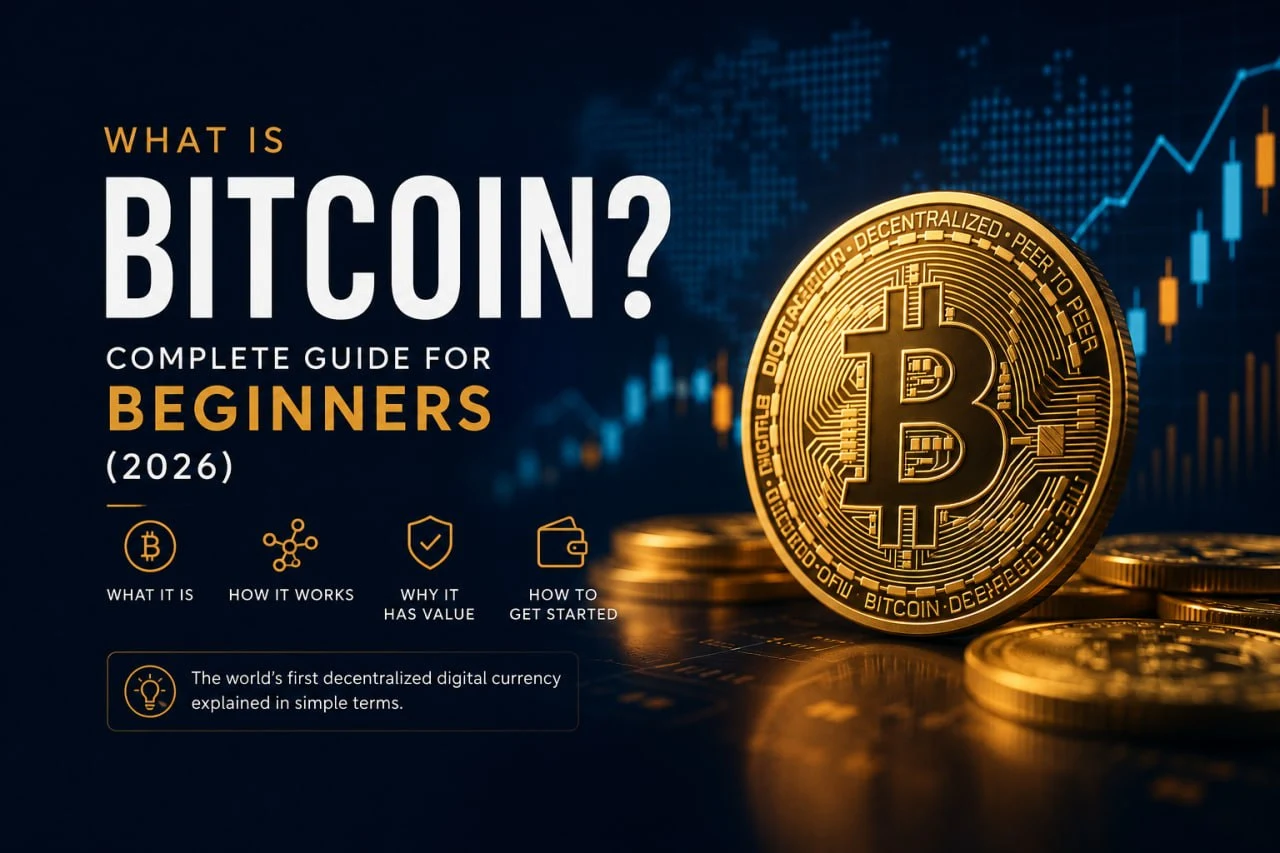
Bitcoin is the world's first decentralized digital currency. Since its launch in 2009, it has grown from an experimental technology into one of the most widely recognized financial assets in the world.
Today, Bitcoin is used by individuals, institutions, public companies, and even governments. It is often described as "digital gold" because of its limited supply and its role as a store of value.
If you're new to crypto, understanding Bitcoin is the best place to start. This guide explains what Bitcoin is, how it works, why it has value, and what beginners should know before investing.
What Is Bitcoin?
Bitcoin is a decentralized digital currency that allows people to send and receive money without relying on banks, payment processors, or governments.
Unlike traditional currencies such as the US dollar or euro, Bitcoin operates on a global network of computers that collectively maintain and verify transactions.
Bitcoin was introduced in 2008 through a whitepaper published by a pseudonymous creator known as Satoshi Nakamoto. The Bitcoin network officially launched on January 3, 2009.
The key idea behind Bitcoin is simple:
People should be able to transfer value directly to one another over the internet without needing a trusted intermediary.
How Does Bitcoin Work?
Bitcoin runs on a technology called blockchain.
A blockchain is a public ledger that records every Bitcoin transaction ever made. Instead of being stored on a single server, copies of this ledger are maintained by thousands of computers around the world.
When someone sends Bitcoin:
- The transaction is broadcast to the network.
- Computers verify the transaction.
- The transaction is grouped with others into a block.
- The block is added to the blockchain.
- The transaction becomes permanently recorded.
Because the blockchain is distributed and transparent, altering transaction history is extremely difficult.
What Makes Bitcoin Different?
Fixed Supply
One of Bitcoin's most important features is its scarcity.
Only 21 million Bitcoin will ever exist.
Unlike traditional currencies, which can be printed by central banks, Bitcoin has a fixed monetary policy built into its code.
Many investors believe this scarcity makes Bitcoin an attractive long-term asset.
Decentralization
No company, government, or individual controls Bitcoin.
The network is maintained by participants around the world who follow the same set of rules.
This decentralization reduces the risk of censorship and single points of failure.
Transparency
Every Bitcoin transaction is recorded on a public blockchain.
Anyone can verify transactions and monitor network activity.
This transparency helps build trust without requiring a central authority.
Global Accessibility
Anyone with an internet connection can access Bitcoin.
There are no borders, business hours, or approval processes required to participate in the network.
What Is Bitcoin Mining?
Bitcoin mining is the process that secures the network and creates new Bitcoin.
Miners use specialized computers to solve complex mathematical problems. When a miner successfully validates a block of transactions, they receive newly created Bitcoin as a reward.
Mining serves two purposes:
- Securing the network
- Issuing new Bitcoin into circulation
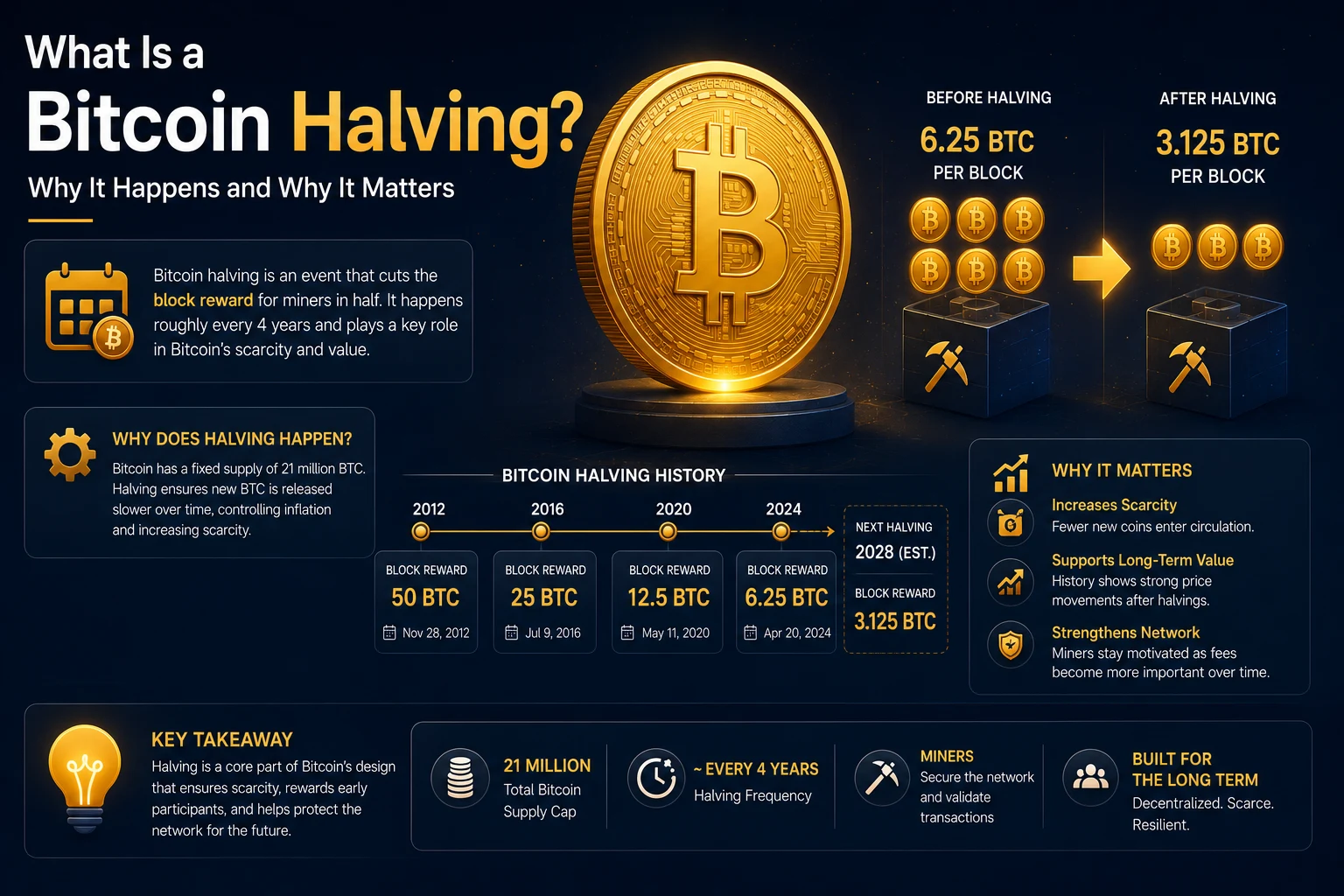
Over time, mining rewards decrease through an event called the Bitcoin halving.
What Is the Bitcoin Halving?
Approximately every four years, the Bitcoin network reduces the amount of new Bitcoin issued to miners.
This event is known as a Bitcoin halving.
Historically, halvings have been significant because they reduce the rate at which new Bitcoin enters circulation.
Previous halvings occurred in:
- 2012
- 2016
- 2020
- 2024
The next halving is expected in 2028.
Many investors closely watch these events because they affect Bitcoin's supply dynamics.
Why Does Bitcoin Have Value?
Bitcoin's value comes from several factors.
Scarcity
There will never be more than 21 million Bitcoin.
Security
The Bitcoin network is considered one of the most secure computer networks in existence.
Adoption
Millions of users, businesses, institutions, and investors participate in the Bitcoin ecosystem.
Utility
Bitcoin allows people to transfer value globally without traditional financial intermediaries.
Store of Value
Many investors view Bitcoin as a long-term hedge against inflation and currency debasement.
Is Bitcoin Safe?
Bitcoin itself has never been hacked.
However, users can lose funds through:
- Exchange failures
- Phishing attacks
- Weak passwords
- Poor wallet security
To improve security:
- Use strong passwords
- Enable two-factor authentication
- Store large holdings in a hardware wallet
- Keep recovery phrases offline
Security is one of the most important aspects of owning Bitcoin.
How Can Beginners Buy Bitcoin?
Most people purchase Bitcoin through a cryptocurrency exchange.
The process typically involves:
- Creating an account
- Completing identity verification
- Depositing funds
- Purchasing Bitcoin
- Transferring assets to a secure wallet if desired
Many investors choose to buy gradually over time rather than making a single large purchase.
This strategy is often referred to as dollar-cost averaging (DCA).
Bitcoin vs Traditional Money
Instead of using a table, here is a format that works better in most CMS and admin panel editors:
Supply
- Bitcoin: Fixed supply of 21 million BTC
- Traditional Currency: Supply can increase through central bank policies
Control
- Bitcoin: Decentralized network
- Traditional Currency: Controlled by central banks and governments
Accessibility
- Bitcoin: Available globally with internet access
- Traditional Currency: Typically tied to specific countries and banking systems
Operating Hours
- Bitcoin: Available 24/7
- Traditional Currency: Often limited by banking hours and payment infrastructure
Transparency
- Bitcoin: Transactions recorded on a public blockchain
- Traditional Currency: Transactions stored in private databases
These differences are a major reason Bitcoin continues to attract interest from investors and institutions.
Risks of Investing in Bitcoin
Bitcoin offers significant opportunities, but it also carries risks.
Volatility
Bitcoin prices can move dramatically in short periods.
Regulation
Governments continue to develop crypto-related regulations.
Security Mistakes
Users are responsible for protecting their own assets.
Market Cycles
Bitcoin has historically experienced both strong bull markets and deep corrections.
Investors should understand these risks before allocating capital.
Final Thoughts
Bitcoin introduced a new way to think about money, ownership, and value transfer on the internet.
More than a decade after its launch, it remains the largest cryptocurrency by market capitalization and one of the most influential technologies in modern finance.
Whether you are interested in investing, learning about blockchain technology, or understanding the future of digital assets, Bitcoin is the foundation of the crypto ecosystem.

 CryptoSlate
 Glassnode
 WatcherGuru
 Altcoin Daily
 WuBlockchain