The engine of modern crypto
If you have read about DeFi, NFTs, or DAOs, you have been reading about things built from smart contracts — even if the term stayed in the background. Smart contracts are the foundational building block that turned blockchains from simple ledgers for sending money into platforms for building entire applications. Understanding them unlocks understanding most of crypto beyond Bitcoin.
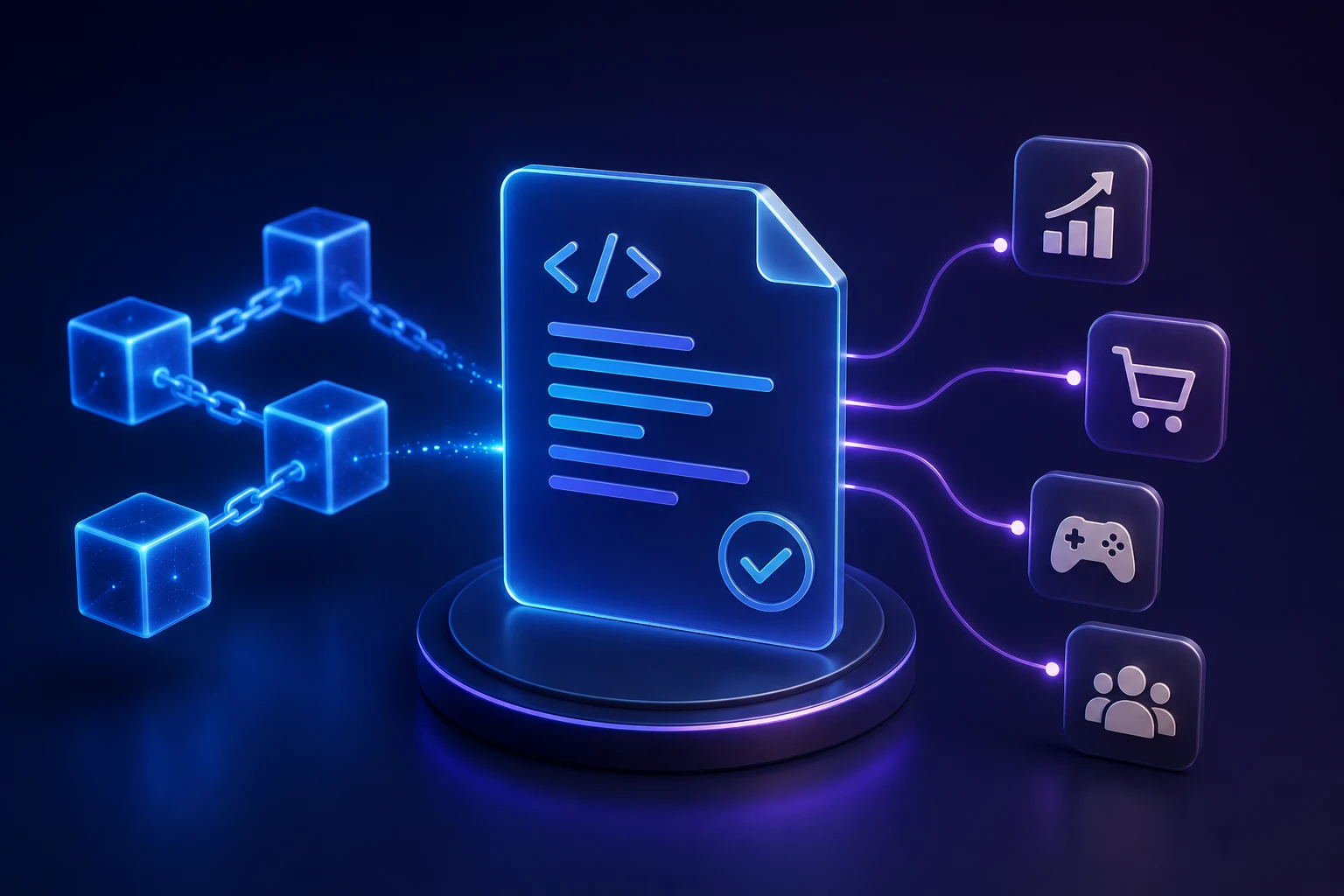
A smart contract is a program stored on a blockchain that automatically executes when predetermined conditions are met. The classic analogy is a vending machine: you put in the right input (money, and a selection), and the machine automatically delivers the output (your snack) according to fixed rules, with no cashier in the middle. A smart contract does the same for digital agreements — it enforces the terms automatically, exactly as written.
How smart contracts work
The core idea is "if this, then that," made trustless and automatic.
- Rules written in code. A developer writes the contract's logic: if certain conditions occur, then certain actions happen.
- Deployed to the blockchain. Once deployed, the contract lives on the blockchain, where its code is public and its execution is verified by the network.
- Automatic execution. When the conditions are met, the contract executes itself. No person needs to approve it, and no one can selectively stop it.
- No intermediary. The whole point is removing the trusted middleman. Instead of trusting a bank, lawyer, or company to honor an agreement, you trust transparent, automatically enforced code.
This is what people mean by "trustless" — you do not have to trust a counterparty's goodwill, only the code and the blockchain it runs on.
What smart contracts power
Almost everything in crypto beyond simple payments runs on them:
- DeFi. Lending, borrowing, and trading on decentralized exchanges are all smart contracts handling funds according to public rules.
- NFTs. The ownership and transfer rules for non-fungible tokens are smart contracts.
- DAOs. The voting and treasury rules of DAOs are encoded in smart contracts.
- Stablecoins and tokens. Many tokens, including stablecoins, are governed by smart contracts.
- Automated agreements. Anything that can be expressed as "if conditions, then outcome" can be automated.
Ethereum popularized programmable smart contracts, and they are now central to most major platforms, including Solana.
"Code is law": the double-edged sword
Smart contracts come with a defining property: once deployed, they typically run exactly as written and are very difficult or impossible to change. This immutability is simultaneously their greatest strength and their most serious danger.
The strength: No one — not even the creator — can quietly alter the rules, censor you, or renege on the agreement. The contract does what it says, transparently and reliably. This is what makes trustless systems possible.
The danger: If the code contains a bug, that bug is also permanent and automatic. There is no customer service to reverse a mistake, no judge to appeal to. Flaws in smart contracts have led to exploits where hundreds of millions of dollars were drained in minutes, executed flawlessly by the very automation that is supposed to be a feature. "Code is law" means the code's mistakes are law too.
Why this matters for you
Whenever you interact with a DeFi protocol, mint an NFT, or use any decentralized app, you are trusting smart contracts with your funds. This is why:
- Audits matter — but do not guarantee safety. Audited contracts have still been exploited.
- You should understand what you sign. Approving a transaction can grant a contract permission to move your funds. Malicious contracts exploit careless approvals.
- Newer, unaudited contracts are higher risk. Established, heavily used, audited contracts have at least survived scrutiny.
None of this is financial advice. The practical takeaway: smart contracts remove the need to trust people, but they require you to trust code — and code can fail. Our how to store crypto securely guide covers protecting yourself when interacting with them.
Stay ahead of contract risk
Smart-contract exploits are among the fastest-moving threats in crypto, and the first reports usually hit the news before official channels respond. Zippfeed tracks DeFi and security headlines with sentiment and importance scoring, so you can hear about a contract exploit or vulnerability early — while there may still be time to protect your funds — rather than learning about it after the damage is done.