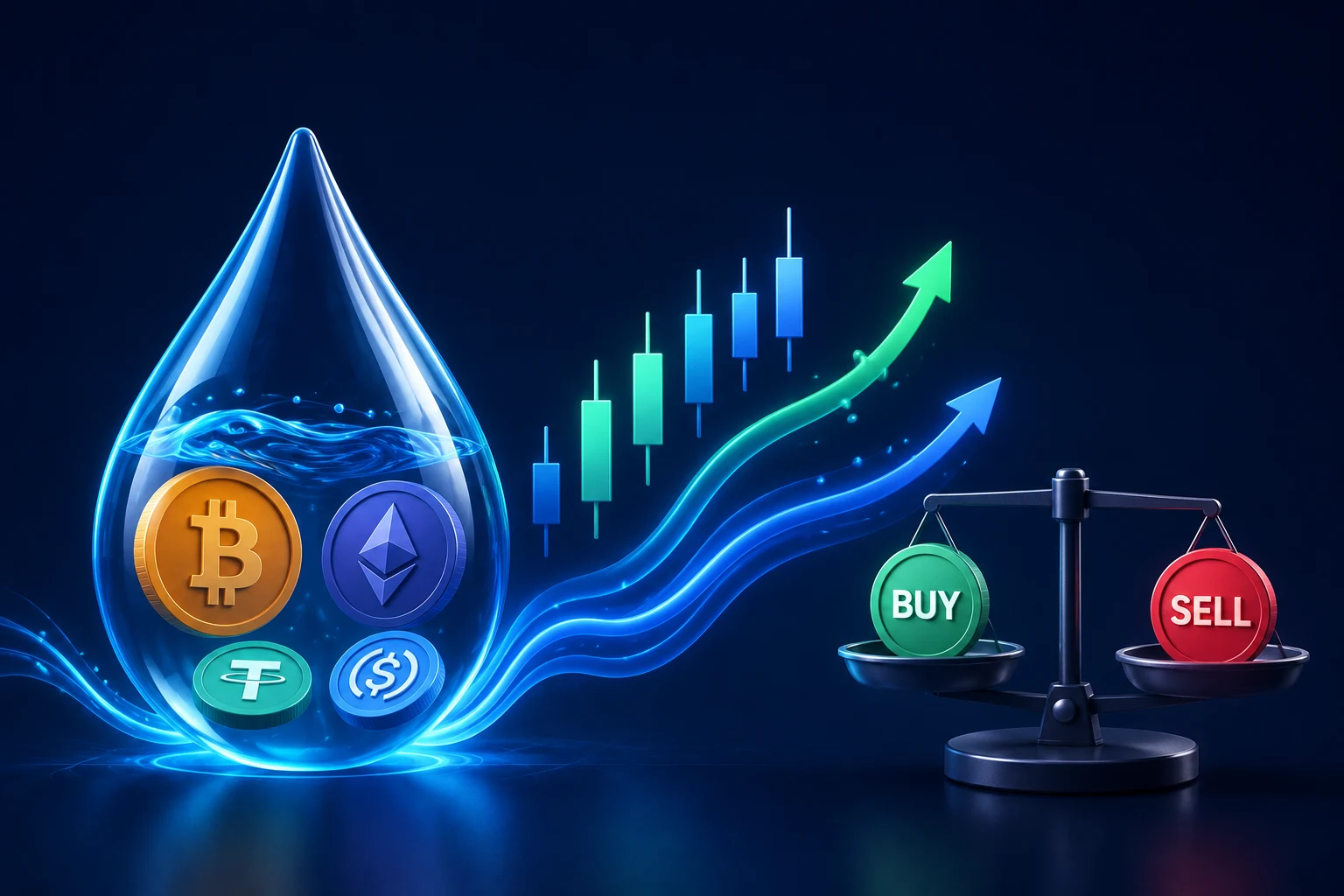
The hidden quality that shapes every trade
When people evaluate a crypto asset, they obsess over price and potential gains. Far fewer think about liquidity — yet liquidity quietly determines whether you can actually act on your decisions at a fair price, or whether you get trapped. It is one of the most practically important concepts in trading, and misunderstanding it is how people end up unable to sell, or selling at terrible prices, exactly when it matters most.
What liquidity actually means
Liquidity is a measure of how easily an asset can be bought or sold without significantly affecting its price. Picture two scenarios:
- A highly liquid market has lots of buyers and sellers and plenty of trading activity. You can buy or sell quickly, and even a sizable order barely moves the price. Bitcoin on a major exchange is highly liquid.
- An illiquid market has few buyers and sellers and thin activity. Even a modest order can move the price sharply, and you may struggle to trade at all without accepting a bad price. A tiny, obscure altcoin is often deeply illiquid.
The simplest test: in a liquid market, you can get in and out easily near the price you see; in an illiquid one, you cannot.
How liquidity shows up in practice
A few concrete signs reveal an asset's liquidity:
Trading volume
High trading volume — lots of the asset changing hands — is a basic indicator of liquidity. Persistently low volume is a warning of thin markets.
The bid-ask spread
The "spread" is the gap between the highest price buyers will pay and the lowest price sellers will accept. In liquid markets, this gap is tiny. In illiquid markets, it widens, meaning you immediately lose value crossing it. A wide spread is a classic sign of poor liquidity.
Slippage
Slippage is the difference between the price you expect and the price you actually get when your order executes. In liquid markets, slippage is minimal. In illiquid markets, a single order can "eat through" available offers and execute at progressively worse prices — sometimes dramatically worse than expected. This is one of the most painful surprises for traders in thin markets.
Market depth
Depth describes how many buy and sell orders exist at various prices. Deep markets absorb large orders smoothly; shallow markets get knocked around easily.
Why liquidity matters so much
Liquidity is not an abstract concern — it is a real and underappreciated dimension of risk:
- Getting out matters as much as getting in. An asset that is easy to buy but hard to sell is a trap. In a panic, illiquid assets can become nearly impossible to exit at any reasonable price, precisely when everyone wants out at once.
- Low liquidity invites manipulation. Thin markets are easy to push around. This is why meme coins and tiny tokens are vulnerable to "pump and dump" schemes — small amounts of money can move the price dramatically.
- Hidden costs. Wide spreads and slippage are real costs that erode returns, often more than visible trading fees.
- Price reliability. In illiquid markets, the "price" you see can be misleading, since it might not survive any meaningful selling.
How to think about liquidity wisely
- Check volume and spreads before buying, especially for smaller assets. If you cannot see healthy activity, assume exiting will be hard.
- Treat illiquidity as a risk multiplier. The smaller and less traded an asset, the more cautious your position sizing should be — connect this to your crypto portfolio thinking.
- Remember liquidity can vanish. An asset that seems liquid in calm markets can dry up instantly in a crisis, as buyers disappear.
- Be skeptical of "you can always sell" assumptions. In thin markets, you may not be able to — at least not at a price you would accept.
None of this is investment advice. The core lesson: an investment is only as good as your ability to exit it at a fair price, and liquidity is what determines that ability.
Trade with awareness of conditions
Liquidity can evaporate fast during volatile or fearful markets — exactly when it matters most. Zippfeed tracks crypto news with sentiment and importance scoring, helping you read the broader market mood that often precedes liquidity crunches, so you're less likely to be caught holding an asset that has quietly become difficult to sell when conditions turn.