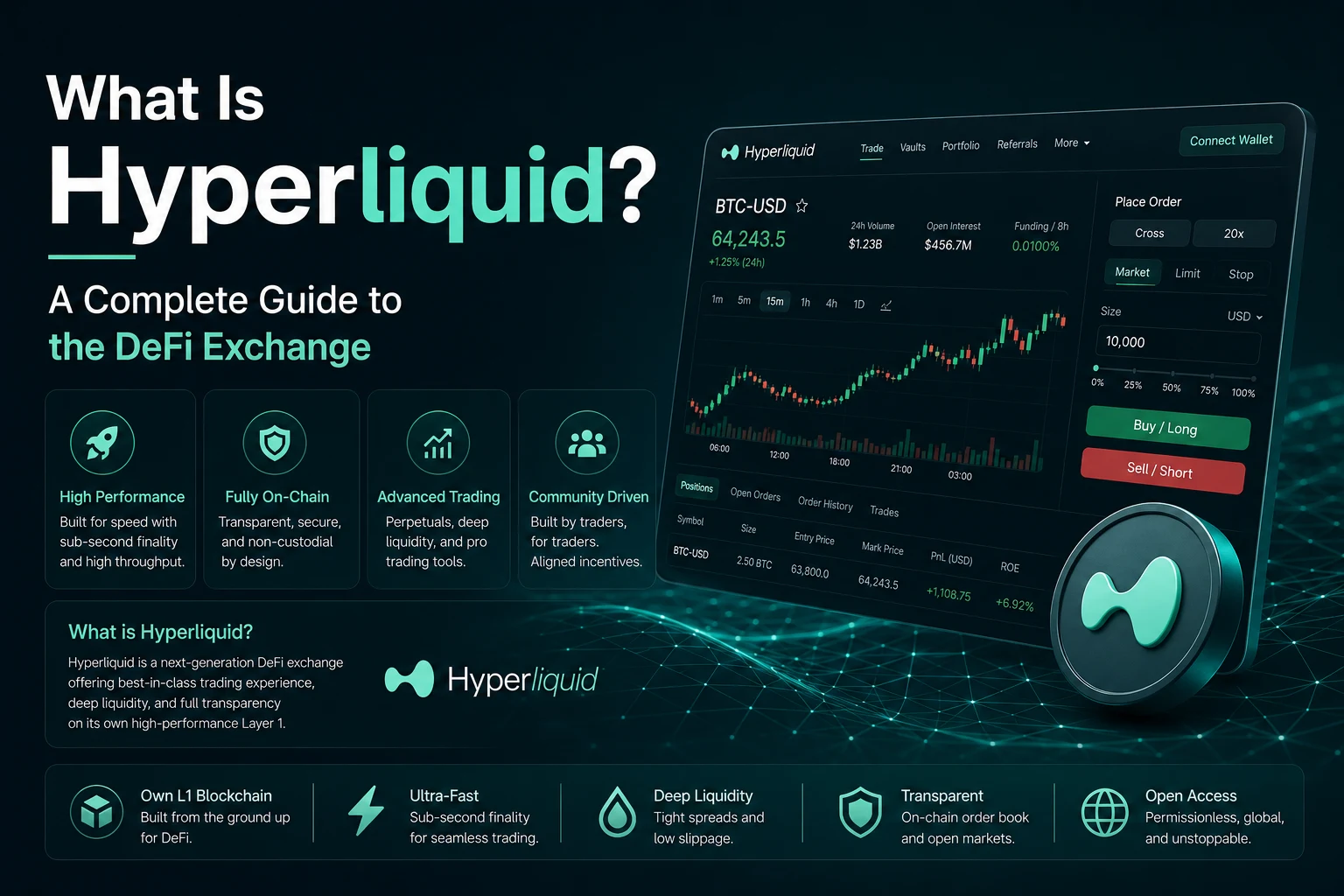
Hyperliquid in context
For years, crypto traders faced an awkward trade-off. Centralized exchanges offered speed, deep liquidity, and a smooth trading experience — but you handed over custody of your funds. Decentralized exchanges let you keep custody, but were often slow, clunky, and ill-suited to fast derivatives trading. Hyperliquid is one of the most prominent attempts to erase that trade-off.
It is a decentralized exchange that runs on its own custom-built blockchain, engineered specifically for trading. The pitch: the performance of a centralized venue with the self-custody and transparency of DeFi.
What makes Hyperliquid different
A purpose-built blockchain
Rather than building on an existing network and inheriting its limitations, Hyperliquid runs on its own chain optimized for one job — fast, high-volume trading. This is why it can offer the kind of responsiveness traders expect, where orders execute near-instantly.
A fully on-chain order book
Most decentralized exchanges use liquidity pools and automated pricing because traditional order books were too slow and expensive to run on-chain. Hyperliquid took the harder path: a complete on-chain order book, the same model professional traders know from centralized venues, but transparent and
verifiable. Every order lives on the chain.
Built for perpetual futures
Hyperliquid is best known for perpetual futures — derivatives that let traders bet on price direction with leverage and no expiry date. We explain the mechanics in understanding crypto futures markets. This focus on derivatives, done with low fees and high speed, is a big part of its appeal to active traders.
The HYPE token
Hyperliquid's native token, HYPE, sits at the center of its ecosystem. Like most platform tokens, it ties into governance, ecosystem incentives, and the economics of the network. As always, a platform's token is a volatile asset distinct from the usefulness of the platform itself — the two should not be confused, and none of this is investment advice.
Why it caught attention
Hyperliquid gained a following for a few concrete reasons: a trading experience that genuinely approaches centralized-exchange smoothness, a community-focused token distribution that rewarded early users, and the technical achievement of a working on-chain order book at speed. For traders who wanted derivatives without surrendering custody, it filled a real gap.
The risks you should weigh
This section matters more than the features.
- Leverage amplifies losses. Perpetual futures with leverage can wipe out a position fast. This is among the highest-risk activities in all of crypto.
- Smart-contract and protocol risk. Like any DeFi platform, the underlying code is a potential point of failure.
- Newer infrastructure. A custom blockchain is impressive but younger and less battle-tested than long-established networks.
- Token volatility. HYPE, like any crypto asset, can swing violently.
- Complexity. Derivatives trading is not for beginners. The tools that enable big gains enable bigger losses.
If you are new to crypto, derivatives trading is not where to start. Build understanding with our how to buy crypto safely and what is DeFi guides first.
Trade with the full picture
Platforms like Hyperliquid move fast, and so does sentiment around them — token unlocks, protocol updates, exploits, and competitive shifts can change the landscape overnight. Zippfeed tracks DeFi and exchange-related headlines with sentiment and importance scoring, so you can gauge how the market actually feels about a platform before you commit capital to it, rather than relying on hype from social feeds.

 CoinDesk
 WuBlockchain
 TheBlock
 Lookonchain