The original way to secure a blockchain
Before there was Proof of Stake, there was Proof of Work — the consensus mechanism that made Bitcoin possible and solved a problem computer scientists had wrestled with for decades: how to get a decentralized network to agree on the truth without anyone in charge, in a way that resists fraud. Understanding Proof of Work is understanding the foundation Bitcoin is built on.
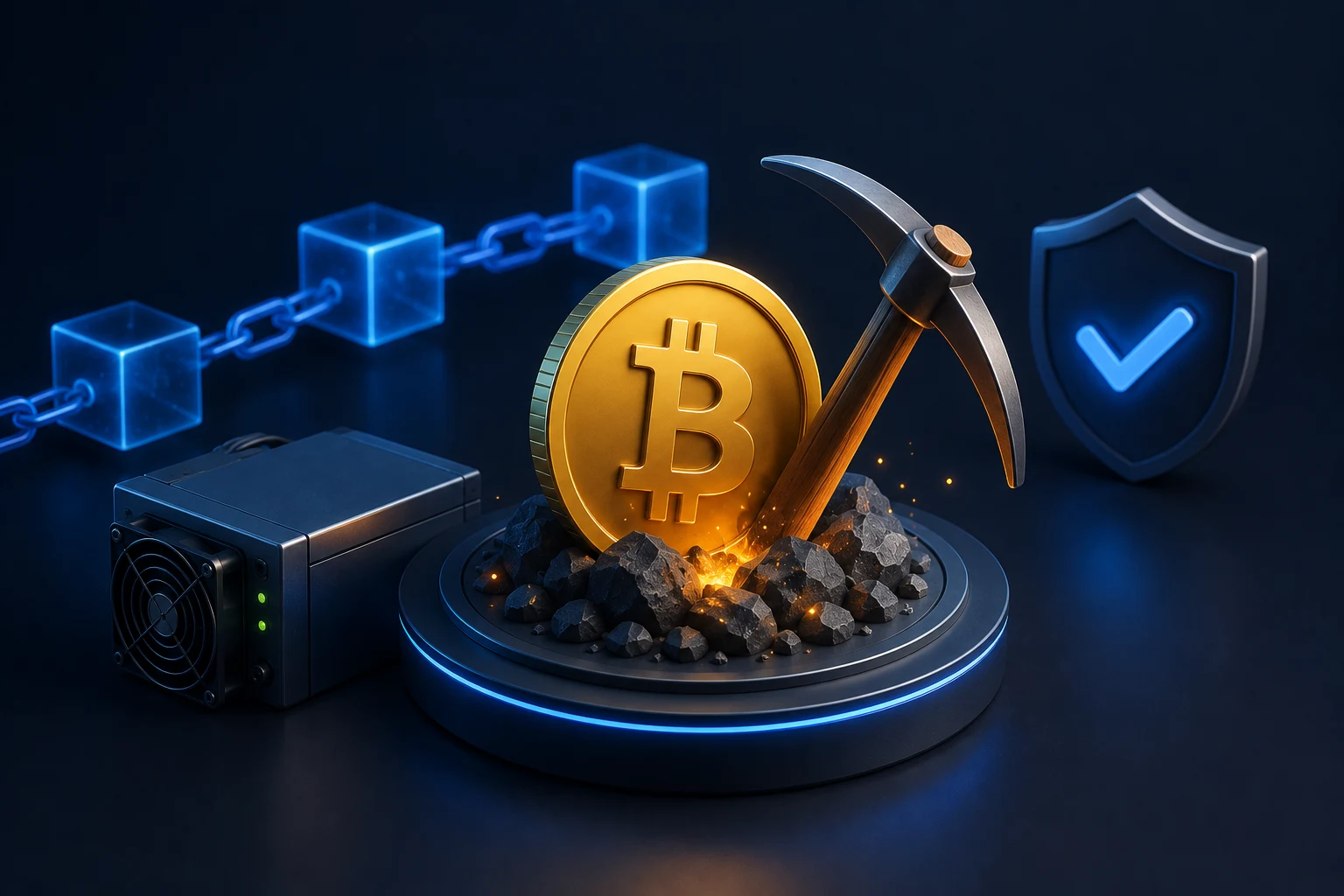
Proof of Work (PoW) secures a blockchain by requiring participants — "miners" — to expend real computational effort. Miners compete to solve a difficult mathematical puzzle, and the first to solve it earns the right to add the next block of transactions to the blockchain, along with a reward. The "work" is genuine: it consumes electricity and computing power, and that cost is precisely what makes the system secure.
How Proof of Work mining works
The process is a continuous, global competition. Our dedicated guide on how crypto mining works goes deeper, but the essentials are:
- The puzzle. Miners race to find a solution to a cryptographic puzzle. There is no shortcut — the only way to solve it is essentially trial and error, trying enormous numbers of guesses per second.
- Competition. Miners worldwide compete simultaneously, dedicating powerful hardware and electricity to the race.
- The winner adds the block. The first miner to find a valid solution gets to add the next block of transactions and is rewarded with newly created cryptocurrency plus transaction fees. For Bitcoin, this reward is governed by the Bitcoin halving.
- Verification is easy. Crucially, while solving the puzzle is hard, verifying that a solution is correct is trivial. The rest of the network instantly confirms the winner did the work.
- Difficulty adjusts. The network automatically adjusts the puzzle's difficulty to keep block times steady as more or less computing power joins.
Why the "work" creates security
The genius of Proof of Work is that it makes attacking the network absurdly expensive. To rewrite history or cheat, an attacker would need to out-compute the entire honest network — controlling a majority of its total computing power. For a large network like Bitcoin, this would require a staggering amount of hardware and electricity, costing far more than any attack could plausibly gain.
In other words, security is bought with real-world cost. The energy is not wasted from this perspective; it is converted into a protective wall that makes dishonesty economically irrational. This is why Bitcoin's Proof of Work is often described as the most battle-tested security in all of crypto — it has protected enormous value for a very long time without being successfully attacked at the protocol level.
The energy debate
There is no avoiding the central criticism: Proof of Work consumes a lot of energy. This is its most contested feature, and the debate is genuine.
- The criticism: PoW's electricity consumption raises environmental concerns, and critics argue the same security could be achieved more efficiently — which motivated the rise of Proof of Stake.
- The counterargument: Defenders argue the energy is the point — it is what makes the security real and unforgeable — and note growing use of renewable and otherwise-wasted energy in mining, as well as mining's potential role in stabilizing energy grids.
Both sides have substance. The honest summary: PoW's robustness and PoW's energy use are two sides of the same coin. You cannot have the battle-tested security without the cost.
Proof of Work vs Proof of Stake
- Proof of Work: Security from computational effort and electricity. Extremely battle-tested. Energy-intensive. Used by Bitcoin.
- Proof of Stake: Security from staked capital. Energy-efficient. Newer at the largest scale. Used by Ethereum, Solana, and many others.
Neither is universally superior — they are different answers with different trade-offs, which is exactly why networks like Bitcoin vs Ethereum diverge so sharply at their foundations. This is education, not investment advice.
Track the networks and the debate
Mining economics, energy policy, and network security developments all move with the news and can affect Proof of Work assets. Zippfeed tracks Bitcoin and mining-related headlines with sentiment and
importance scoring, so you can follow the developments — regulatory moves on mining, energy debates, network milestones — that actually matter, with a clear read on how the market is reacting.