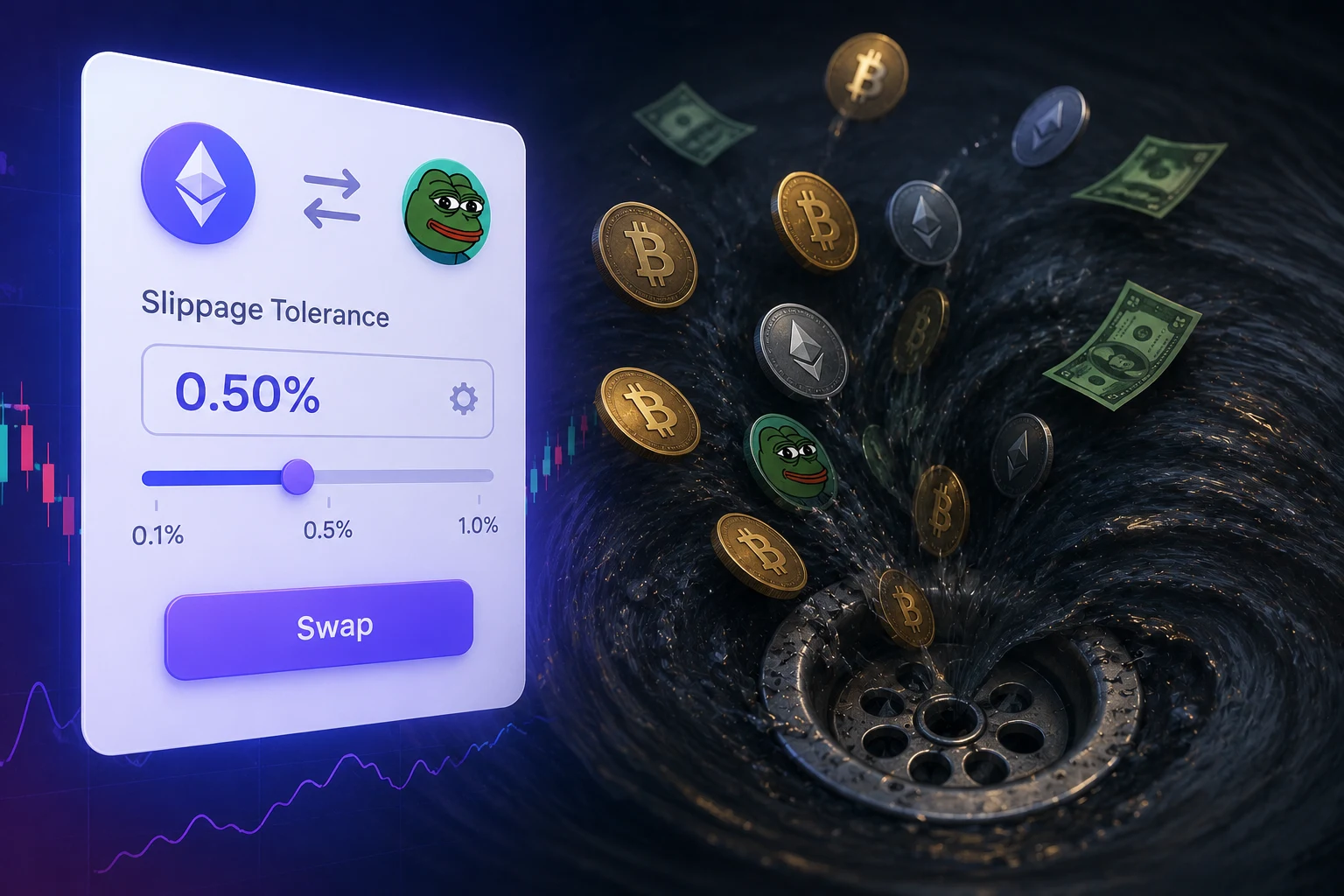
What slippage tolerance actually means on a swap
When you click "swap" on a decentralized exchange, your transaction does not execute instantly. It is sent to a mem pool, picked up by a router, then settled on-chain. During that window, the quoted price can move. Slippage tolerance is the band of movement you are willing to accept between the price you saw and the price you actually get.
Concretely, if ETH is quoted at $3,000 and you set 1% slippage, the router will fill your trade at any price between roughly $2,970 and $3,030. Anything worse than $2,970 on a sell (or $3,030 on a buy) should cause the trade to revert. Most wallets and DEX frontends pick 0.5% as the default because it is a tight band that works well on liquid pairs where the price rarely moves more than a few basis points in the seconds it takes to settle.
The phrase that matters here is "permission, not a target." A 0.5% tolerance does not mean you will lose 0.5%. On a liquid pair you will often lose nothing. But if you set 5% or 20%, you are not aiming for 5% or 20% slippage; you are giving the router permission to fill you anywhere up to that number. The execution you actually get depends on who else is competing for that trade.
How a high slippage setting drains you in practice
Imagine you find a new token trending on social channels. You go to a DEX, paste the contract, and try to buy $500 worth. The interface warns you that liquidity is thin. The auto-router suggests a slippage of 5%, then 12%, then 49% as your transaction keeps reverting. You finally crank it to 49%, click confirm, and receive a fraction of the tokens you expected. The rest of the ETH you sent was captured by something between your wallet and the chain.
There are usually three culprits, and they often cooperate. First, the pool itself is thin, so your trade moves the price dramatically relative to its size; this is called price impact and it is distinct from slippage. Second, a mem pool observer sees your pending transaction with its generous 49% ceiling, and uses a sandwich attack to profit from it. Third, the token itself may be a honeypot designed to make the buy possible and the sell impossible, with the 49% slippage being the mechanism that lets the deployer siphon value.
This is the failure mode the angle is built around: clicking confirm on a default the user did not understand. The 0.5% default is not a scam. A 49% "set and forget" tolerance on a token you cannot read the contract for is. The slippage number you choose is the maximum you are willing to be hurt; on a thin pool with adversarial actors, that maximum is exactly what gets taken.
How slippage tolerance is enforced in the router
Slippage tolerance is enforced at the smart contract level, not by the website you are using. When you sign a swap on Uniswap, 1inch, Matcha, CowSwap, or any router that aggregates them, the signed message contains a minimum output amount. The router calls the pool, executes the trade, and checks the result against that minimum. If the output is below the minimum, the entire transaction reverts and your gas is spent but your tokens are not moved.
The math works like this. If you are buying a token with ETH and the quoted price implies you should receive at least 1,000 tokens, a 1% slippage tolerance means the minimum output is 990 tokens. A 5% tolerance sets the minimum to 950 tokens. A 49% tolerance sets it to 510 tokens. The contract will accept anything at or above that minimum; it does not check whether the trade was "fair" or whether bots interfered.
Two implications follow. First, the protection is binary: the trade either fills at or above the minimum, or it reverts. There is no partial fill on a typical AMM swap. Second, the minimum is set by you when you sign. Once signed and broadcast, it cannot be changed. This is why the frontends ask you to confirm a slippage number, and why raising it to make a trade go through is a real decision with real consequences.
On Uniswap v3 and similar concentrated liquidity venues, the math is identical from the user's perspective, but the pool can be thinner at the current tick, which means your price impact is higher and a tight slippage is more likely to revert. On Uniswap v2-style pools, depth is distributed evenly, so large trades against a small pool produce large price impact that is often mistaken for slippage.
Sandwich attacks, MEV bots, and the mem pool
A mem pool is the public waiting room for unconfirmed transactions. Validators and block builders see your swap before it is included in a block, including the token, the size, the router, and the slippage ceiling. Searchers, who are specialized bots, scan this mem pool for profitable opportunities. The most common attack against a generous slippage setting is the sandwich.
A sandwich attack has three steps. The bot sees your pending buy of Token X with a 10% slippage. It places a buy of Token X just before yours, pushing the price up. Your trade then executes at a worse price than you expected, but still within your tolerance, so it does not revert. The bot then sells Token X immediately after, capturing the price impact it created. You receive fewer tokens, and the bot profits from the difference.
Sandwich attacks are a subset of MEV, or Maximal Extractable Value, which is the broader category of profit that block producers and searchers can extract by reordering, inserting, or censoring transactions. On Ethereum mainnet, MEV is a real and persistent tax on DEX users. The cost shows up as worse execution on every swap that touches a public mem pool with non-trivial slippage.
Tokens and pools that are most affected share three traits. They are volatile, so price moves of several percent inside a single block are common. They have shallow liquidity, so a moderate-sized trade produces meaningful price impact. They attract impatient buyers, so slippage tolerances are set high enough to absorb a sandwich. Memecoins tick all three boxes, which is why the sandwich economy is most visible on new token launches.
Why 49% slippage is a scam signature, not a setting
When a DEX frontend prompts you to raise slippage above roughly 5% and especially toward 20%, 30%, or 49%, that prompt is doing one of two things. Either the pool is so thin that your trade would otherwise revert, in which case you should probably not be trading it at that size, or the token has a sell restriction in its contract that causes honest swaps to fail.
Honeypot tokens encode a rule like "transfers from this contract are disabled" or "sells are taxed at 100%." You can buy. You cannot sell, or selling returns a tiny fraction. To get your buy to land before the restrictions, the frontend suggests a high slippage. Once you buy, your tokens are illiquid. The deployer drains the ETH side of the pool, and you are left holding a token you cannot exit.
Even on a non-scam token, raising slippage to 49% on a thin pool effectively gives the mem pool a blank check. A searcher can move the price by 30% in the block, fill your trade at the worst permitted price, and pocket the difference. You do not need a malicious contract for this outcome; you only need a public mem pool and an aggressive bot. The slippage you set is the upper bound on what they can take.
The practical rule is that slippage above about 3% should be a yellow flag on any token you have not independently verified. Slippage above 10% should be a red flag that requires you to read the contract, check holder concentration, and confirm that sells are not taxed or blocked. Slippage at 49% should be a stop sign. The trade is almost always worse than skipping it.
Custom vs auto slippage settings
Most wallets and DEX frontends offer two ways to set slippage. Auto slippage, sometimes called dynamic or smart slippage, uses an algorithm to estimate the minimum slippage needed to land the trade based on the pool, the size, and recent volatility. Custom slippage lets you type a number yourself, with 0.1%, 0.5%, and 1% as common presets.
Auto slippage is convenient and usually well-calibrated on mainstream pairs. It is also the source of the 49% prompt on honeypot tokens, because the algorithm is trying to make your trade succeed, not protect you from a bad trade. On legitimate pairs, dynamic slippage often picks 0.1% to 0.5%. On long-tail tokens, it can climb into double digits because the pool would otherwise revert on every transaction.
Custom slippage is the safer default once you understand what the number does. A good starting set is 0.1% to 0.5% for top pairs like ETH and stablecoins, 0.5% to 1% for liquid altcoins, and 1% to 2% for trades you are deliberately making on volatile assets you have researched. Anything above 2% on a token you cannot explain deserves a pause and a contract read.
For larger trades, you can also split the order. Two swaps of half the size generally produce less price impact and face fewer sandwich opportunities than one swap of the full size, because each individual trade fits inside a tighter slippage band. This is more work but it is the kind of habit that separates casual swappers from operators who size their exposure deliberately.
How private mem pools like Flashbots Protect help
A private mem pool is a separate channel between your wallet and block builders. Instead of broadcasting your swap to the public mem pool where every searcher can see it, you send it directly to a builder who includes it in a block without exposing it to the open mem pool. Flashbots Protect is the most widely used example on Ethereum, and similar services exist on other chains.
When your transaction does not appear in the public mem pool, sandwich bots cannot see it in time to insert trades around it. The execution you get is closer to the price you were quoted, and you can set tighter slippage without risking reverts caused by adversarial reordering. For users who swap frequently on Ethereum mainnet, routing through a private mem pool is one of the highest-leverage safety upgrades available.
There are trade-offs. Private mem pools are not free; the builder takes a small cut, and not all wallets support them. Some private pools have a different trust model than the public mem pool, since you are trusting the builder not to frontrun you. In practice, the major Flashbots-style services are run by reputable teams and audited, but the trust assumption is real and worth understanding.
Not every chain has a mature private mem pool. On Layer 2 networks and alternative Layer 1s, the mem pool dynamics differ. Some L2s sequence transactions through a centralized sequencer, which changes the threat model. Others have very short block times, which reduces but does not eliminate sandwich opportunities. The principle is the same, however: if your trade is visible before it is confirmed, someone can profit from that visibility.
How to set slippage tolerance the smart way
Slippage is a permission, a budget, and a defense, all encoded in one number. The default 0.5% is a sensible starting point on liquid pairs. On volatile, illiquid, or unverified tokens, the right slippage depends on what you know about the contract, the pool, and the route. A useful mental model is: tighter is safer, looser is riskier, and the number is the worst case you are agreeing to in writing.
Before any swap, especially on a token you have not traded before, check three things. The contract on a block explorer for sell restrictions, transfer taxes, and owner privileges. The pool depth and 24-hour volume to estimate price impact at your trade size. The holder distribution to see whether a few wallets can dump on you immediately after you buy. If any of these is unfavorable, your slippage should be tight enough to make the trade revert rather than fill badly.
For users who swap on Ethereum mainnet regularly, enabling a private mem pool such as Flashbots Protect and routing trades through it is one of the most effective ways to reduce sandwich exposure. Combined with disciplined slippage settings, this approach recovers a meaningful share of execution quality that would otherwise be lost to MEV.
Follow slippage exploits and mem pool threats with the right signal
Slippage tolerance news moves fast, and so do the attacks built around it. Sandwich bots, honeypot contracts, and mem pool routing changes are all signals that matter for anyone trading on-chain, and tracking them manually across dozens of tokens and chains is a losing game. Zippfeed surfaces crypto headlines with sentiment scoring (bullish, neutral, or bearish) and an importance rating, so you can spot the warnings that actually matter before you click confirm on the next swap.


 WuBlockchain
 Crypto Capital Venture
 Lookonchain
 TheBlock