The signal taxonomy
Markets are emotional. Prices reflect not just fundamentals but how investors feel about those fundamentals — and at extremes, the feeling can dominate the reality. How to read crypto market sentiment covers the broader topic; the Fear and Greed Index is one of the most widely cited single numbers attempting to capture it.
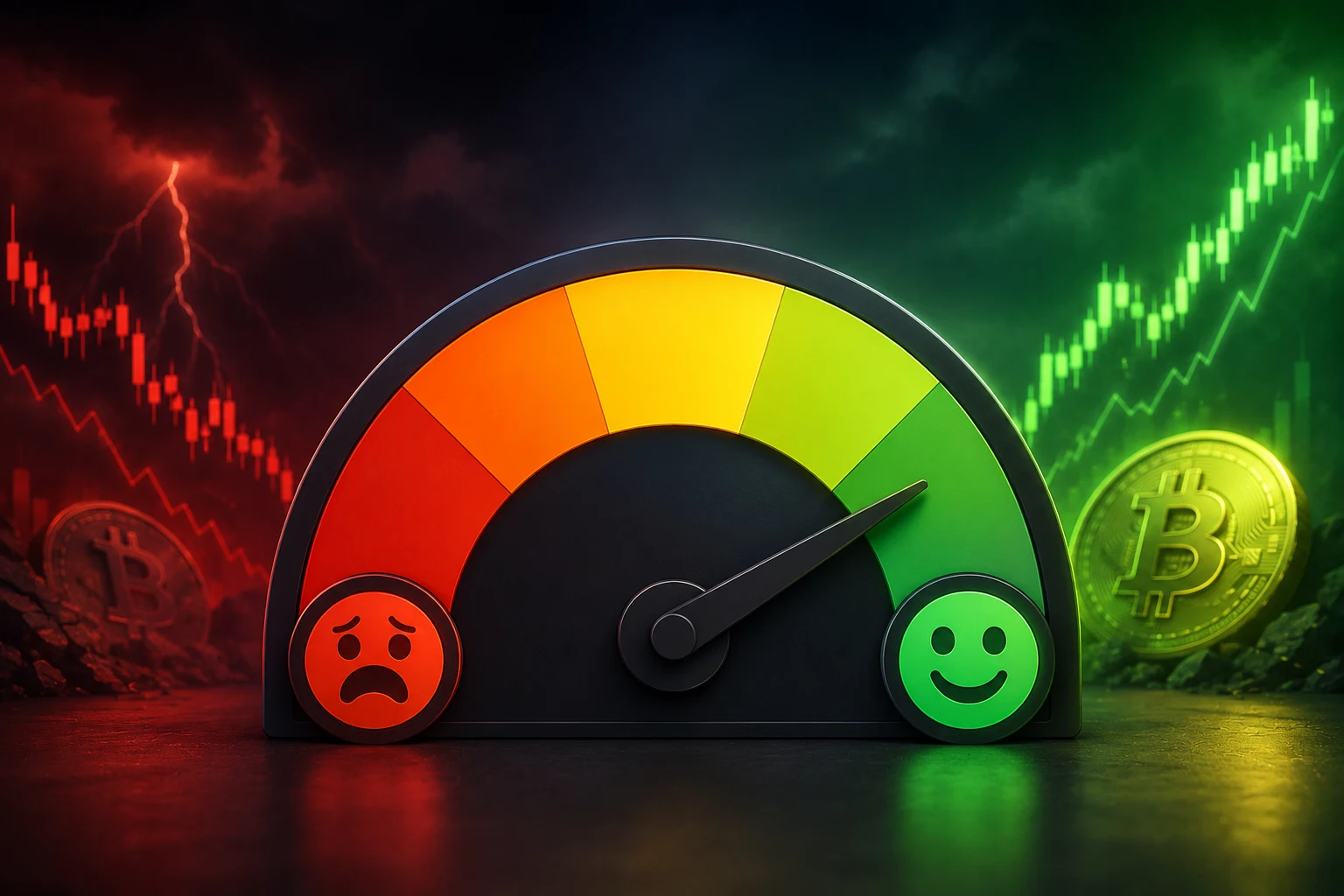
The Index is published by Alternative.me and scores BTC sentiment on a daily 0-100 scale, with five bands: Extreme Fear (0-24), Fear (25-49), Neutral (50), Greed (51-74), and Extreme Greed (75-100). A handful of inputs feed the score, each weighted differently:
- Volatility (25%). The current volatility and max drawdown of BTC compared with the recent 30- and 90-day averages. Unusual volatility tends to signal fear.
- Market momentum and volume (25%). Current volume and momentum versus their 30- and 90-day averages. High buying momentum in an up market is read as greed.
- Social media (15%). Posting rates and engagement around BTC topics on social channels.
- Dominance (10%). BTC dominance — its share of total crypto market cap. Rising dominance often coincides with fear in altcoins; falling dominance with greed.
- Trends (10%). Google search volume for BTC-related queries.
- Surveys (currently paused). Originally polled investor sentiment directly.
The exact weights have shifted over time, and the maintainer publishes details on their methodology page. The point is that several signals — not just price — are bundled into a single readable number.
Reading the Index
The Index is most informative at the extremes, not in the middle.
- Extreme Fear (0-24). Sharp drawdowns, panic, headlines about "the death of crypto." Historically, sustained Extreme Fear readings have clustered near major lows.
- Fear (25-49). Caution, sideways action, low conviction. Often appears in the late stages of a downtrend or early stages of recovery.
- Neutral (around 50). Balanced. The Index provides the least information here — many days sit in this band without telling you much.
- Greed (51-74). Optimism returning, healthy uptrends, but not yet euphoric.
- Extreme Greed (75-100). Euphoria, viral retail interest, headlines about "unstoppable" rallies. Historically, sustained Extreme Greed readings have clustered near major tops.
The classic contrarian framing — popularised by Warren Buffett's "be fearful when others are greedy and greedy when others are fearful" — fits the Index well. The Index does not tell you what you should do; it tells you what the average participant seems to be feeling.
How to use it well
The Index is at its most useful as a context input, not a trading signal:
- Sanity-check your own emotional state. If the Index says Extreme Greed and you feel certain prices will keep rising, that is exactly when discipline pays off most. What is hype in crypto covers how this kind of broad euphoria distorts judgement.
- Calibrate position sizing. Many investors lean into smaller new buys in Extreme Greed and more deliberate buys in Extreme Fear, on the basis that the average outcome from either has historically been more favourable than chasing greed and capitulating in fear.
- Cross-check against other signals. A single reading is a single data point. Trends over weeks — sustained Extreme Fear or Greed — are more informative than a single day.
- Watch divergences. Falling prices into an already-Extreme-Fear reading can mark exhaustion; rising prices into an already-Extreme-Greed reading can mark peak euphoria.
What it won't do for you
The Index has real limits, and several mistakes are common:
- It is not a timing signal. Extreme readings can last weeks. A reading of 80 today might be 85 tomorrow — "extreme" can get more extreme before turning.
- It is BTC-centric. The inputs lean heavily on BTC volatility, dominance and search. Altcoin-specific euphoria can run hot while the headline number looks neutral.
- It can be gamed by news events. A single large headline can spike the Index without changing the underlying market structure.
- Backtesting is fragile. The methodology has changed over the years; "this worked historically" claims should be treated with scepticism.
- It says nothing about why. A reading of 20 in a panic-driven crash and a reading of 20 in a slow grinding decline are very different setups; the Index alone won't tell them apart.
Treat the Index as a cheap, useful summary — one of several signals you watch — rather than an oracle.
What history teaches (and doesn't)
Long-time crypto investors will tell you the Index has "called" several major turns. They are mostly right — sustained readings deep in Extreme Fear coincided with the lows of 2018, 2020 (Covid crash), 2022 (post-Luna), and other major drawdowns; sustained Extreme Greed marked the 2021 top zone. They are also being selective. The Index also stayed in Greed for months in 2021 well after a contrarian would have started reducing risk, and dropped into Fear during 2024 corrections that turned out to be buying opportunities only in hindsight.
The honest summary: the Index improves your odds of recognising emotional extremes. It does not eliminate noise, and treating any single reading as decisive will lead you wrong. Use it as one input alongside crypto market cycles, on-chain data, and the broader news flow.
Read the mood with the headlines that shape it
A sentiment number is most useful when you can see the news driving it. Zippfeed tracks crypto headlines across many sources with sentiment (bullish, neutral, bearish) and importance scoring, so the Fear and Greed reading sits alongside the stories actually moving it — exchange trouble, ETF flows, regulatory moves, market shocks. That way the Index is not just a number on a dial; it is a number you understand. This is educational, not financial advice.

 CryptoSlate
 Glassnode
 WatcherGuru
 Altcoin Daily
 WuBlockchain