Web1, Web2, Web3 in one paragraph
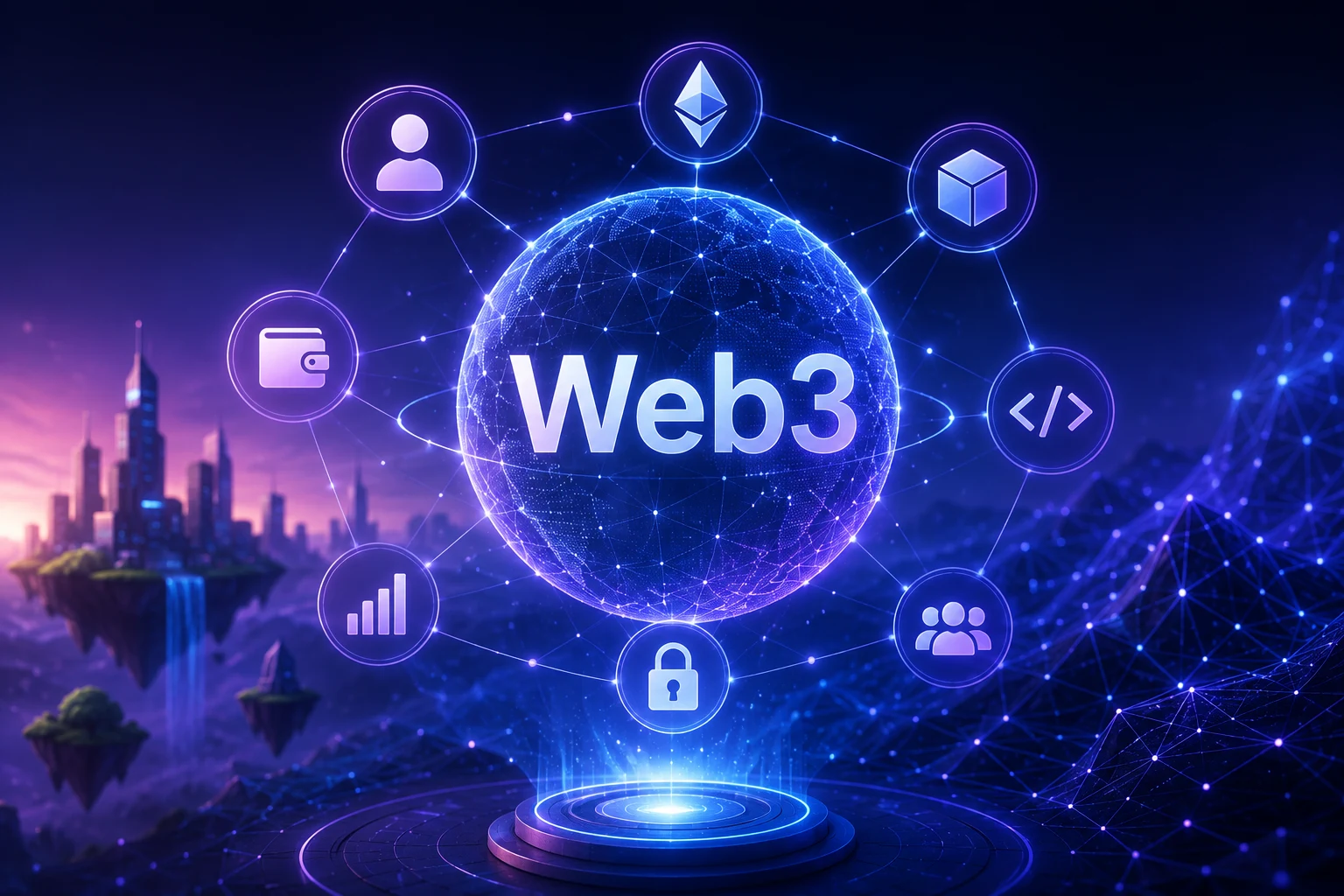
Web1 was the early internet of the 1990s: mostly static pages you could read. Web2 is what we've used since the mid-2000s: dynamic platforms (Google, Facebook, YouTube, Instagram, TikTok) where you can read and write — but the platforms own your data, your identity, and the rules. Web3 proposes a third era where users own their identity, data, and digital assets directly via cryptographic wallets, with apps built on public blockchains instead of on a company's private servers.
How Web3 actually works
Wallets as universal accounts
In Web2 every app has its own account system — emails, passwords, profiles, all stored on their servers. In Web3, a single crypto wallet functions as your account across every compatible app. You connect the wallet, sign a message to prove ownership, and the app reads your on-chain state (token holdings, NFTs, ENS name) without storing your data centrally. One wallet, many apps.
On-chain data
The data that matters — token balances, NFT ownership, smart contract interactions, on-chain identity — lives on a public blockchain anyone can read. That data isn't locked in a platform's database; if one app shuts down, the next can pick up exactly where you left off.
Tokens as economic primitives
Web3 apps usually have a native token. The token can be used as in-app currency, a governance vote, a yield-bearing position, or a status / access pass. Whether each token actually needs to exist is a separate question — many Web3 projects shipped tokens because they could raise money that way, not because the product needed one.
What Web3 actually delivers today
Stripped of marketing, here's what genuinely works.
- Self-custodial wallets and identity. ENS names, Lens profiles, on-chain reputation that follows you across apps.
- DeFi. Lending, swapping, and yield without an intermediary — for users willing to manage the risk.
- NFTs as access passes and memberships. Holding a token unlocks a Discord, an event, a software license.
- Crowdfunding via tokens. DAOs let groups pool capital and vote on its deployment.
- Direct creator monetization. Artists, writers, and musicians can sell editions to fans without a platform taking 30-50%.
None of this requires "replacing Big Tech." It just expands what users can do in addition to the Web2 apps they already use.
What Web3 is not (yet)
Where the marketing usually overshoots:
- It is not a faster internet. Most chains are slower than centralized servers; users tolerate it because of the ownership tradeoff.
- It is not truly decentralized end-to-end. Front-ends are usually centralized websites; many "decentralized" apps depend on a small handful of operators. Outages happen.
- It is not better at everything. A blockchain is the worst place to store a TikTok video. Web3 wins for ownership and value transfer, not for content delivery.
- It is not free. Transactions on most chains still cost something, especially when networks are busy. That cost is the price of decentralization.
The risks worth knowing
- You are your own bank. Self-custody means you carry the security burden. Lose the seed phrase, lose access.
- Smart contract risk. The code that runs Web3 apps can be exploited. Funds can be lost in minutes with no recourse.
- Token speculation. Most Web3 tokens trade as speculative assets. Investing in tokens to access an app is not the same as using the app.
- Phishing and signature scams. Web3 has a unique attack surface — every transaction signature can move funds or grant approvals. Malicious sites mimic real ones.
- Project abandonment. Decentralized doesn't mean immortal. Many DAOs and Web3 projects ship, raise tokens, and quietly die.
How to start (carefully)
The cheapest way to feel what Web3 is: install a wallet, get an ENS name, try a token-gated community or a creator drop. Use a separate wallet from any meaningful holdings; assume any transaction you don't understand is a trap; never share your seed phrase. Our guides on what is a smart contract and how to store crypto securely are the right warmup before signing anything that moves real money.
Read Web3 like a pro
Web3 evolves through fast, partly invisible cycles — protocol upgrades, exploits, governance fights, narrative pivots. Zippfeed tracks Web3 and crypto headlines across sources with sentiment and importance scoring, so you can tell when a chain is genuinely shifting versus when a thread is just a coordinated push. The reality of Web3 is decided in news flow, not in pitch decks.