








 CoinDesk
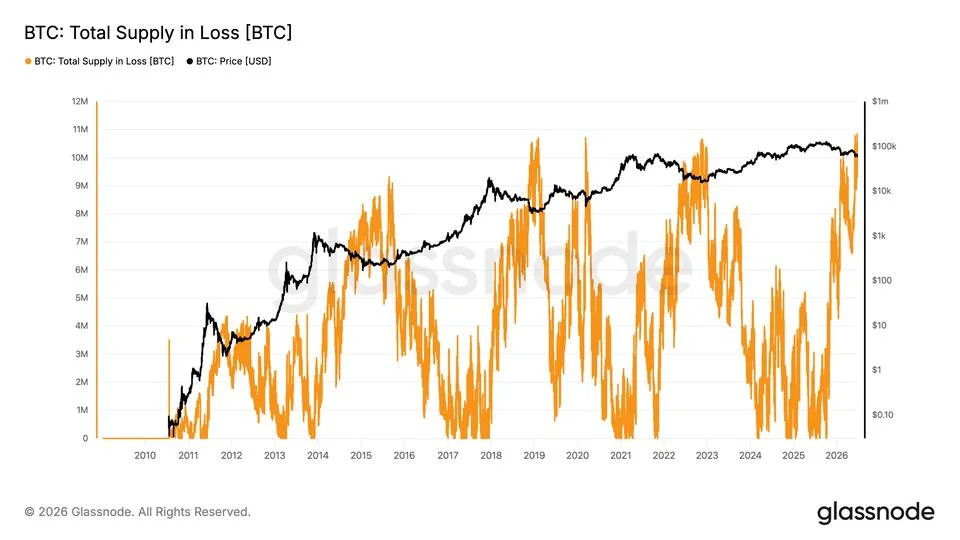



Bitcoin's slide to around $59,100 on Wednesday pushed 10.83 million BTC into loss, the highest reading on record, exceeding peaks seen during past bear-market bottoms. The figure climbed from 9.8 million four months ago and from 10.78 million in early June, and now sits broadly above the ~10.5 million levels that marked cycle lows in 2019, 2020 and 2022.
Long-term holders, defined by Glassnode as investors who have held their coins for at least 155 days, are not capitulating. They now control roughly 14.8 million BTC, an all-time high representing close to 75% of the ~20 million BTC in circulation. Within that cohort, 5.58 million BTC sit at a loss, the second-highest reading ever recorded, behind only March 2020.
Why it matters
The supply-in-loss metric is a classic capitulation proxy: a high reading signals that a large share of holders are underwater and theoretically more willing to sell. But the data tells a more nuanced story this cycle. Long-term holders, historically the cohort that absorbs bear-market supply, are still adding rather than distributing. Roughly 37% of their holdings are in the red, yet their aggregate share of supply keeps expanding, a pattern that has consistently marked the late stages of previous drawdowns rather than the start of fresh downside.
Market impact
The price action around the print frames the tension. Bitcoin has repeatedly tested the $60,000 level since February, briefly breaking below it several times, while exchange volumes in May fell 3.45% to $4.41 trillion, the lowest since September 2024. Lower volume into deeper unrealized losses usually signals thinning sell-side pressure rather than panic, because the marginal seller is no longer the long-term holder. Watch the LTH supply share and the 155-day realized loss ratio for confirmation that the cohort is still absorbing rather than distributing.

Frequently asked questions
-
What does the Bitcoin supply in loss metric measure?
It counts the amount of BTC currently held at a price below the cost basis of its current owner. A higher reading means more holders are sitting on unrealized losses, a classic capitulation proxy.
-
Why is the latest 10.83M BTC print considered a record?
It exceeds the peaks reached at every prior bear-market bottom. Previous cycle lows in 2019, 2020 and 2022 topped out near 10.5M BTC in loss, so the current reading is the deepest on record.
-
How are long-term holders behaving during this drawdown?
They are still accumulating. The cohort now controls a record 14.8M BTC, roughly 75% of circulating supply, and 5.58M of those coins are at a loss, the second-highest level after March 2020.
-
What does high supply in loss usually mean for price?
Historically, peaks in supply in loss have marked late-stage bear markets rather than fresh downside, especially when long-term holders keep adding. The metric signals stress, but the response of the LTH cohort is what determines whether the stress resolves into further selling or a base.
-
What on-chain signals should traders watch next?
Two Glassnode prints: the long-term holder supply share, still rising, and the 155-day realized loss ratio, which gauges how aggressively underwater holders are selling. Combined with low exchange volume, they will confirm whether the market is absorbing or distributing.
 Whale Alert
 Crypto News
 CryptoSlate
 CoinTelegraph
 WuBlockchain
 WatcherGuru
 Lookonchain