








 CoinDesk
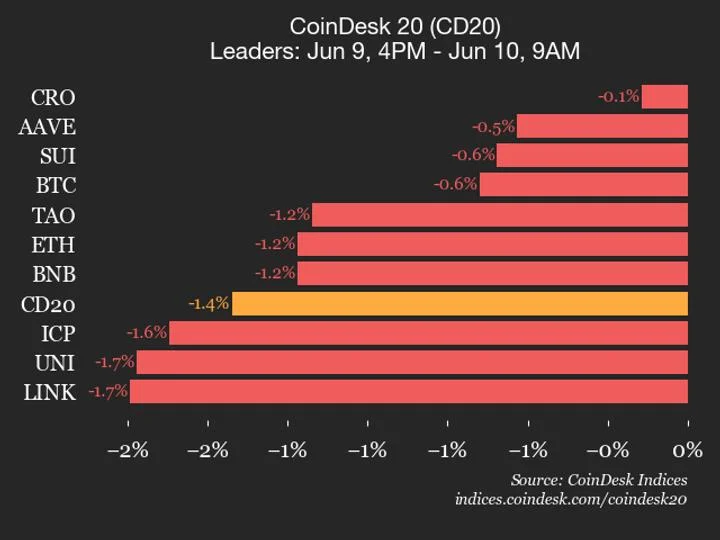
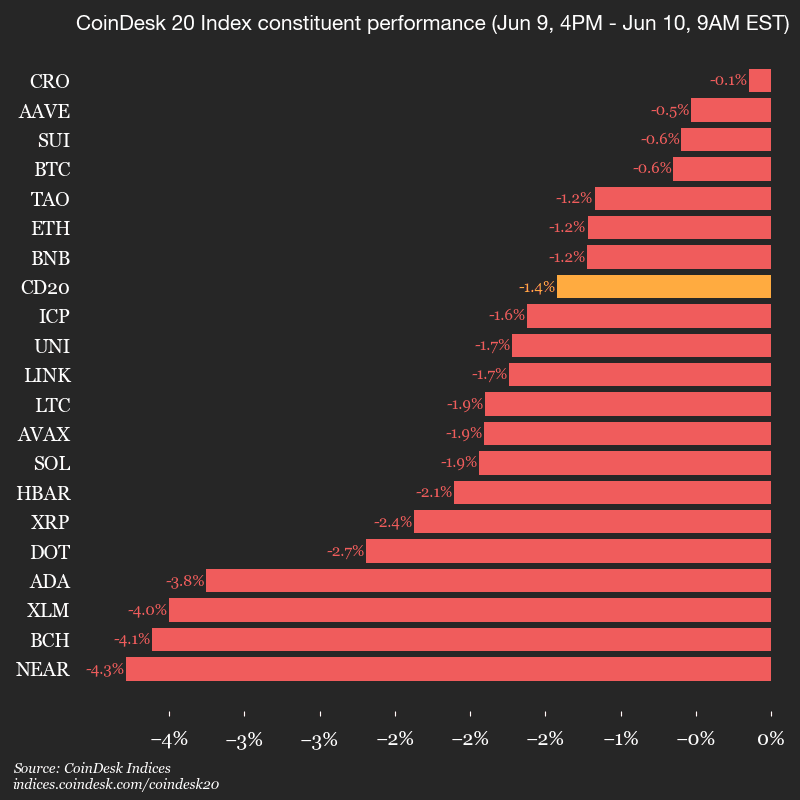
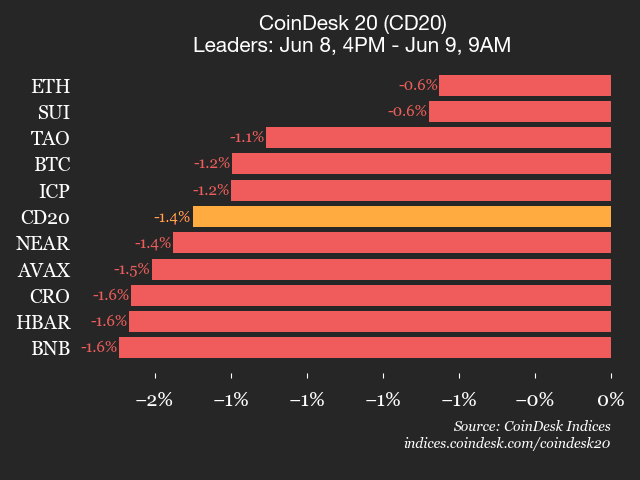

The CoinDesk 20 Index fell 1.4% to 1663.81 in the latest session, a 24.03-point drop that masked an unusually clean signal underneath: every one of the 20 constituents closed lower. Bitcoin Cash (BCH) led losses at -4.1% and NEAR Protocol (NEAR) followed at -4.3%, while the day's "best" performers — CRO at -0.1% and AAVE at -0.5% — still failed to hold flat.
Why it matters
A 1.4% drop on the index is unremarkable in isolation, but 20-for-20 negative breadth is not. When every large-cap crypto asset sells off in lockstep, the catalyst is almost always a macro impulse — a dollar move, a rates repricing, or a risk-off rotation out of the sector — rather than token-specific news. Breadth like this turns a routine pullback into a tape-reading signal: the market is being told to de-risk, not to differentiate.
Market impact
The laggard side does the more useful work here. BCH and NEAR are both high-beta to broad crypto beta, so their 4%+ drops confirm the move was beta-driven rather than thesis-driven — neither name had a project-specific catalyst to explain the underperformance. Conversely, the relative resilience of CRO and AAVE at well under 1% down points to where defensive flows parked during the session, a rotation pattern worth watching if the red tape extends into the next session.





Frequently asked questions
-
What is the CoinDesk 20 Index?
The CoinDesk 20 is a broad-based market index tracking the performance of 20 major crypto assets, traded on multiple platforms in several regions globally. It is maintained by CoinDesk Indices.
-
What was the CoinDesk 20's level in this update?
The CoinDesk 20 was trading at 1663.81, down 1.4% (-24.03 points) since 4 p.m. ET on the prior session. All 20 constituent assets closed lower.
-
Which assets were the biggest laggards?
NEAR Protocol (NEAR) was the worst performer at -4.3%, followed by Bitcoin Cash (BCH) at -4.1%. Both are high-beta to broad crypto beta, with no project-specific catalysts cited.
-
Which assets held up best?
Cronos (CRO) fell just 0.1% and AAVE declined 0.5%, making them the session's relative leaders. Their resilience pointed to where defensive flows parked during the selloff.
-
Why does 100% negative breadth matter more than a 1.4% drop?
A routine 1.4% index decline can reflect single-name weakness, but when every constituent closes red, the move is almost always a macro impulse — a dollar shift, rates repricing, or sector-wide de-risking — rather than asset-specific news.
 Crypto Rank News
 Crypto News
 Lookonchain
 Altcoin Daily
 WatcherGuru