


 CryptoSlate
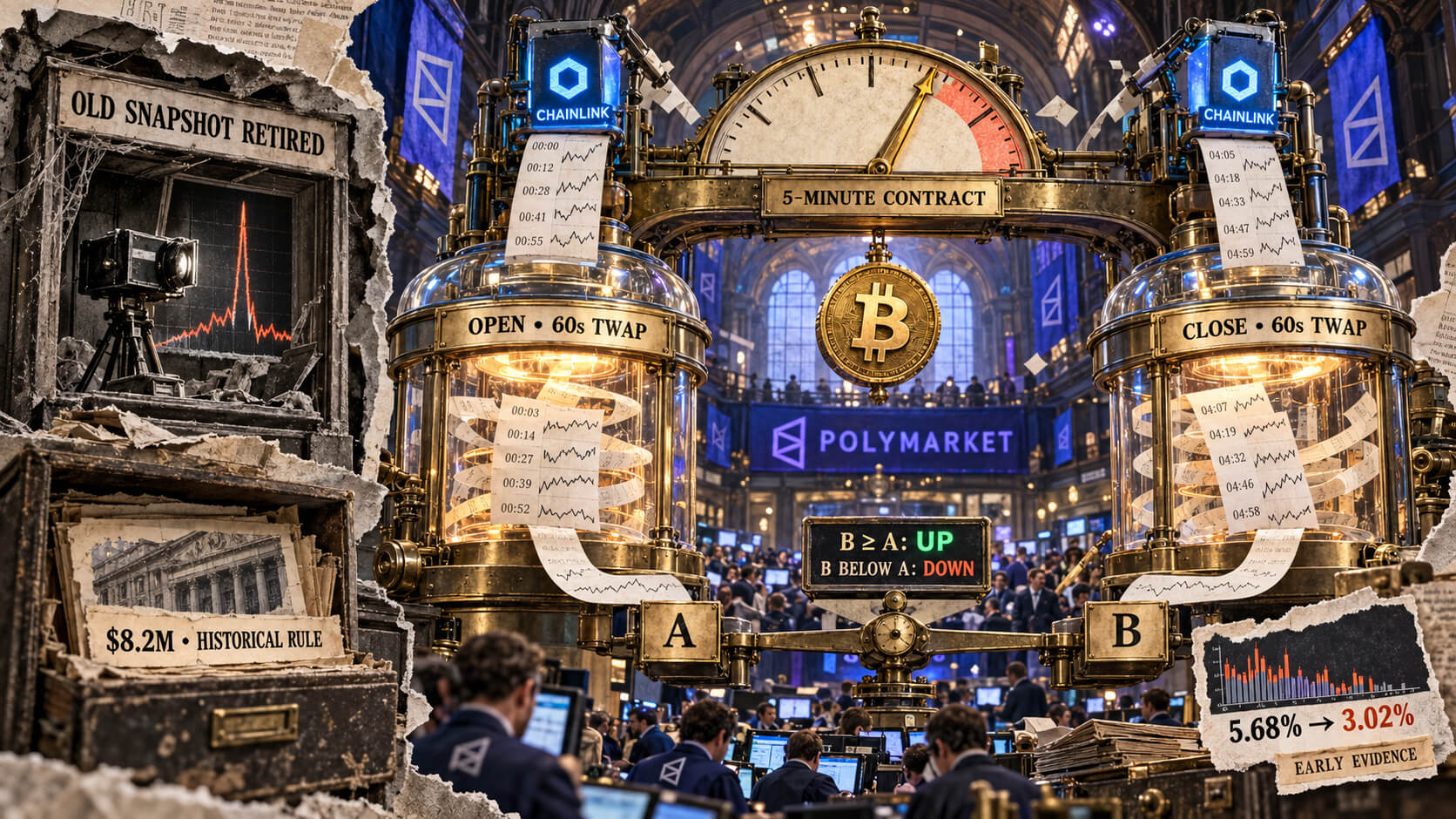


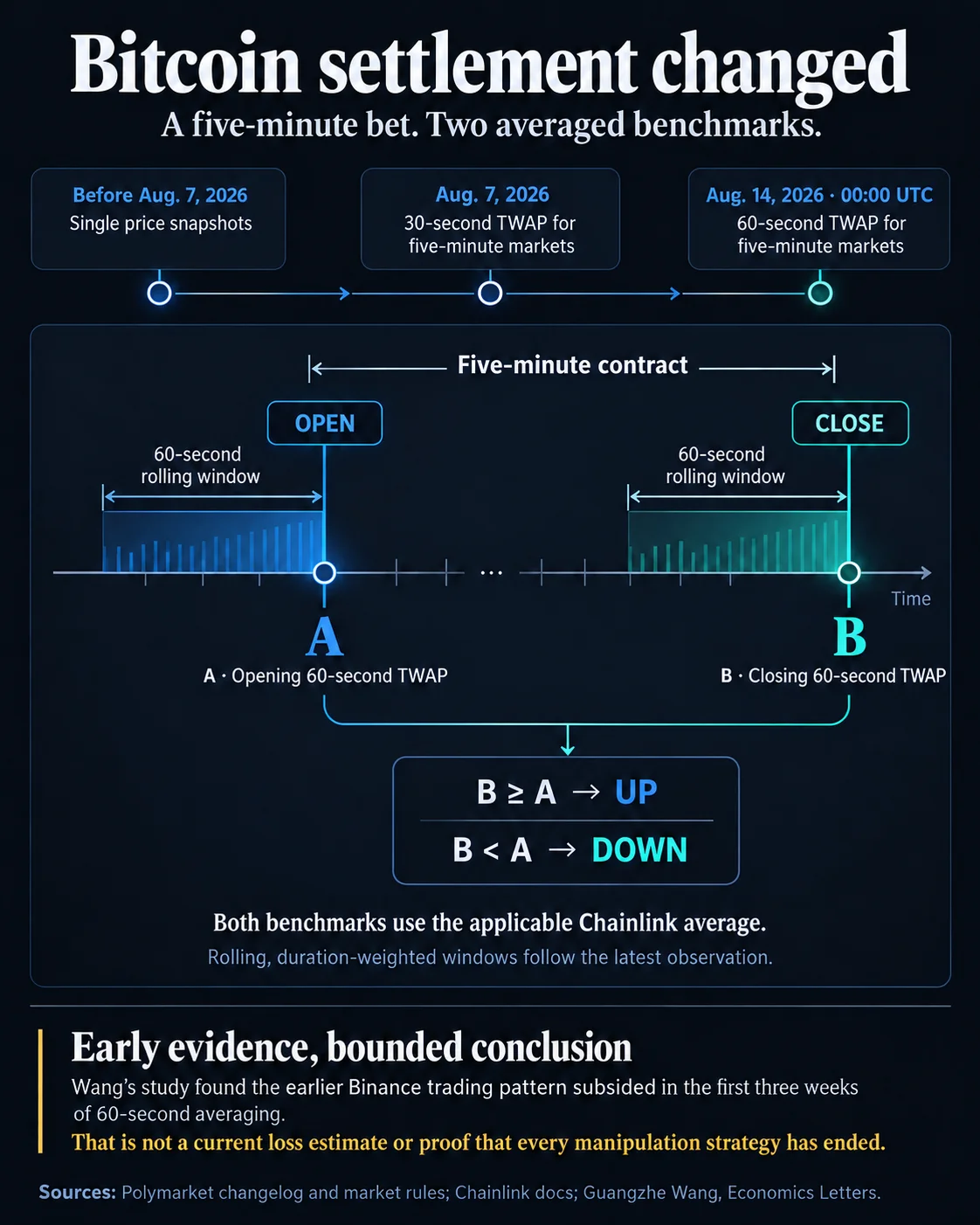
Polymarket’s five-minute Bitcoin markets now use 60-second averages for both opening and closing benchmarks, a reform that changed the incentive to move a single settlement price. In Wang’s before-and-after sample, Binance’s final-10-second volume share fell from 5.68% under single-snapshot settlement to 3.02% under the 60-second regime, close to the 3.05% pre-launch baseline. The sample covered 82,752 Bitcoin boundaries from July 1, 2025, through Sept. 4, 2026.
Why it matters
The reform followed earlier research that identified settlement-time spot-flow spikes and reversals around Polymarket’s five-minute Bitcoin contracts. Under the previous rule, a brief move could matter if it landed on the selected reference price. With a 60-second time-weighted average price, that move contributes according to how long it affects the measurement window.
Polymarket switched crypto up/down markets from single snapshots to Chainlink-computed averages on Aug. 7 and extended five-minute markets to 60 seconds on Aug. 14. The opening benchmark and final settlement value now use the applicable TWAP feed. That is a material change to the strategy and risk calculation, not simply a change in data presentation.
Market impact
Wang found no systematic migration into earlier trading bins and no recurrence of the earlier near-strike reversal pattern during the first three weeks of the 60-second regime. The result supports the reform’s effectiveness against the measured Binance pattern, but it does not prove that every manipulation strategy has disappeared.
The previously cited estimate of $8.2 million earned by 821 wallets belongs to the earlier research and cannot be carried into the current rule without evidence. A current profitability test would need to include prediction-market gains, Bitcoin trades, execution costs, and the reference values used at both boundaries.

Frequently asked questions
-
What changed in Polymarket’s five-minute Bitcoin contracts?
Polymarket replaced single-snapshot benchmarks with 60-second Chainlink-computed TWAPs for both the opening price and final settlement value.
-
How did Binance trading change after the 60-second settlement reform?
Wang’s sample found that Binance volume in the final 10 seconds fell from 5.68% under single-snapshot settlement to 3.02% under the 60-second regime.
-
How large was Wang’s Bitcoin sample?
The study examined 82,752 Bitcoin boundaries using Binance one-second data from July 1, 2025, through Sept. 4, 2026.
-
Did the reform eliminate all possible manipulation strategies?
No. The findings support the reform against the measured Binance trading pattern, but do not show that every possible strategy has disappeared.
-
Does the earlier $8.2 million wallet-gain estimate apply to the new rule?
Not directly. The estimate covered the earlier settlement rule, while a current profitability test would also need Bitcoin trades, execution costs, and both reference values.
 WatcherGuru
 WuBlockchain
 TheBlock
 CoinDesk
 Lookonchain
 CoinTelegraph