








 CoinDesk
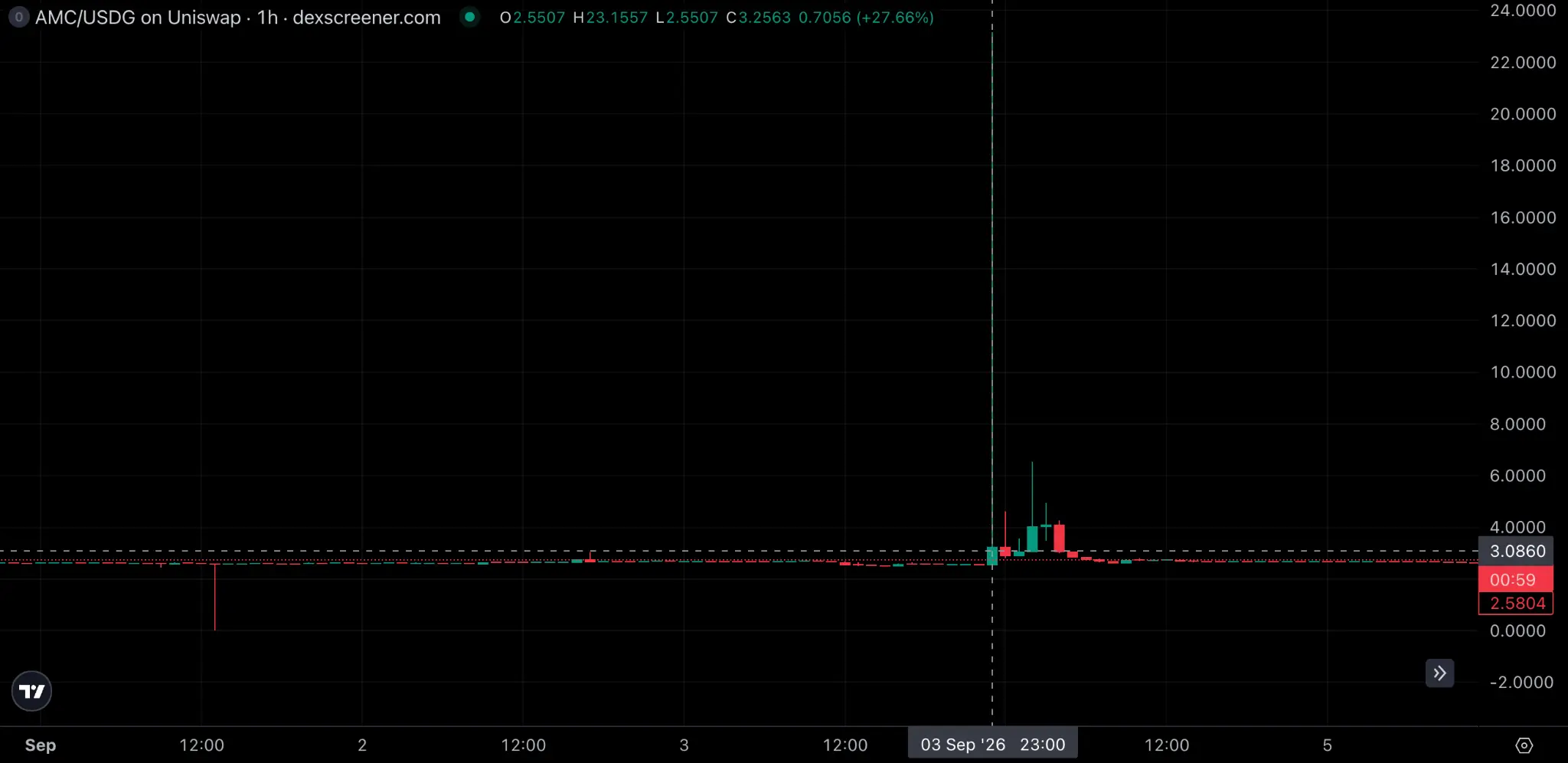


Robinhood’s tokenized AMC share traded as high as $23.16 while AMC had closed at $2.54, then fell to $3.26 within the same hour. The $10.5 million trading burst showed how a wrapped stock token can diverge sharply from the underlying share when the NYSE is closed.
The episode has widened a dispute between AMC CEO Adam Aron and Robinhood CEO Vlad Tenev over which tokenization model deserves to be treated as a legitimate market. The SEC’s Sept. 17 view grants a five-year exemption for issuer-sponsored tokens that preserve the same dividends, votes and class rights as the underlying share. Synthetic exposure, including Robinhood’s tokenized stock model, is excluded.
Why it matters
Robinhood’s AMC token generally tracked the NYSE price across seven sessions, closing within 0.87% of the stock at the median and 2.71% at the widest point. But the alignment depends on arbitrage and the ability to create or redeem tokens against shares.
Robinhood’s Jersey issuer has only one authorized participant for minting and redemption. When the AMC token spiked, no tokens were minted or burned. Without a liquid borrowing market for the token, traders could not simply short the premium and hedge against the underlying share. Sellers were therefore making directional bets with their own capital, while demand for an unrelated memecoin also helped move the AMC token pool.
Market impact
Wrapped tokens can expand access to U.S. equities. Robinhood’s Stock Tokens cover more than 190 companies across 120 countries, but that reach comes with counterparty risk, weaker issuer transparency and a premium or discount when the underlying market is closed. SEC rules cap onchain trading at 0.25% of average daily volume for large-cap stocks and 2.5% for other listed stocks, while offshore wrapped tokens for non-U.S. holders remain outside the SEC’s jurisdiction.
Issuer-sponsored tokens take a different path. They tokenize the registered share itself, preserving voting rights and corporate actions while reducing the conversion risk between separate instruments. Their weakness is limited distribution and thin liquidity. A mature market may need both models, connected through exchanges, brokers, market makers, transfer agents and clearinghouses. The key challenge is building the infrastructure that lets those markets share a live price, collateral and settlement rail around the clock.
Frequently asked questions
-
Why did Robinhood’s AMC token diverge so sharply from AMC’s stock price?
The underlying NYSE market was closed, while the token continued trading. Limited minting, redemption and borrowing infrastructure prevented arbitrageurs from quickly aligning the token with AMC’s last quoted share price.
-
What happened to Robinhood’s AMC token during the September spike?
The token rose from $2.55 to $23.16 while AMC had closed at $2.54, then fell to $3.26 within the same hour. Trading volume in the pool reached $10.5 million.
-
How does the SEC distinguish issuer-sponsored tokens from wrapped tokens?
The SEC’s Sept. 17 view covers issuer-sponsored tokens that preserve the underlying share’s dividends, votes and class rights. Synthetic exposure, including Robinhood’s tokenized stock model, is excluded.
-
What are the main advantages and risks of wrapped stock tokens?
Wrapped tokens can expand access to U.S. equities across markets, but holders face counterparty risk, weaker issuer transparency and possible price dislocations when the underlying exchange is closed.
-
Why could both tokenization models be needed?
Wrapped tokens provide broad distribution, while issuer-sponsored tokens preserve shareholder rights and offer a cleaner reference for market makers. Connecting both through shared settlement and collateral rails could support continuous trading.
 TheBlock
 CoinTelegraph
 WatcherGuru
 Altcoin Daily
 WuBlockchain