


 CryptoSlate


Aave's TVL fell about $1.03 billion and Lido's dropped $713 million from Oct. 27 to Nov. 3, a combined decline of roughly $1.74 billion. The figures came as stablecoin market capitalization fell about $10.8 billion over 30 days, with contraction already underway before Binance disclosed its Oct. 29 security breach. Binance estimated about $6.34 billion in assets were impacted and said it would absorb the financial impact.
Why it matters
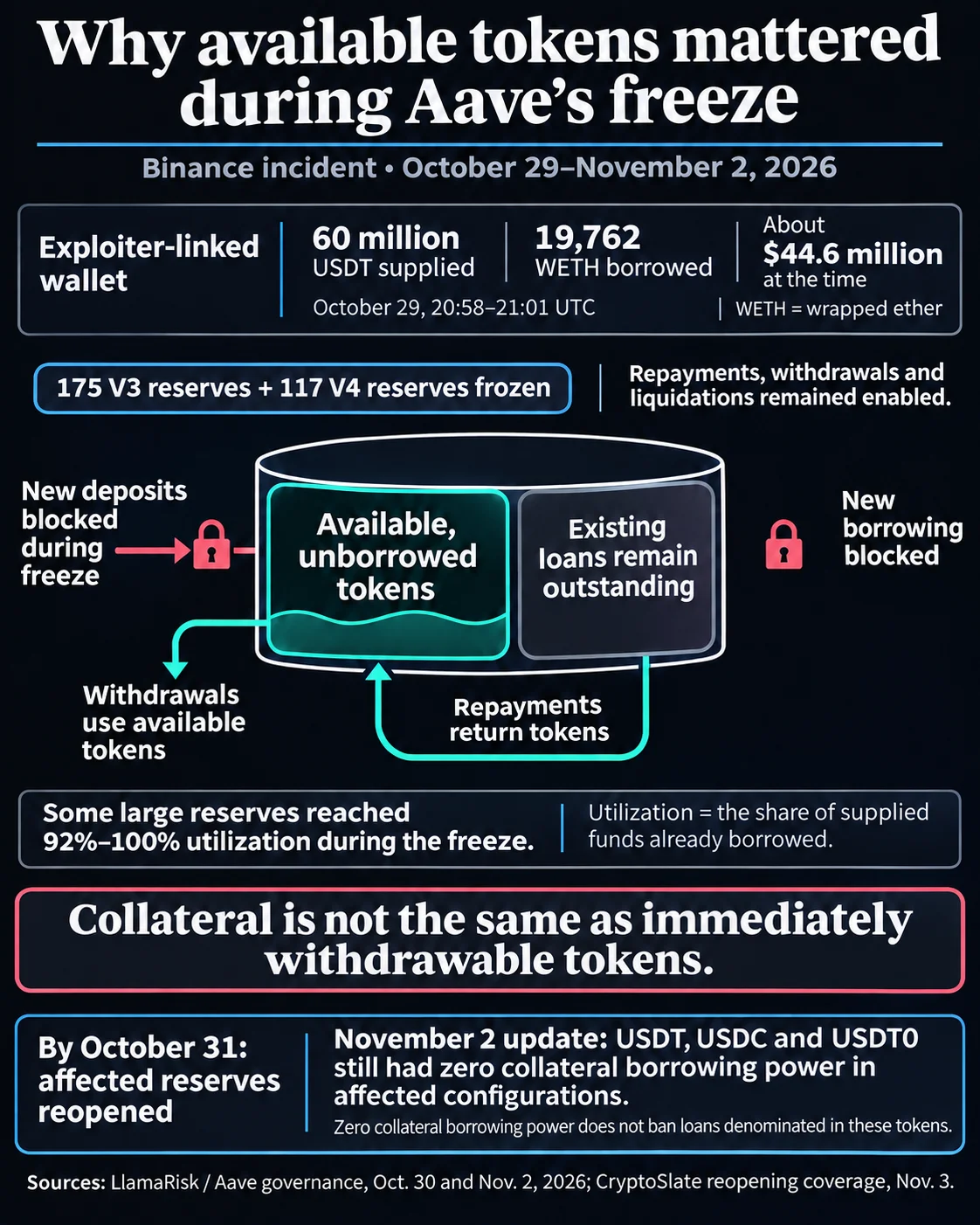
The breach added pressure to an already contracting market. An exploiter-linked wallet supplied 60 million USDT to Aave and borrowed 19,762 WETH, worth about $44.6 million at the time. Aave's risk provider, LlamaRisk, described the position as overcollateralized and subject to normal liquidation, with no risk to suppliers identified in its Oct. 30 assessment.
Aave guardians then froze 175 V3 reserves and 117 V4 reserves. New deposits and borrowing were paused in those reserves, while repayments, withdrawals and liquidations remained available. Withdrawals pushed some large reserves to 92%-100% utilization, meaning nearly all supplied funds were borrowed, and borrowing costs rose. The affected reserves reopened by Oct. 31.
Market impact
LlamaRisk's Nov. 2 update said USDT, USDC and USDT0 still had zero collateral borrowing power in affected configurations. It also reported that specified non-stablecoin collateral settings had been restored and that affected reserves returned to pre-incident rate curves on Nov. 1.
The TVL declines are not proof of equivalent withdrawals: falling token prices can reduce dollar-denominated TVL without depositors moving assets. DeFiLlama's dashboard put stablecoin market capitalization at $293.8 billion on Nov. 3, down more than $10 billion in 30 days. Healthier conditions would include renewed stablecoin issuance, returning lending deposits, lower reserve utilization and steadier collateral prices. A TVL rebound alone would not establish that lending liquidity had returned.





Frequently asked questions
-
How much did Aave and Lido's TVL decline between Oct. 27 and Nov. 3?
Aave's TVL fell about $1.03 billion and Lido's dropped $713 million, a combined decline of roughly $1.74 billion.
-
What did the exploiter-linked wallet do on Aave?
It supplied 60 million USDT and borrowed 19,762 WETH, worth about $44.6 million at the time. LlamaRisk described the position as overcollateralized.
-
What happened to Aave reserves during the temporary freeze?
New supply and borrowing stopped in frozen reserves, while repayments, withdrawals and liquidations remained enabled. Some large reserves reached 92%-100% utilization as withdrawals rose.
-
Which stablecoins retained zero collateral borrowing power in affected Aave configurations?
LlamaRisk's Nov. 2 update said USDT, USDC and USDT0 still had zero collateral borrowing power in the affected configurations.
-
Does a decline in TVL prove that depositors withdrew funds?
No. Falling token prices can reduce dollar-denominated TVL without depositors moving assets, so the reported decline does not establish equivalent capital flight.
 WatcherGuru
 Crypto Capital Venture
 Whale Alert
 Lookonchain
 WuBlockchain
 Crypto Rank News
 CoinDesk