








 Lookonchain
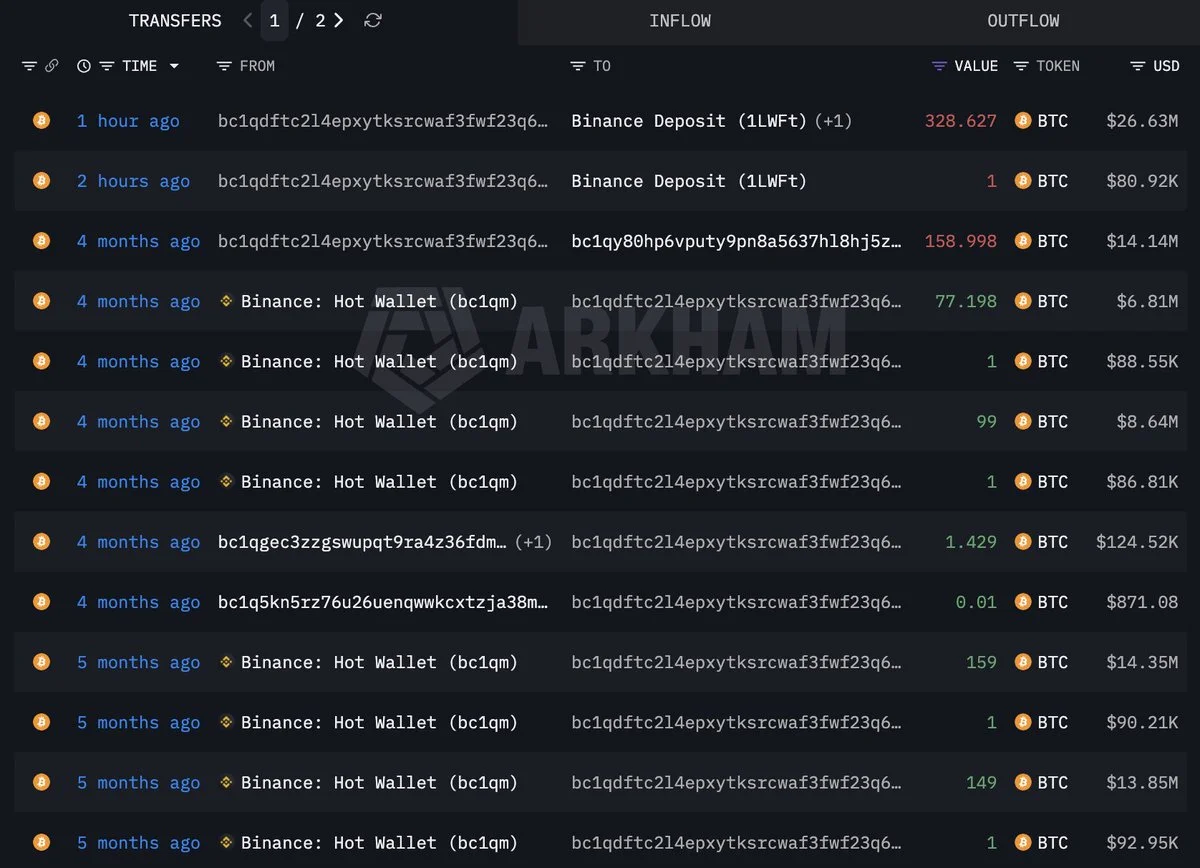


A whale wallet deposited 489 $BTC, worth roughly $39.59 million, to Binance one hour before reporting, cutting a position opened four months ago at an average entry of $90,144. The sale locks in a realized loss of approximately $4.45 million.
Why it matters
The deposit traces back to a buy executed around the October 2024 peak near $90K, meaning the holder rode the entire post-ATH drawdown before choosing to exit into a still-weak tape. On-chain flow into Binance from long-dormant whales has been a recurring signature of late-cycle capitulation rather than mid-cycle rebalancing — these are wallets that have already absorbed the full retracement and are now accepting the loss to redeploy capital.
Market impact
A single 489 $BTC deposit does not move spot, but the *type* of seller does: a four-month holder realizing a double-digit-million loss is the kind of flow that signals exhausted patience among the marginal long. Combined with the broader pattern of whale-to-exchange transfers in the same band, it adds to the bearish tape reading rather than offsetting it.

Frequently asked questions
-
What happened in this whale transaction?
A wallet deposited 489 $BTC, worth roughly $39.59 million, to Binance and locked in an approximately $4.45 million loss on a position opened four months earlier at an average entry of $90,144.
-
When did the whale originally buy the Bitcoin?
The position was accumulated four months before the deposit, at an average price of $90,144 — around the October 2024 peak near $90K.
-
How much did the whale lose on the sale?
The realized loss is approximately $4.45 million, reflecting the gap between the $90,144 average entry and the spot price at the time of the Binance deposit.
-
Does a 489 $BTC deposit move the Bitcoin price?
A single 489 $BTC transfer is small relative to spot liquidity and does not move the market on its own, but the pattern of long-dormant whales capitulating onto sell-side venues is read as a late-cycle distribution signal.
-
Why is a whale-to-Binance deposit considered bearish?
Transfers to Binance typically signal intent to sell, and a four-month holder realizing a double-digit-million loss indicates exhausted patience among marginal longs — a pattern associated with late-cycle capitulation rather than routine rebalancing.
 TheBlock
 Crypto Capital Venture
 CryptoSlate
 CoinTelegraph
 WatcherGuru
 Crypto News
 CoinDesk
 Whale Alert