








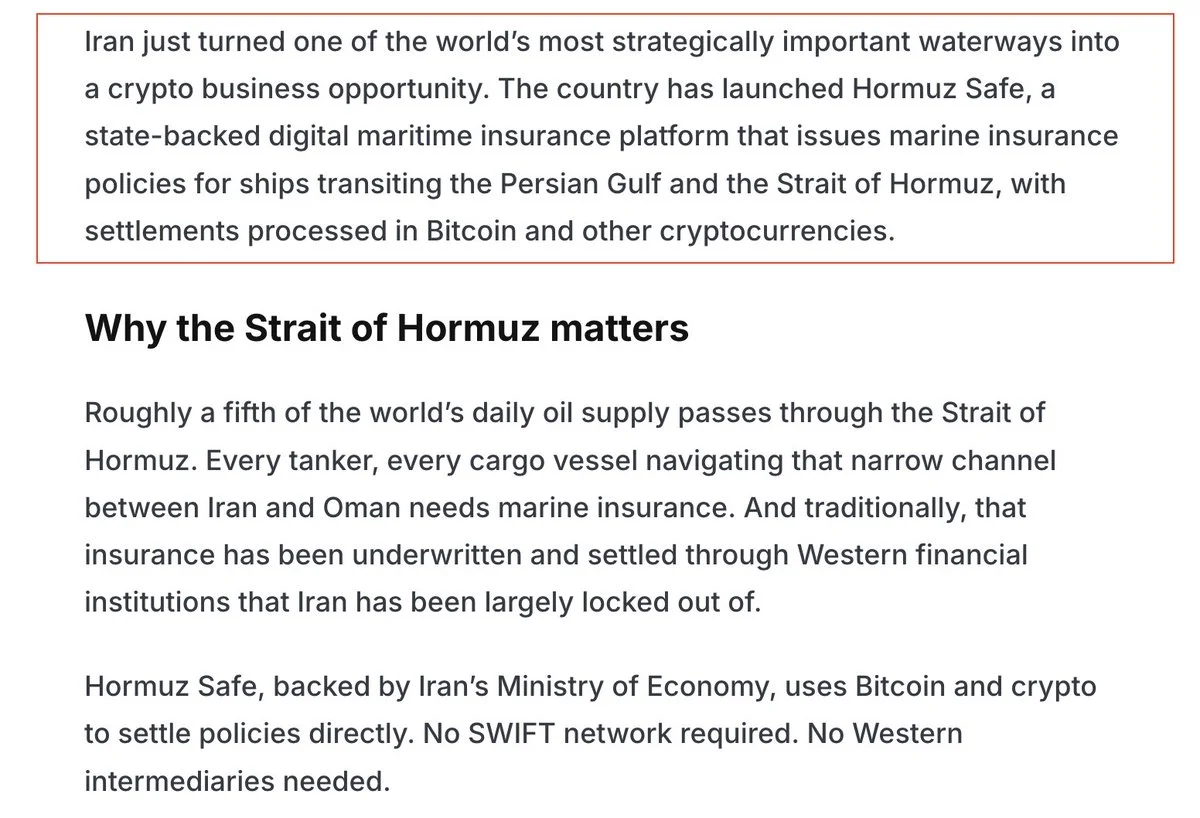

Iran's Ministry of Economic Affairs has backed a new state-supported digital maritime insurance platform called Hormuz Safe, targeting vessels transiting the Persian Gulf and the Strait of Hormuz. Settlement is denominated in Bitcoin and other cryptocurrencies, and the explicit design goal is to route around SWIFT and Western intermediaries.
Why it matters
Gulf shipping insurance is one of the most concentrated and sanctions-sensitive corners of global finance — a small number of Lloyd's of London syndicates and P&I clubs effectively underwrite most of the world's tanker fleet. If even a slice of that book migrates to a Bitcoin-settled platform that doesn't touch Western correspondent rails, the precedent travels faster than the policy itself.
Market impact
Iranian government insiders are projecting over $10 billion in annual revenue if Hormuz Safe captures a meaningful share of the Gulf shipping insurance market. That is an aspirational ceiling, not a baseline: international recognition remains unresolved, and the platform sits squarely inside the orbit of US secondary sanctions. The bet is structural — a parallel settlement layer for one of the world's most oil-loaded shipping lanes.
Source: [Iran launches Hormuz Safe, a Bitcoin-settled maritime insurance platform for Persian Gulf shipping — Crypto Briefing](https://cryptobriefing.com/iran-hormuz-safe-bitcoin-maritime-insurance/)

Frequently asked questions
-
What is Iran's Hormuz Safe platform?
Hormuz Safe is a state-backed digital maritime insurance platform backed by Iran's Ministry of Economic Affairs, targeting vessels transiting the Persian Gulf and the Strait of Hormuz. It supports settlement in Bitcoin and other cryptocurrencies.
-
Why is Iran using Bitcoin for maritime insurance settlement?
The explicit design goal is to route around SWIFT and Western intermediaries, allowing the platform to operate outside the US-dominated correspondent banking system.
-
How much revenue could Hormuz Safe generate?
Iranian government insiders have estimated the platform could generate over $10 billion in annual revenue if it captures a meaningful share of the Gulf shipping insurance market, though that figure is described as aspirational rather than a baseline.
-
What are the main risks facing Hormuz Safe?
The platform still faces challenges around international recognition and the risk of US secondary sanctions, which could deter foreign shippers and reinsurers from participating.
-
Why does Gulf shipping insurance matter for crypto adoption?
Gulf shipping insurance is highly concentrated among a small number of Lloyd's of London syndicates and P&I clubs. If a portion of that book migrates to a Bitcoin-settled platform, it would create a precedent for parallel settlement rails in one of the world's most oil-loaded shipping corridors.

 WatcherGuru
 CoinDesk
 CoinTelegraph
 Crypto News