








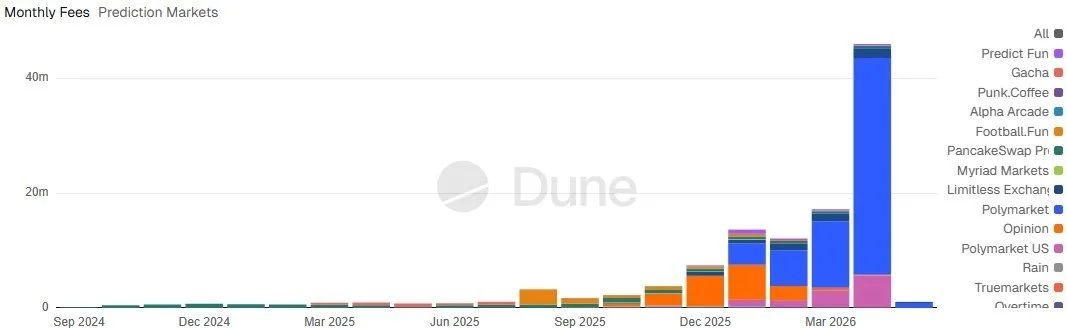
Polymarket's monthly fees reached $43.36 million in April, a record high and more than double March's total, according to @defioasis data. The figure implies annualized fees of roughly $520 million.
Why it matters
Polymarket Global generated $37.81 million of the April take, with Polymarket US contributing $5.55 million. Together, the two venues accounted for over 97% of total fees in the on-chain prediction market sector — a concentration ratio that has direct implications for category economics. When a single platform captures this share of fee flow, the marginal incentive for competing protocols to keep building is materially weaker.
Market impact
The doubling is the headline, but the split between Global and US is the more durable signal: roughly 14% of Polymarket's fees now come from the US-regulated product, despite the venue being a fraction of the global platform's age. For the broader prediction-market sector, the read is consolidation, not expansion — a single venue's revenue curve is no longer a proxy for the category's.
Frequently asked questions
-
How much did Polymarket make in fees in April 2026?
Polymarket generated $43.36 million in fees in April, a record high and more than double the prior month, per @defioasis data. The figure annualizes to roughly $520 million.
-
What is the split between Polymarket Global and Polymarket US?
Polymarket Global contributed $37.81M of April's fees, while Polymarket US added $5.55M. The US-regulated product is roughly 14% of total Polymarket fee flow despite being a fraction of Global's age.
-
How concentrated is the on-chain prediction market sector?
The two Polymarket venues together accounted for over 97% of total fees in the on-chain prediction market sector in April, per @defioasis — an unusually high concentration ratio for a crypto fee category.
-
Why does Polymarket's fee concentration matter for competing prediction protocols?
When a single platform captures 97%+ of category fee flow, the marginal incentive for rival protocols to keep building prediction-market infrastructure weakens materially. Category revenue growth becomes a single-venue metric rather than a sector-wide signal.
-
What does the Polymarket US fee share signal about US demand?
The ~14% US share on a venue much younger than Polymarket Global is an early indicator that US-regulated event-market demand may be structurally distinct — though it remains unclear whether it leads or simply follows the offshore flow.

 Whale Alert
 Lookonchain
 TheBlock
 Crypto Rank News
 CoinDesk
 Crypto News
 CryptoSlate