








 CoinDesk
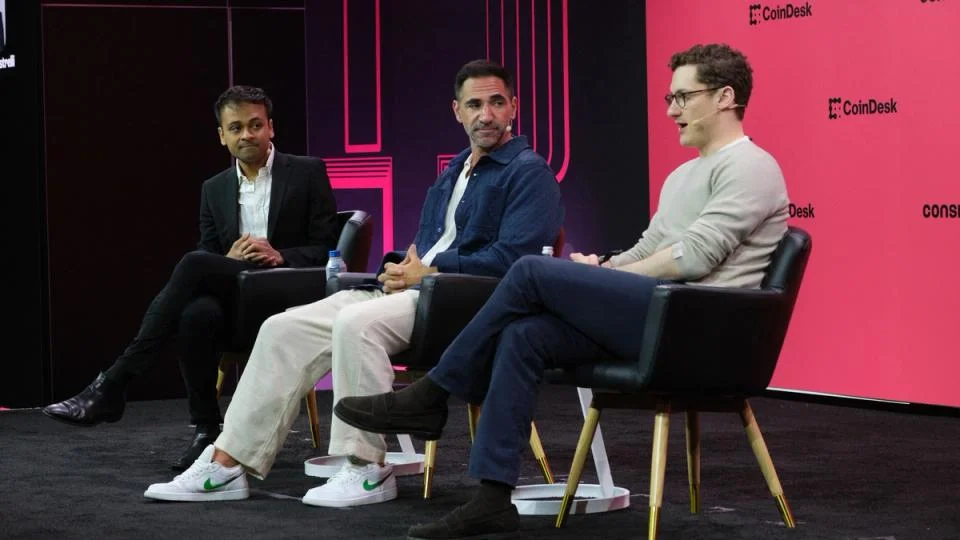


Novig will transition this summer from a 35-state sweepstakes product to a federal Designated Contract Market framework, co-founder and CEO Jacob Fortinsky said Thursday at Consensus Miami 2026, a move he framed as the first step toward treating sports event contracts as financial instruments rather than state-licensed gambling. The company expects to operate in all 50 states once the shift is complete, leapfrogging the patchwork of state sportsbook licenses that has defined US sports betting since PASPA fell in 2018.
Adam Mastrelli, founder of 57 Maiden, an AI-driven prediction-market trading firm, said the industry's hostility to sharp bettors is what pushed his team off legacy sportsbooks and onto platforms like Novig. "My partner and I got kicked off of two big sportsbooks within two months of trading because we were sharp," he said — comparing it to LeBron James being banned from the NBA for being too good. Of 154 trading strategies his firm prototyped, only three still run profitably; the most lucrative was the WNBA season.
Why it matters
Fortinsky put the global sports-betting market at roughly $2 trillion and argued it remains structurally dominated by legacy casinos that limit or ban profitable customers. An earlier attempt to license at the state level in Colorado, he said, ended with regulators telling Novig the priority was tax revenue, not consumer protection or market efficiency. The federal DCM route lets Novig sidestep that state-by-state gatekeeping and is the same framework Kalshi and Robinhood have used to scale event contracts nationally.
The legal architecture is the real story. Fortinsky predicted the federal-state jurisdictional fight — currently 15 pending suits between the CFTC, Kalshi, Robinhood, and various states — will reach the Supreme Court within two to three years. Counterintuitively, he argued sports is the safest vertical inside prediction markets because political and event-driven contracts carry bigger insider-trading and manipulation risk.
Frequently asked questions
-
What is Novig's new federal DCM framework and how does it differ from its current model?
Novig will transition this summer from a 35-state sweepstakes product to a federal Designated Contract Market framework, which would let it operate in all 50 states under CFTC oversight rather than as a state-licensed gambling product.
-
Why does Novig's CEO want sports betting regulated as a financial product?
Jacob Fortinsky argued that sports event contracts are binary financial instruments that have been mis-categorized as gambling, and that the legacy sportsbook model is structurally broken because it limits and bans its most profitable users.
-
Why were 57 Maiden's founders banned from major sportsbooks?
Adam Mastrelli said he and his partner were kicked off two major sportsbooks within two months because they were 'sharp' — winning too consistently — and the firms turned to prediction markets like Novig, which charges no fees and lets traders build synthetic positions.
-
How likely is the sports event-contract legal fight to reach the Supreme Court?
Fortinsky predicted the federal-state jurisdictional fight — currently 15 pending lawsuits between the CFTC, Kalshi, Robinhood, and various states — will reach the Supreme Court within the next two to three years.
-
Why did Fortinsky call sports the 'safest vertical' in prediction markets?
He argued counterintuitively that sports carries less insider-trading and manipulation risk than political and event-driven contracts, where the information edge and outcome uncertainty are larger and harder to police.
 WuBlockchain
 CoinTelegraph
 WatcherGuru
 CryptoSlate
 Benjamin Cowen
 TheBlock