Why every first-time buyer needs a red flag checklist
New tokens launch every day, and the majority of them lose value or disappear entirely within months. The pitch almost always looks the same: a slick website, a bold use case, a chart that has already pumped, and a community chat where everyone insists this is the next big thing. Most of those tokens go nowhere, and a meaningful share of them are designed from day one to separate buyers from their money.
The uncomfortable truth is that spotting a bad token is not about predicting the next 100x winner. It is about avoiding the most common traps first. Once you can rule out the obvious scams, you can think more clearly about the harder questions of whether a project actually solves a problem and whether demand for its token is real.
This article is a checklist, not a trading guide. Treat it as the minimum due diligence you should run before clicking buy on any token you have never held before, especially anything promoted by a friend, an influencer, or a Telegram group you just joined.
The risks of ignoring the checklist
Ignoring red flags has a track record, and it is not pretty. Studies of token launches across recent cycles have repeatedly found that a large share of new tokens end up worthless, and a smaller but persistent share turn out to be outright fraud. For a beginner, the practical risk is not missing the next Bitcoin. It is putting a meaningful part of your savings into something that goes to zero in a week.
The classic failure mode is the rug pull, where developers attract buyers, sometimes push the price up with their own capital, then drain the liquidity pool and disappear. In a soft rug, the team simply stops building and walks away with the treasury. In a hard rug, the contract itself is built so that only insiders can sell, locking retail buyers into a token whose price collapses toward zero as soon as insiders exit.
There are also the slower scams. Tokens with massive insider allocations that unlock gradually can dump on retail over months. Projects with no working product rely on hype cycles that fade. Airdrop farms extract your time and data, then list tokens that immediately crash. None of these require a clever attacker. They only require a buyer who skipped the checklist.
The seven core red flags before you buy
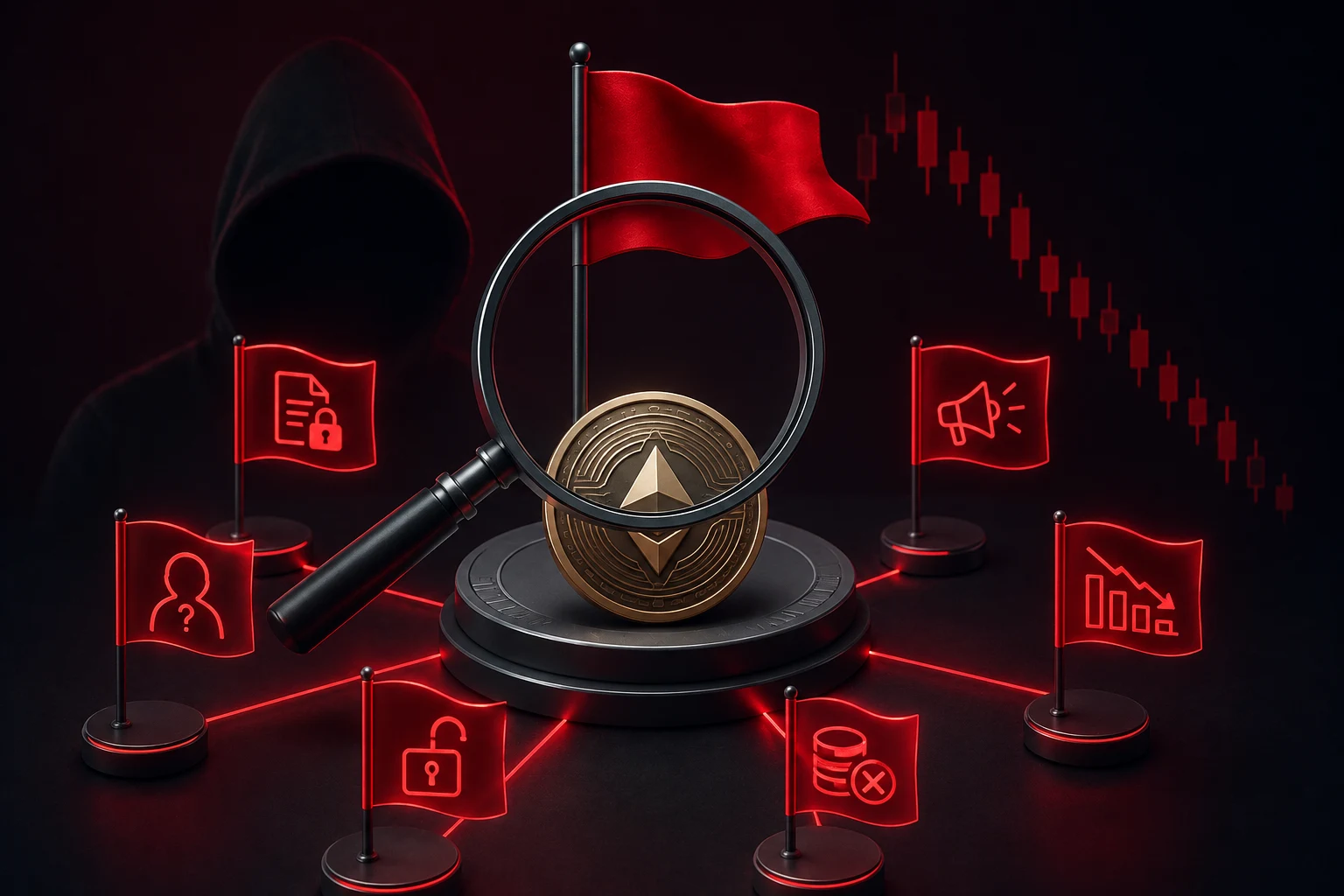
Run each token through these seven checks. They will not catch every bad project, but they will filter out the vast majority of common scams and obvious mistakes. If a token fails two or more of these checks, treat that as a hard pass regardless of the upside story.
1. Anonymous team with no track record
If the founders are pseudonymous, that is not automatically disqualifying. Bitcoin's creator was anonymous. But pseudonymity combined with no public history of shipped products, no LinkedIn profiles, no prior companies, and no accountability is a serious red flag. Real builders usually have something to point to. If you cannot find out who is behind the project or what they have done before, assume the worst until proven otherwise.
2. Unlocked team tokens with cliff dates
Look at the tokenomics page or the smart contract. If the team holds a large share of the supply and those tokens are not vested over multiple years, insiders can dump on you the day after launch. A short or zero cliff, a short unlock period, or a team allocation over roughly 15 to 20 percent of total supply are all reasons to be cautious. Locked and vested team tokens align incentives. Unlocked ones do not.
3. No working product, only a roadmap
A whitepaper is not a product. A roadmap slide is not a product. If the only thing you can interact with is a website, a Discord, and a buy button, you are buying a promise. Working products, even rough ones, with public addresses, real users, or testable code are a fundamentally different category of investment than pure narrative.
4. Liquidity not locked or LP not burned
On a decentralized exchange, the liquidity pool is what lets you sell. If the developers still control that pool, they can pull it at any moment. Look for proof that liquidity is locked in a known locker contract for a meaningful period, often a year or more, or that the LP tokens have been sent to a dead address and burned. Without that, a rug pull is one transaction away.
5. Contract not verified on the block explorer
On EVM chains like Ethereum, Arbitrum, or Base, you can read a token's source code on the block explorer. If the contract is not verified, you have no way to check for hidden mint functions, hidden owner privileges, blacklist functions, or transfer taxes. Unverified contracts mean you are trusting the team blindly. Verified contracts still require reading, but at least they can be read.
6. Huge airdrop or giveaway pressure
Free token airdrops, surprise giveaways, and "connect your wallet to claim" prompts are a top attack vector. Many are phishing. Others are ways to build a list of wallets that can later be targeted, or to seed a token to people who will dump it immediately. If the primary growth tactic is giving tokens away with urgency, be very careful about what you sign and where you got the link from.
7. Paid shills versus organic community
Open any new token's Telegram or X replies and look at who is talking. Identical phrasing, new accounts, generic praise, and relentless calls to buy are signs of a paid influencer campaign. Organic communities argue, ask hard questions, and have veterans who push back on hype. A chat where every message is bullish and every question is shut down is a marketing channel, not a community.
How to verify each red flag in practice
Knowing the list is not enough. Each check takes two to three minutes of actual work, and most beginners skip them because the chart is already pumping and they feel late. Slow down. None of these steps require expertise, only attention.
For the team, search the founders' names, wallet addresses, and GitHub handles. Real teams link their own histories. For tokenomics, find the token contract on a block explorer and read the allocation. For liquidity, look for the lock transaction on the locker's website and confirm the unlock date. For the contract, click "Contract" on the explorer page and look for the verification checkmark. For the community, sort the chat by new users and read what they actually write.
None of these checks guarantee safety. A project can pass all seven and still fail because the market moves, the team makes bad decisions, or the product never finds users. What the checks do is rule out the most common, most preventable losses. After running them, your remaining risk is closer to ordinary startup risk and farther from outright theft.
What to do when a red flag appears
If a token fails one check, treat it as a yellow flag and dig deeper. Maybe the team is pseudonymous but has shipped three prior projects with real users. Maybe the team allocation is high but the cliff is two years and the tokens are vesting linearly. Context matters, and good projects do not always look perfect on paper.
If a token fails two or more checks, walk away. Not "wait for a dip," not "buy a small amount to test," not "average in at support." Walk away. The upside story will still be there in a week if it is real. If the story only works if you ignore the warnings, it is not a story you want to be part of.
If a token passes all seven checks, you still have a long list of harder questions about valuation, demand, competition, and whether the token even needs to exist. The red flag checklist is the entry gate, not the whole analysis. Be honest with yourself about how much homework you have actually done before sizing a position.
Stay ahead of risky token launches
Crypto moves fast and so does the news around new token launches, including the warnings, the rug pulls, and the post-mortems that explain exactly how a project went wrong. Tracking those signals manually across X, Telegram, Discord, and on-chain explorers is a losing game for anyone with a job and a life. Zippfeed surfaces new token headlines with sentiment scoring labeled bullish, neutral, or bearish, plus an importance rating, so you can spot red flags early and avoid being exit liquidity on the next launch.