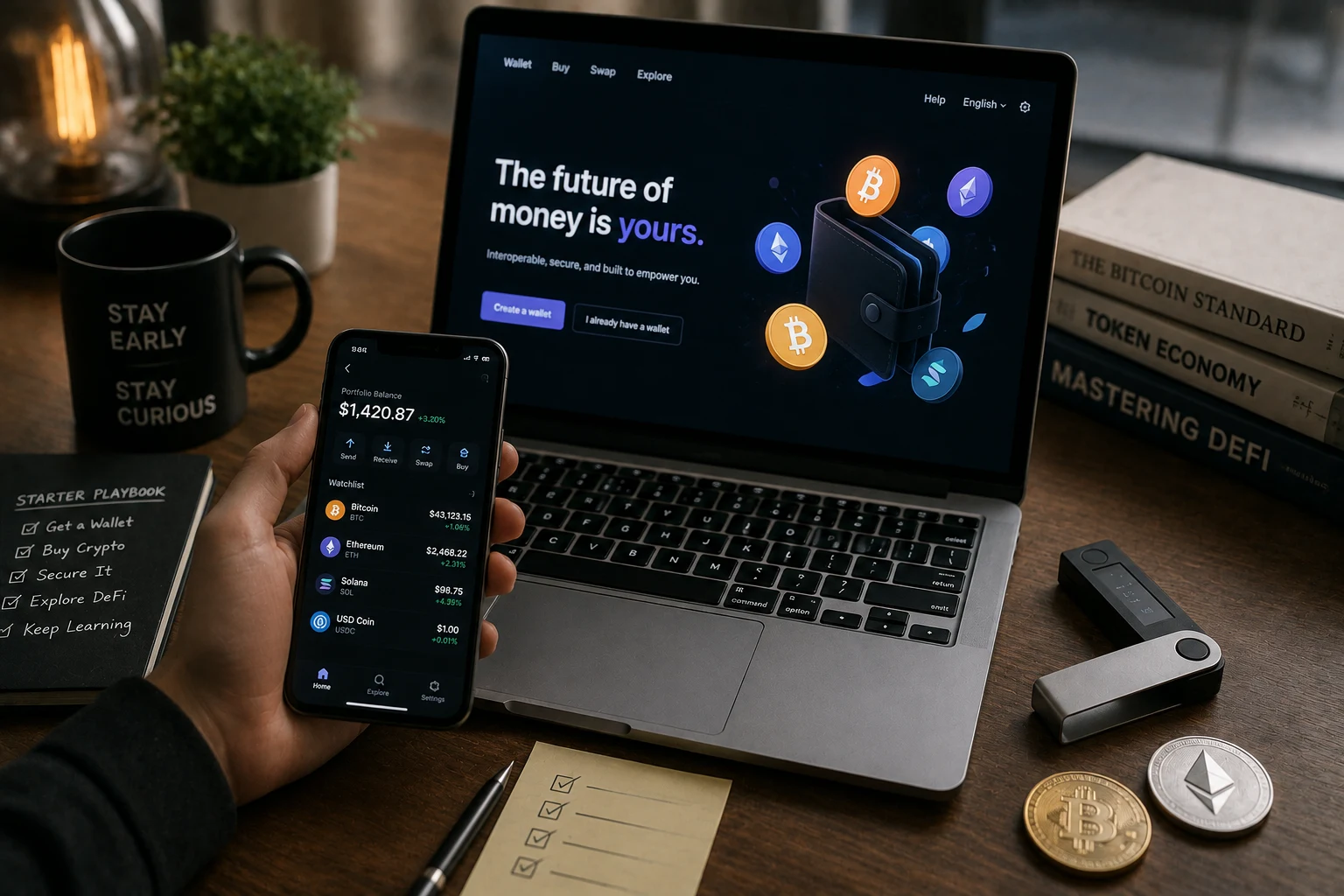
What a seed phrase actually is
A seed phrase, sometimes called a recovery phrase, mnemonic phrase, or backup phrase, is a sequence of simple English words like witch collapse practice feed shame open despair creek road again ice least. It looks like a sentence a child could read, but every word is pulled from a fixed list of 2048 carefully chosen words known as the BIP-39 word list, and the order of the words is the actual secret.
When a self-custody wallet is first set up, the software generates a very large random number behind the scenes. That number is the master private key, the single value that mathematically controls every address in your wallet. The wallet then converts that number into the word sequence you see on screen so a human can write it down. The words are a friendlier representation, not a different kind of secret. Anyone who learns the words in the right order effectively has the underlying key.
This is why the phrase is sometimes called the keys to the kingdom. Lose it and the wallet becomes permanently inaccessible, since no central company can reset it for you. Show it to anyone else and they can drain the funds, because the underlying math gives them everything they need to sign transactions as you. The words themselves are not what is being protected. The random number they represent is what is being protected.
How seed phrases are generated
Modern wallets follow a public standard called BIP-39, which is short for Bitcoin Improvement Proposal 39. The standard is open and is used by most self-custody wallets, including hardware wallets, mobile wallets, and browser extensions, so a phrase generated by one wallet can usually be restored in another.
The generation process has three steps. First, the wallet's random number generator produces a sequence of bits, the raw ones and zeros that computers actually use. For a 12-word phrase this is 128 bits, and for a 24-word phrase this is 256 bits. Second, the wallet computes a short checksum from those bits, which is a few extra bits that act as an error-detection code, the same idea as the check digit on a credit card number. Third, the combined bit string is split into 11-bit chunks, and each chunk is used to look up a word in the 2048-word BIP-39 list. That gives you 12 or 24 words in a specific order, plus the embedded checksum.
The interesting detail is that the words carry no meaning as a sentence. witch collapse practice feed shame open despair creek road again ice least is gibberish if you read it as English. The randomness comes from the underlying bits, not from the dictionary, and the dictionary just makes those bits easier to transcribe by hand. If even one word is wrong, or the words are in the wrong order, the checksum will fail and the wallet will not restore, which is a useful safety net when you re-enter your phrase later.
Entropy, collision risk, and why the math matters
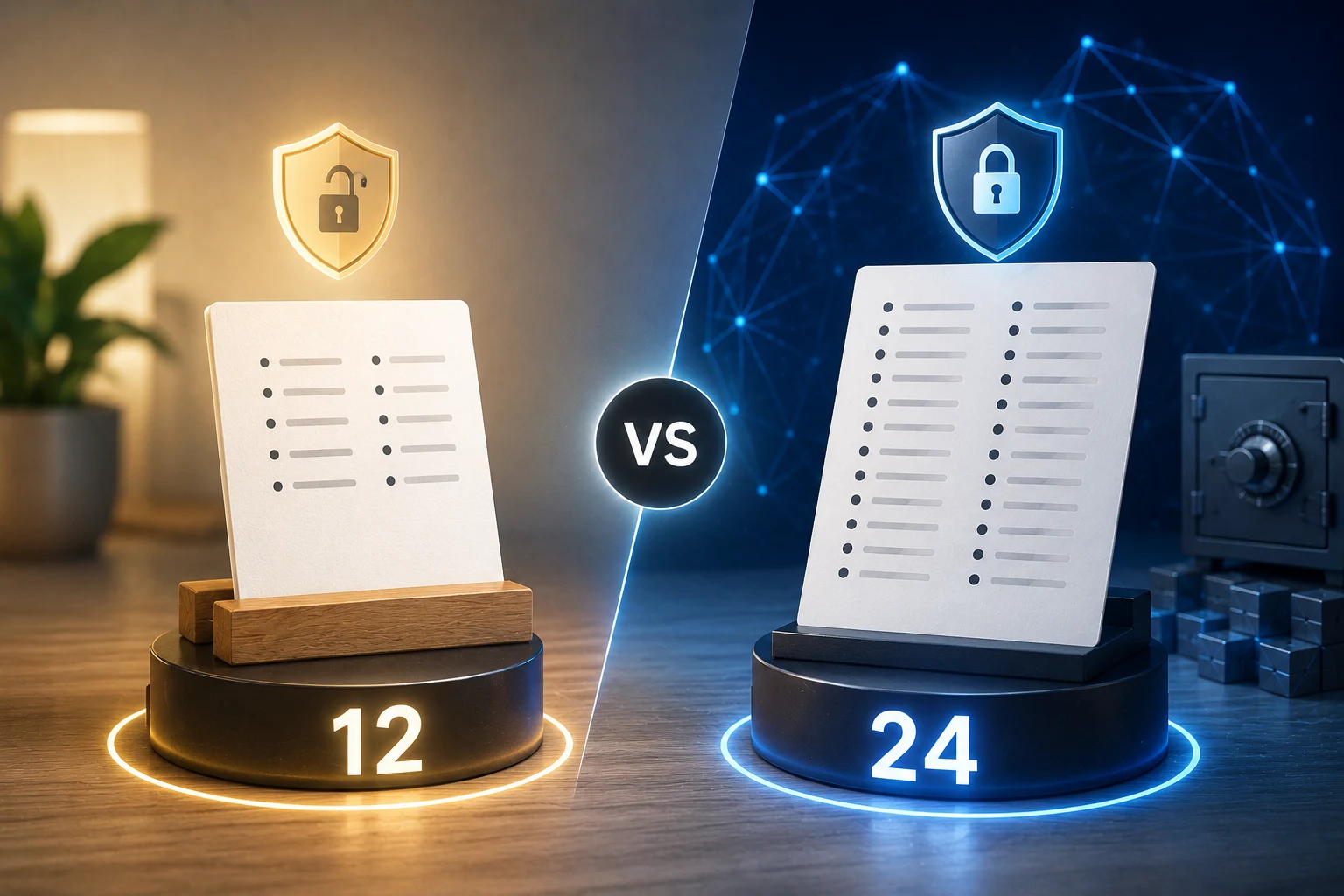
Entropy is a measure of how much randomness sits inside a secret, expressed in bits. Every additional bit of entropy doubles the number of possible values an attacker would have to try. A 12-word phrase has 128 bits of entropy, which means there are 2 to the power of 128, or about 3.4 times 10 to the 38, possible phrases. A 24-word phrase has 256 bits of entropy, which means 2 to the power of 256 possible phrases, an astronomically larger number.
Collision risk is the chance that two different randomly generated phrases turn out to be the same. With 128 bits of entropy, the chance of a random collision is roughly 1 in 2 to the 64, which is the threshold at which cryptographers start to call a system secure. With 256 bits, the chance drops to about 1 in 2 to the 128, which is the same strength as the underlying private keys on Bitcoin and Ethereum. In both cases the chance of a brute-force guess is effectively zero, because there is not enough energy in the observable universe to count that high.
For a beginner the practical question is not whether 128 bits is enough, because it is. The real question is what happens at the edges, when devices produce biased randomness, when people re-roll phrases in predictable ways, or when future attackers get access to better computers. 256 bits gives a much larger safety margin against all three of those failure modes, which is why 24 words is sometimes pitched as more future-proof. That framing is honest, but it can also be misleading. A phrase that is leaked through a screenshot, a phishing site, or a careless cloud backup is exposed regardless of length, because the attacker does not need to guess at all.
Where the real risks actually are
Most people who lose crypto to a seed-phrase problem did not lose it because a 128-bit phrase was mathematically weak. They lost it because the phrase was never backed up, was backed up in only one place, or was exposed to someone with bad intentions. Understanding the storage pitfalls matters far more than the word count.
Single-copy and online backups
The single most common mistake is storing the phrase in a phone screenshot, a notes app synced to the cloud, an email draft, or a password manager that is itself online. Each of these creates a permanent copy on a server you do not control, and that server becomes a target. Attackers specifically search cloud backups for sequences that look like BIP-39 word lists, and malware on phones and laptops has been observed scanning image galleries for the same thing.
Physical damage and single-location backups
A piece of paper in a drawer can be destroyed by fire, water, or a curious child. A metal seed-phrase plate solves the fire and water part, but not the discovery part. A common compromise is to store two copies in two separate physical locations, such as a home safe and a bank deposit box, so that a single accident cannot wipe out access.
Phishing and fake wallet apps
Malicious sites and fake wallet apps routinely ask users to enter their existing seed phrase to "verify" or "restore" a wallet. No legitimate wallet ever asks for an existing seed phrase through a website. Once a phrase is typed into one of these prompts, the funds are typically moved within minutes. This is true for both 12-word and 24-word phrases.
Optional passphrases and the hidden wallet feature
Many BIP-39 wallets also support an optional 25th word, sometimes called a passphrase or extension word, which is not stored on the device. This adds another factor of protection on top of either length, but it also means losing the passphrase is just as final as losing the words themselves. It is a powerful tool, but one that beginners should research carefully before relying on.
How to choose between 12 and 24 words
For a brand-new wallet, the choice is usually made by the wallet software. Hardware wallets like Ledger and Trezor default to 24 words, while many mobile wallets default to 12 words. Both are industry-standard and both are secure against brute-force guessing for the foreseeable future.
A reasonable rule of thumb is to use 24 words when the wallet software supports it and the user is comfortable writing down and storing a longer list, since the extra margin against future attacks is essentially free once the phrase is on paper or metal anyway. A 12-word phrase is a fine choice for smaller balances, for learning, or for a wallet the user is happy to treat as semi-disposable.
What matters more than the length is the storage habit. Write the phrase down at wallet setup time, on paper or stamped into metal, never on a phone. Make a second copy and store it in a separate physical location. Never type the phrase into a website, a chat app, or a support form. Treat the phrase with the same seriousness as a passport or a house deed, because in cryptographic terms that is exactly what it is.
Common myths to put aside
One persistent myth is that a 24-word phrase is twice as secure as a 12-word phrase. It is not twice as secure, it is 2 to the power of 128 times harder to brute-force, which is a number so large that the difference between the two is not even meaningful in human terms. The right way to think about both lengths is that they are unguessable, and the remaining risks are operational, not mathematical.
Another myth is that longer phrases are harder to lose. The opposite is often true. More words means more chances to mis-transcribe a word or mis-order the list, which is why the BIP-39 checksum exists. Some users find that writing a 12-word phrase on a single metal plate and verifying it once is more reliable than juggling a 24-word phrase across two plates.
A third myth is that any sequence of 12 English words is a valid seed phrase. It is not. Valid phrases are drawn from the specific 2048-word BIP-39 list, and the words must line up with a valid checksum. A randomly chosen 12-word sequence from the dictionary has only a 1 in 16 chance of being a real phrase, which is another reason the checksum is a useful guard against typos at restore time.
Stay ahead of wallet security the smart way
Wallet security stories move fast. New wallet-recovery scams surface every quarter, and even experienced users miss shifts in best practice, like the move from paper to metal backups or the slow rollout of optional passphrases. Tracking every wallet-security headline by hand is a losing game, and missing a single one can be the difference between keeping and losing a balance. Zippfeed surfaces wallet and security headlines with sentiment scoring, so you can see whether the news cycle is bullish, neutral, or bearish on a given tool, and an importance rating, so you can tell which updates are worth acting on and which are noise.