The big picture
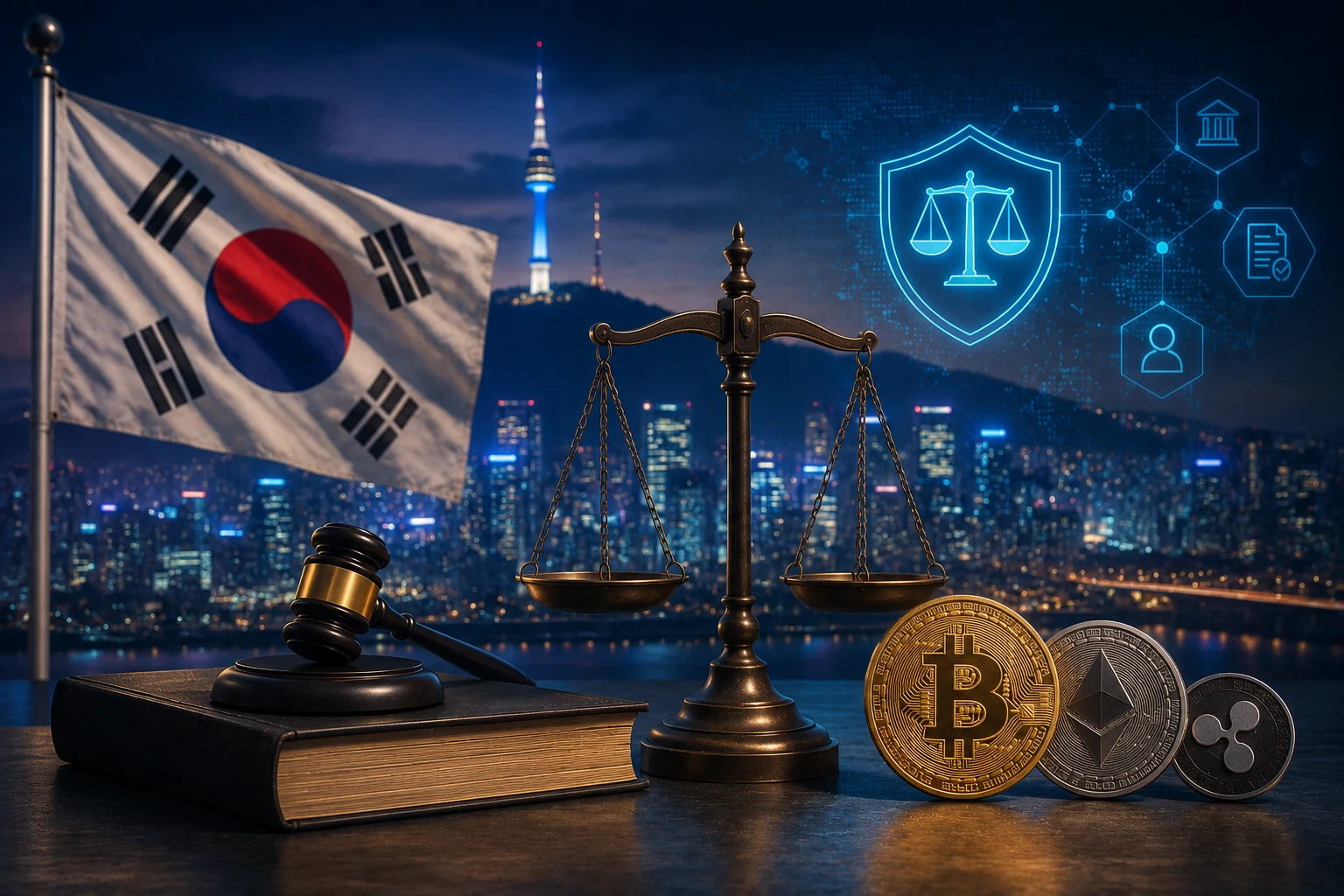
South Korea is one of the largest and most active crypto markets in the world by retail participation, and one of the more tightly bordered. The regulator combines a real-name banking rule that effectively forces every active exchange to integrate with a Korean bank, with conduct standards that the Virtual Asset User Protection Act formalised in 2024. The intent is straightforward: keep retail users inside a regulated perimeter, with cybersecurity, custody and abuse rules. The downside is friction; the upside is that user-asset protection and disclosure standards are now codified rather than left to industry custom.
This is an educational overview, not legal advice. Rules continue to evolve and details can move with FSC notices, parliamentary amendments and tax-law changes.
Who the regulator is
The Financial Services Commission (FSC) is the lead policy regulator for crypto in South Korea. The Financial Intelligence Unit (FIU), which sits within the FSC, supervises virtual asset service providers (VASPs) for anti-money-laundering compliance under the Specified Financial Information Act. The Financial Supervisory Service (FSS) handles day-to-day market supervision. The National Tax Service handles tax. The Bank of Korea participates in stablecoin and CBDC policy.
Registration with the FIU is the practical gateway: a VASP cannot operate legally without it, and the conditions — including the real-name banking partnership — are demanding.
What is regulated
Several distinct buckets sit inside South Korea's perimeter today:
- Real-name banking and exchange registration. Korean exchanges must partner with a Korean bank for KRW deposits and withdrawals, and each user must use a real-name account tied to their verified identity. Without an active bank partnership, an exchange cannot accept KRW deposits — a major filter on which platforms operate at scale.
- Virtual Asset User Protection Act. Active since 2024, it requires user-asset segregation, insurance against hacks and operational failures, market-abuse rules covering manipulation and undisclosed material information, and disclosure obligations for listed assets. This is the closest South Korea has come to a comprehensive conduct framework.
- Anti-money-laundering supervision. The Specified Financial Information Act extends AML obligations to crypto, including customer due diligence, transaction reporting and travel rule compliance.
- Security tokens. Existing securities law applies to tokens that qualify as securities; a dedicated security token framework has been developed in stages.
Together these create a market that is regulated in detail at the exchange level but still lively at the user level — Korean retail flow is among the most active in the world on listed tokens.
Practical implications for users and businesses
For Korean residents, the experience of using a registered exchange feels normal but heavily verified. You link a real-name bank account, complete identity checks, and operate within the platform's listed token set. The User Protection Act adds clearer obligations on the exchange side around asset safekeeping and abusive behaviour. Trading remains highly active and includes a strong derivatives appetite, although derivatives are mostly accessed through specific products rather than blanket leverage.
For businesses, South Korea is a regulated market with a high bar to entry. Registration as a VASP, securing a real-name banking partnership, and meeting the User Protection Act's segregation, insurance and disclosure requirements are non-trivial. Many global firms either set up a Korean entity for the Korean market or partner with a registered Korean exchange.
On tax, South Korea legislated a crypto income tax that has been delayed multiple times due to political and operational concerns. Mining, staking, NFT-related earnings and frequent trading can trigger taxable income under existing rules; specific application has changed over time and is best verified with a qualified tax professional and current National Tax Service guidance.
What is changing
Expect continued attention to the Virtual Asset User Protection Act, particularly on listed-asset disclosure, on derivatives and on the borderline between professional and retail investors. The security-token regime is being built out in phases. The crypto income tax timeline is a live policy debate. Stablecoins and CBDC work proceed in parallel — the Bank of Korea participates actively in cross-border digital currency experiments.
Compared with the European Union's MiCA — see what is MiCA — South Korea takes a similar protection-first stance but with stronger banking integration. Compared with Japan's regime — see crypto regulation in Japan — Korea allows more active retail trading, leaning on disclosure rather than tight product gating.
Follow Korean crypto policy as it moves
South Korean crypto rules move on FSC announcements, parliamentary amendments and FIU guidance updates. Major shifts often pre-stage in financial-sector hearings months before they bind. Zippfeed surfaces Korean crypto headlines with sentiment and importance scoring so you can tell which announcements are background noise and which will affect what is available, how it is traded and what protections apply. This is education, not financial or legal advice — but informed beats surprised every time.