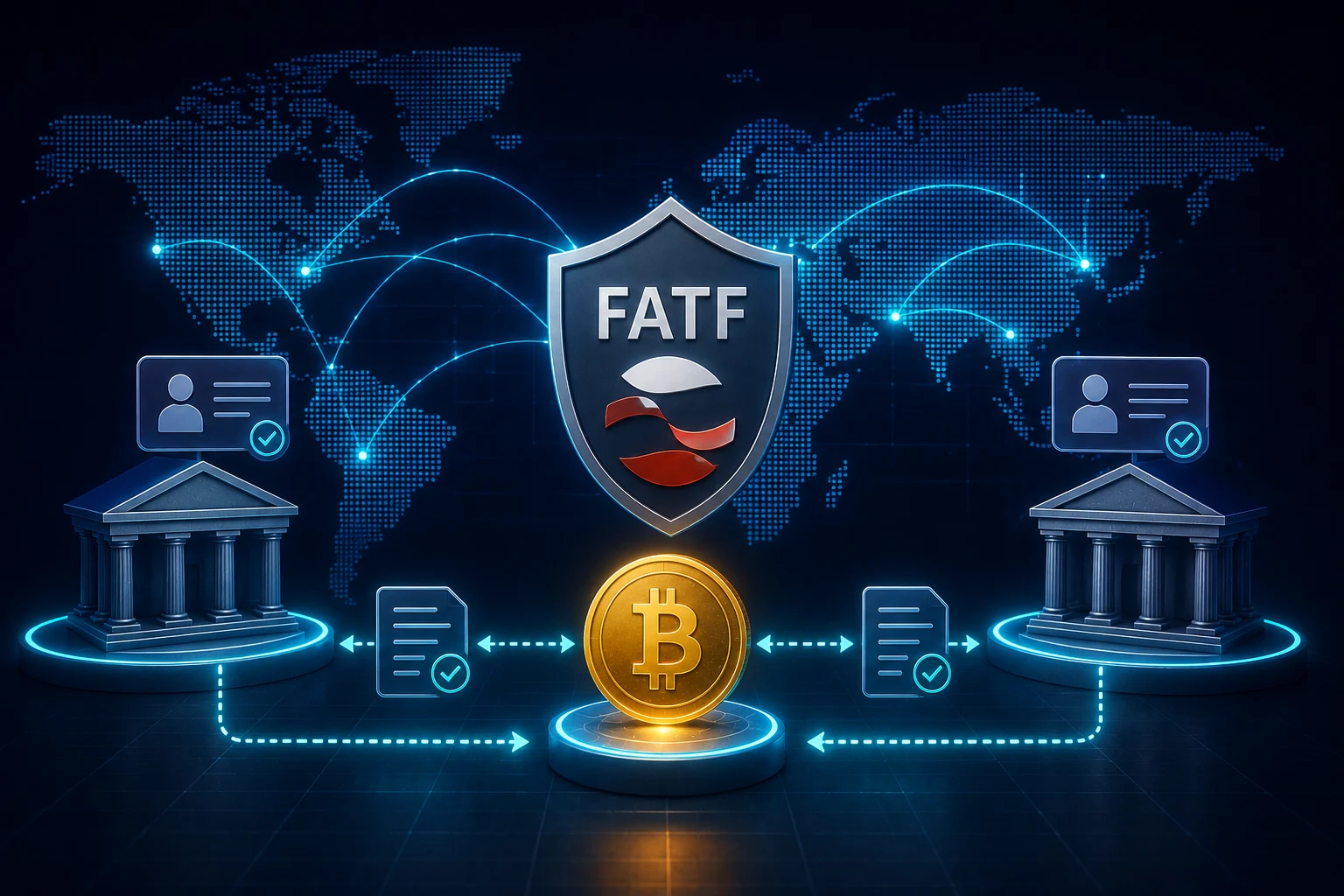
What the FATF Travel Rule actually says
The Travel Rule is Recommendation 16 of the Financial Action Task Force (FATF), the global anti-money-laundering standards body. For decades it has forced banks to pass identifying information about the sender and receiver of wire transfers above a threshold. In 2019, FATF extended the same logic to virtual assets and virtual asset service providers, so that crypto transfers get treated similarly to traditional cross-border payments.
For a single transfer above the threshold, both the sending and receiving VASP must collect, store, and transmit a defined set of fields. In practice this includes the originator's full name, account or wallet reference, address or national ID number, and the same data for the beneficiary, plus information about the originating institution and the value and date of the transfer. The exact field set is spelled out in the FATF's Updated Guidance for a Risk-Based Approach to Virtual Assets.
FATF itself does not write law. It publishes recommendations, and each member country translates them into its own rules. That is why the headline numbers vary slightly. The most common threshold is roughly USD/EUR 1,000, which the FATF has highlighted as a de minimis floor, while some jurisdictions like the European Union set it lower or, in the case of card-based transfers, exempt smaller amounts altogether.
The point of the rule is to remove the anonymity gap that otherwise sits between crypto and the traditional financial system. If a bank in Frankfurt wires euros to a bank in Singapore, both banks know who is on each end. The Travel Rule tries to make the same statement true when the value moves through a centralized crypto exchange instead of a bank.
Real risks and failure modes for users
Most retail users will never type "FATF Travel Rule" into a search bar. They will, however, feel the rule when a withdrawal from a major exchange suddenly gets rejected, delayed, or asks for more information than it used to. The first practical risk is that compliant exchanges start gating which destinations they will send funds to.
Concretely, several large centralized exchanges now refuse to send crypto directly to addresses they cannot identify as belonging to another VASP, or they require extra information before crediting deposits from unknown self-custody wallets. This can mean extra friction: delayed withdrawals, blocked deposits, or requests to re-send transactions with additional documentation.
The second risk is uneven enforcement. Because each country moves at its own pace, two users in different jurisdictions can have very different experiences of the same transfer. One may sail through with no questions, the other may find their funds frozen for review. This is sometimes called the "sunrise issue" and it is one of the main reasons the Travel Rule is hard to implement cleanly across borders.
The third risk is the failure mode regulators keep pointing to: sanctioned actors, ransomware operators, and large-scale fraud rings still manage to move funds because they find the venue with the weakest controls. The Travel Rule is supposed to close that loophole, but only if every significant venue plays by the same rules. When a major exchange skips checks, it undermines the entire network. That is what happened in several recent enforcement cases.
Finally, there is a category risk that does not show up on a price chart. If you store significant value in self-custody, and you receive funds from a VASP that later flags your address, you may end up with frozen accounts at exchanges that refuse to credit you later. The rule does not technically apply to self-custody, but it shapes how easily you can move between self-custody and regulated venues.
Why DeFi front-ends sit in the gray zone
Decentralized finance complicates the Travel Rule because the FATF language was written for identifiable intermediaries. A pure smart contract has no operator, no HR department, and no one to send an email to when a transaction needs to be reviewed. Most regulators accept that a fully autonomous on-chain protocol, with no controlling party, is not a VASP and therefore is not directly subject to Recommendation 16.
The complication is the front-end. The website you visit to swap tokens on a decentralized exchange is usually run by a known team. That team takes a fee, controls the user interface, often controls the contract upgrade path, and is identifiable by domain registration, hosting provider, and social media presence. FATF's 2021 guidance explicitly noted that creators and operators of front-ends can be considered VASPs if they facilitate transactions on behalf of users.
Different countries are testing this idea in different ways. Some regulators, like those in the United States through FinCEN guidance and the Treasury's proposed rules, have signaled that front-end operators may fall under money-transmission rules depending on their activity. Others, including some European supervisors, have been more cautious and are still working out how to apply existing AML frameworks without crushing protocol-level innovation.
In practice, this is why some centralized exchanges now refuse to send funds directly to certain DeFi front-end addresses. They cannot reliably collect the beneficiary data the Travel Rule expects, so they either block the transfer, route it through a partner that can collect the data, or require the user to confirm the destination is a personal self-custody wallet rather than a service. Users experience this as friction, but the underlying logic is that the sending VASP cannot satisfy Recommendation 16 without knowing who is on the other side.
How self-custody interacts with the Travel Rule
Self-custody is the cleanest case in the rule's text. If you hold your own private keys and you are not operating a service for other people, you are not a VASP and the Travel Rule does not impose obligations on you directly. You do not have to collect or transmit originator and beneficiary data on your own transfers.
The indirect effects, however, are significant. When you withdraw from a centralized exchange to your own wallet, the exchange is the sending VASP and has to decide whether it can satisfy Recommendation 16. If it cannot identify the receiving wallet as belonging to another VASP, it may treat the destination as unhosted and apply additional checks or refuse the transfer entirely.
Some exchanges have introduced proof-of-ownership flows for self-custody addresses, asking you to sign a message that confirms you control the private key, and then attaching that attestation to the transfer record. This is not required by the Travel Rule itself, but it is one of the practical workarounds that compliance teams have adopted to satisfy the spirit of the rule without blocking all self-custody flows.
Users sometimes interpret these checks as the Travel Rule banning self-custody. It does not. What it does is push the cost of due diligence onto the centralized venue, which then passes that cost back to the user in the form of delays, limits, or documentation requests. The practical takeaway for someone who relies on self-custody is that the on-ramp and off-ramp to the regulated system are getting tighter, even though the wallet itself is untouched.
Enforcement: Binance, OKX, and the cost of weak controls
Enforcement is where the Travel Rule stops being abstract. In recent years, several large centralized exchanges have been fined or sanctioned for anti-money-laundering failures that intersect directly with Recommendation 16. The most high-profile case is Binance, which in 2023 settled with the US Department of Justice, FinCEN, and OFAC. The settlement included a record penalty and a multi-year monitor, with FinCEN specifically citing failures around suspicious activity reporting and effective AML controls, which are the operational backbone of Travel Rule compliance.
Other major venues have faced similar scrutiny. OKX paid a penalty in 2025 over allegations that its platform facilitated transactions for users associated with sanctioned entities, alongside broader AML shortcomings. Earlier actions against operators like Bittrex and shape-shifting services followed the same pattern: weak or no Travel Rule controls, gaps in transaction monitoring, and inadequate customer due diligence on large transfers.
The pattern matters because it tells you what regulators are actually prioritizing. The Travel Rule is not a paper exercise. It is enforced through fines, monitors, and, in the worst cases, through restrictions on operating in major markets. For a compliance officer, this is the practical pressure that drives investment in Travel Rule technology and partner screening.
For a user, the same enforcement record explains why some exchanges behave very differently from others. A venue that has just settled a major AML case will tighten withdrawal rules, add new questions for unhosted transfers, and increase monitoring. A venue operating in a lighter-touch jurisdiction may still process the same transfer without friction. The Travel Rule is the same on paper, but the experience depends entirely on where the venue is regulated.
How transfers actually work under the Travel Rule
The mechanics are simpler than the FATF's reputation suggests. When a regulated VASP sends crypto above the threshold, it packages the required originator and beneficiary information and transmits it to the receiving VASP. The on-chain transfer itself still happens as it always did, but the identifying data travels alongside it, often through dedicated messaging protocols that sit on top of the blockchain rather than inside it.
Several industry consortia have built this plumbing. The Travel Rule Information Sharing Architecture, sometimes called TRISA, was developed by the travel rule industry working group. The OpenVASP protocol, the VerifyVASP directory, the TRUST network, and the CodeisLaw Notabene network all serve similar purposes: they let two VASPs identify each other, exchange the required fields securely, and produce an audit trail that regulators can review.
The practical result for a user is that withdrawing from one major exchange to another is increasingly likely to involve a silent data handshake behind the scenes. Both venues verify each other's identity, both attach the originator and beneficiary information to the transaction, and the transfer settles on chain. If either side cannot complete the handshake, the transfer may be held, returned, or rejected.
Wallets and tools are catching up too. Some wallet providers now support Travel Rule fields for transfers above the threshold, and some have built integrations so that a user can attach the required information without manually filling in forms. This is still a work in progress, and it is where a lot of the practical friction in 2025 and 2026 is concentrated.
Practical implications for users and operators
For an everyday user, the most visible implication is that transfers between two compliant exchanges now look more like bank wires. You may see a beneficiary name on a deposit screen, you may receive a confirmation that the counterparty was identified, and you may be asked to provide additional information if the receiving venue cannot match the data the sending venue forwarded. None of this guarantees that your funds are safer, but it does mean that the receiving venue now has more context on who is on the other side.
For someone moving between centralized and decentralized venues, the rule is the reason some exchanges no longer send funds directly to certain DeFi front-ends. If you want to interact with a decentralized protocol, you may need to withdraw to a self-custody wallet first and then use that wallet to interact with the front-end, rather than sending exchange funds straight to a smart contract from the exchange interface.
For a compliance officer at a VASP, the practical implications are heavier. The Travel Rule forces investment in partner due diligence, message-passing infrastructure, monitoring, and training. It also forces clearer policies around unhosted wallets, high-risk jurisdictions, and transactions that touch sanctions lists. None of this is optional in major markets, and the enforcement record shows that the cost of under-investment is now measured in hundreds of millions of dollars in penalties.
For a DeFi builder, the implication is that the front-end is no longer invisible. Even if the underlying protocol is genuinely autonomous, the team that runs the website where users connect their wallets may be treated as a VASP depending on the jurisdiction. This is reshaping how front-ends are structured, governed, and funded.
Read Travel Rule enforcement critically with Zippfeed
Travel Rule enforcement moves quickly: a single regulator's announcement can redraw which exchanges will accept which transfers, and the gap between countries is wide enough that the same transfer can be frictionless in one market and frozen in another. Tracking those moves manually, especially alongside the underlying enforcement cases and the technical chatter around protocols like TRISA and OpenVASP, is a losing game. Zippfeed surfaces crypto regulation headlines with sentiment scoring, bullish, neutral, or bearish, and an importance rating, so you can spot the rule changes that actually change how your transfers are processed before they hit your inbox.