What readers actually want to know when they compare VIRTUAL and TAO
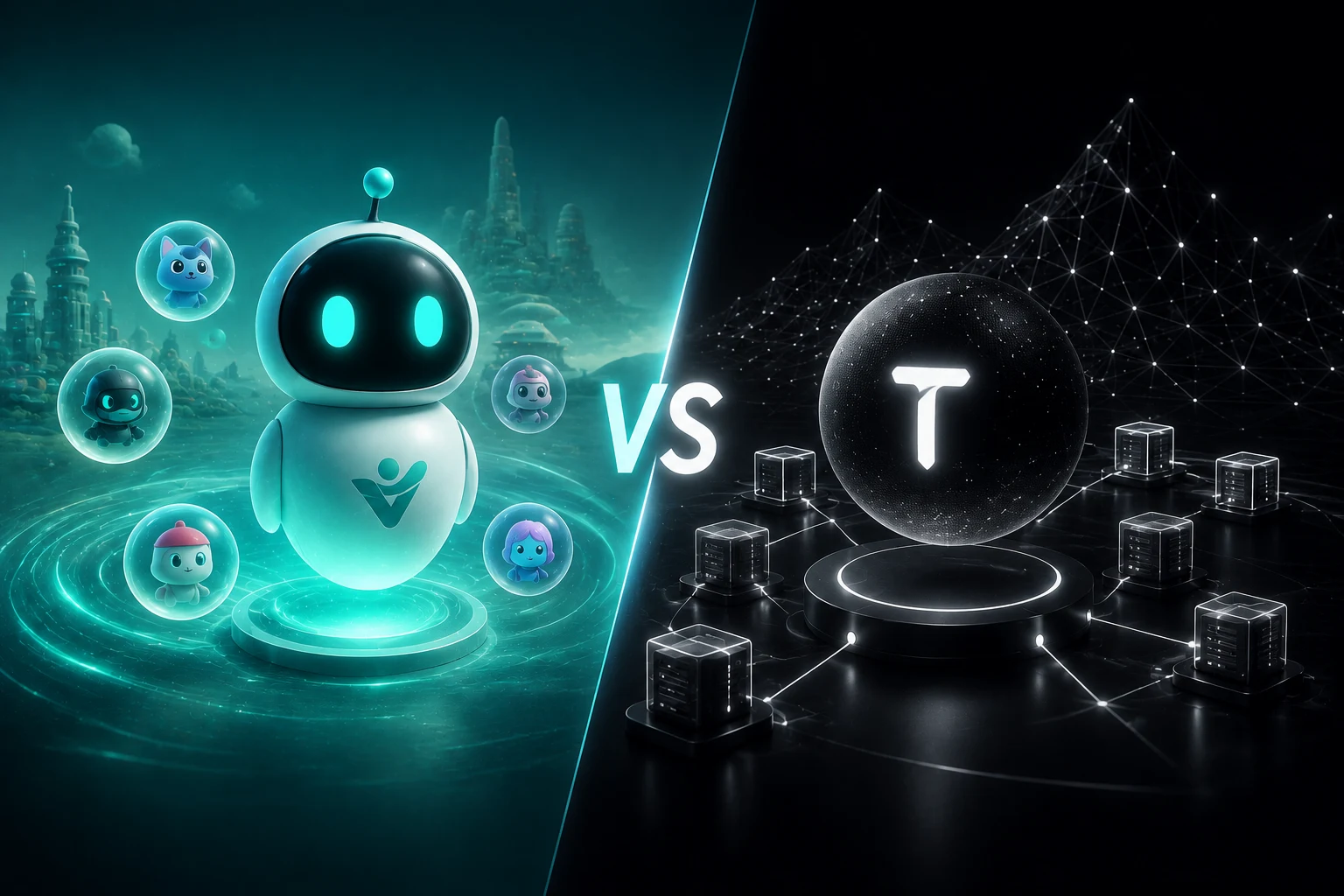
Most comparison searches hide a simpler question underneath: which one of these tokens captures real economic activity if AI agents become a large market, and which one is mostly narrative? Virtuals Protocol and Bittensor both lean on the same AI agent story, but they sit on opposite sides of the stack. Virtuals tries to ship agents that people use. Bittensor tries to be the underlying network that other people's agents pay for compute from. Treating them as direct competitors obscures what each one is actually buying.
The second confusion is the word "agent" itself. In crypto, "AI agent" usually means one of three very different things: an autonomous on-chain bot that executes trades or transactions, a tokenized wrapper around a model or product with a revenue claim, or a node on a decentralized AI network. Virtuals lives mostly in the second category, Bittensor in the third. Readers comparing the two need to know which kind of agent each project actually sells before any valuation makes sense.
Finally, both projects launched into a frothy market where launching any "AI agent token" raised money quickly. That environment produced a wave of agent launches, copycat designs, and outright scams. Any honest comparison has to spend real time on the failure modes, because the structural risk in this category is unusually concentrated in early insiders.
How Virtuals Protocol works, in plain terms
Virtuals Protocol is a launchpad and marketplace for AI agents built on its own chain, originally an L2 on Ethereum called Base and later extended to its own Virtuals chain. The protocol helps teams design an agent, mint a token alongside it, list that token on a bonding curve, and eventually graduate to a public automated market maker. Holders of the agent's token are sold the idea that they own a slice of that agent's future revenue.
The revenue claim comes from a "buyback and burn" or "fee share" mechanic. When an agent generates income (through API access, subscriptions, or downstream usage), a share of those fees flows back into the agent's token economy. In practice, most agents listed on Virtuals in 2024 and 2025 generated negligible revenue. The tokens traded on narrative, memes, and the hope that one or two breakout agents would justify the whole platform.
VIRTUAL is the platform-level token. It accrues value in two ways: a share of the fees from each agent's launch and trading activity, and governance over the protocol's parameters. Holders do not own the agents directly. They own a claim on the platform that issues the agents. That distinction matters, because it means the platform can grow the number of agents while most individual agent tokens decay toward zero, a pattern that already played out across the first cohort.
How Bittensor works, in plain terms
Bittensor is a decentralized network where participants run machine learning models, called miners, and judge each other's outputs, called validators. The network is split into "subnets," each focused on a specific task such as text generation, image synthesis, translation, or scraping. When a miner produces a useful response, validators rank it, and the network mints new TAO and distributes it to high-ranking miners and validators.
The economic model is closer to a commodity market than a startup. Anyone with compute can spin up a miner, compete for rankings, and earn TAO if their model performs well. There is no headcount, no roadmap, no quarterly earnings call. The "product" is the network itself, which is meant to be queried by downstream applications that pay in TAO for inference or specialized outputs.
TAO, the native token, functions like a combination of a work token and a reserve currency. Miners earn it, validators stake it, and external users spend it to access subnet services. dTAO, a more recent redesign, lets each subnet have its own tradable token whose emissions are driven by market demand for that subnet's output, with TAO acting as the settlement layer across all subnets.
The honest framing is that Bittensor has real activity on its network, measurable miners, measurable TAO paid out, and a working token economy, but it does not yet have a large, paying customer base outside the network itself. Most TAO emissions cycle back into the network rather than coming from external AI buyers, which means the system is still mostly paying itself.
Product-led versus infrastructure-led AI agents
The most useful mental model for this comparison is the split between product-led and infrastructure-led designs. Virtuals is product-led: it tries to launch specific agents with names, personalities, and use cases that end users or other apps might adopt. Bittensor is infrastructure-led: it provides a competitive marketplace for raw AI work and assumes downstream products will form on top.
Product-led designs are easier to understand but harder to scale. Each agent needs a team, a roadmap, distribution, and ideally paying customers. Infrastructure-led designs are easier to scale in theory but harder to monetize, because competing on raw inference is a race to the bottom against centralized clouds like AWS, Google Cloud, and a handful of well-funded AI labs.
This is why VIRTUAL and TAO respond differently to the same news cycle. A breakthrough model release tends to lift Bittensor, because it expands what miners might be able to do. A breakout consumer app or viral agent tends to lift Virtuals, because it validates the launchpad thesis. Reading price action without knowing which lever each token is exposed to produces a lot of confused narratives.
Valuation when "agents" have no earnings
Valuing early-stage AI agent tokens is harder than valuing almost any other crypto category. There are no discounted cash flows to compute, no steady revenue streams, and usually no audited financials. Most agents are pre-revenue or have negligible income that gets blown around by launch incentives and wash trading. So any number you see for "TAO earnings" or "VIRTUAL fully diluted valuation" is, at best, a snapshot of network activity, not a measure of business value.
For Virtuals-style projects, the closest analogues are venture capital portfolios. You can look at the number of agents launched, the proportion that graduated from the bonding curve, the average fees collected, and the survival rate after six months. By those measures, the first year of Virtuals produced a long tail of dead tokens and a small number of survivors that held most of the fees. Survivorship bias is severe: the tokens you hear about are the ones that did not go to zero.
For Bittensor, the analogue is closer to a Layer 1 or a commodity network. You can look at active miners, TAO emissions per subnet, the share of emissions flowing to validators versus miners, and the ratio of organic external demand to internal recycling. None of these are perfect substitutes for revenue, but they are at least observable on-chain. Treat any TAO market cap multiple as a guess about future demand for decentralized AI compute, not a current valuation of a going concern.
Risks unique to agent tokens
AI agent tokens carry a cluster of risks that are less common in older crypto sectors. The first is insider extraction. Launchpads like Virtuals often allocate large tranches of agent tokens to the team, advisors, and early backers at low prices. If those tokens unlock quickly, the team can sell into retail demand and drain liquidity long before any product ships.
The second is the rug-pull pattern. Because anyone can spin up an agent, mint a token, and post a glossy narrative on social media, the space is flooded with low-effort launches. Common red flags include locked team tokens that are actually controlled by multisigs the team still operates, agents whose "revenue" comes from the protocol's own incentive budget, and founders who disappear after the bonding curve graduates.
The third risk is narrative decay. "AI agent" was a strong story in late 2024 and 2025, but narratives in crypto rotate. When attention moves on, the marginal buyer disappears and price discovery becomes brutal. Tokens that survived purely on story, without products or revenue, are the most exposed.
There is also a structural risk specific to Bittensor: the network pays miners and validators from emissions, which means most TAO earned on the network is recycled into selling pressure or staking rather than held by external users. Until external demand for subnet services is large enough to absorb emissions, the network depends on continued belief in the long-term thesis to keep the system solvent.
Where Venice (VVV) fits as a third variant
Venice is worth mentioning because it shows a third design that is neither pure launchpad nor pure infrastructure. Venice is a privacy-focused AI inference API that wraps access to large models behind a token. Users stake or hold VVV to get inference credits, and the protocol burns or recycles tokens based on usage. Holders are sold the right to use the product, not ownership of a startup.
This makes Venice closer to a utility or SaaS token than to a venture-style bet. If demand for private inference is real and durable, VVV has a measurable use case. If not, holders are left with a token whose only sink is the same usage that is failing to materialize. It avoids the launchpad-style insider extraction of Virtuals but inherits the demand problem that Bittensor also faces.
For readers comparing VIRTUAL and TAO, the useful lesson from VVV is that "AI agent token" can mean a launchpad governance token, a work and reserve token, or a usage-rights token. Each carries a different risk profile and a different valuation framework, even when the marketing language sounds identical.
What this means if you are deciding what to do
If you already hold or are considering VIRTUAL or TAO, the honest framing is that you are betting on two different hypotheses at once. Holding VIRTUAL is a bet that one or more agents launched through Virtuals will produce durable revenue, that the platform will capture a meaningful share of that revenue, and that early agent token decay will not damage confidence in the launchpad as a whole. Holding TAO is a bet that decentralized AI compute will attract real external demand, that Bittensor's subnets will out-compete centralized clouds on at least some tasks, and that the network's emissions will not drown out price.
None of these hypotheses has been definitively proven. Anyone who tells you that one of these tokens is "obviously" undervalued is doing the same forecasting you are, just with more confidence. Treat any position size as a bet on a forecast, use position limits you would still be comfortable with if the project stalls, and assume that most individual agent tokens launched through Virtuals will go to zero even if the platform itself survives.
Read AI agent tokens critically with Zippfeed
AI agent tokens move fast and so does the news around them. Tracking which agent launches have real revenue versus which ones are recycled incentive budgets is a losing game if you try to do it manually. Zippfeed surfaces VIRTUAL, TAO, and the wider AI agent category with sentiment scoring (bullish, neutral, or bearish) and an importance rating, so you can tell hype from substance and react to the stories that actually matter.



 Altcoin Daily