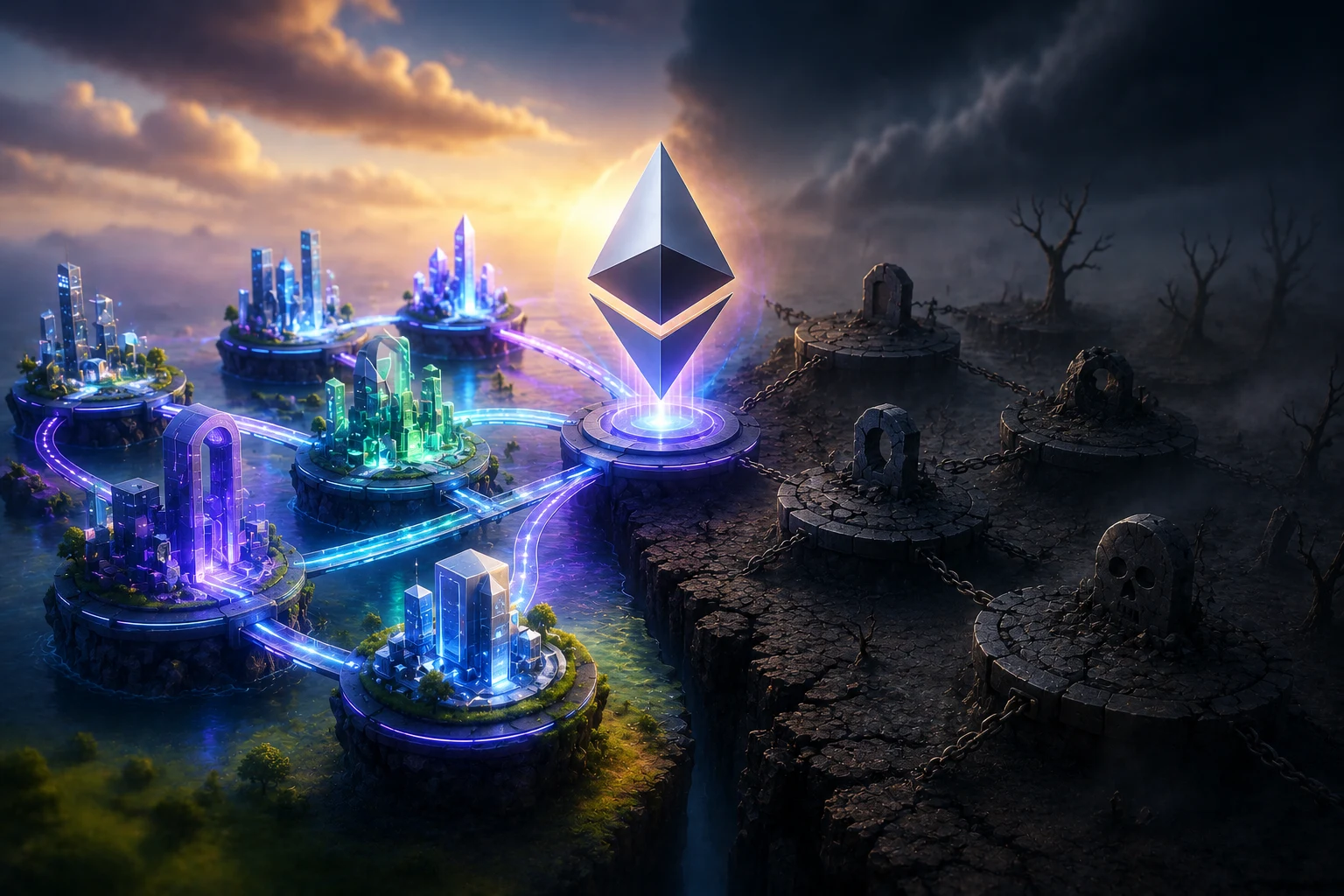
Why the Ethereum L2 landscape suddenly looks so crowded
Ethereum mainnet can only process roughly 15 to 30 transactions per second. As decentralized finance (DeFi), non-fungible tokens (NFTs), and on-chain games pushed that limit, the community settled on a roadmap that scales by moving execution off Ethereum onto Layer 2 (L2) rollups, then posting compressed transaction data back to L1 for security. By early 2026, Etherscan and L2Beat together track more than 100 distinct rollups, sidechains, and validiums that describe themselves as Ethereum L2s.
The hard truth is that listing an L2 is easy. A team can deploy a fork of an open-source rollup stack, point a sequencer at a cloud server, and list a token within weeks. What is hard is convincing real users and real capital to show up, and keeping the sequencer, the proof system, and the apps funded over a multi-year bear market. The result is a long tail of chains that look like L2s on paper but behave like ghost towns in practice.
How to tell if an L2 is actually alive
Marketing dashboards love to lead with total value locked (TVL), the dollar value of assets deposited into the chain's smart contracts. TVL can be inflated by a single depositor, by team-controlled wallets, or by illiquid wrapped assets, so it is a weak signal on its own. A more honest pulse combines four metrics: daily active addresses (DAAs), daily transactions, sequencer revenue, and net bridge flows between the L2 and Ethereum or other L1s.
Empirically, a useful rule of thumb is that an L2 with fewer than about 1,000 daily active addresses is likely running on bots, airdrop farmers, and wash trading. Crossing roughly 10,000 DAAs usually indicates a mix of human users, applications, and bridges that are worth paying attention to. Chains above 100,000 DAAs, in 2026 terms, are the genuine consumer-facing networks.
Sequencer revenue is the second honest signal. The sequencer is the machine that orders transactions and collects the gas fees users pay; on most rollups it is a single server run by the team, which is why decentralization of the sequencer is such a hot topic. If sequencer revenue falls toward zero, the team has no organic cash flow to fund prover infrastructure, audits, or app grants, and the chain starts to depend on its treasury runway alone. Several 2024 and 2025 launches ran out of runway exactly this way.
Active L2s in 2026: who is actually working
The handful of networks that consistently cross the activity thresholds in early 2026 is shorter than most landing pages suggest. Arbitrum One, the original optimistic rollup, still leads on raw DeFi TVL and developer mindshare, with a deep order-book-style DEX (decentralized exchange) ecosystem and a mature grant program. Coinbase's Base, also optimistic, has become a default home for consumer-facing launches thanks to its distribution through the Coinbase app.
OP Mainnet (formerly Optimism) and its Superchain partners (including Base and several others using the OP Stack) form the optimistic cluster. Polygon has rebranded its stack around the POL token and pivoted toward aggregated chains and Polygon zkEVM, while Mantle (MNT) has carved out a niche in real-world assets (RWA) and yield-bearing ETH. ZK rollups in active use include zkSync Era, Starknet, and Linea, with each pushing validity proofs that mathematically guarantee state transitions rather than waiting a seven-day challenge window the way optimistic rollups do.
For a balanced read of the active set, L2Beat's stage classification is useful. A chain labeled Stage 1 has at least a working fraud-proof or validity-proof system and a security council that can intervene; Stage 0 is a training-wheels rollup controlled by a multisig; Stage 2 is fully decentralized with no operator override. As of 2026, only a small subset has reached Stage 1 or beyond, and most of the long tail sits at Stage 0.
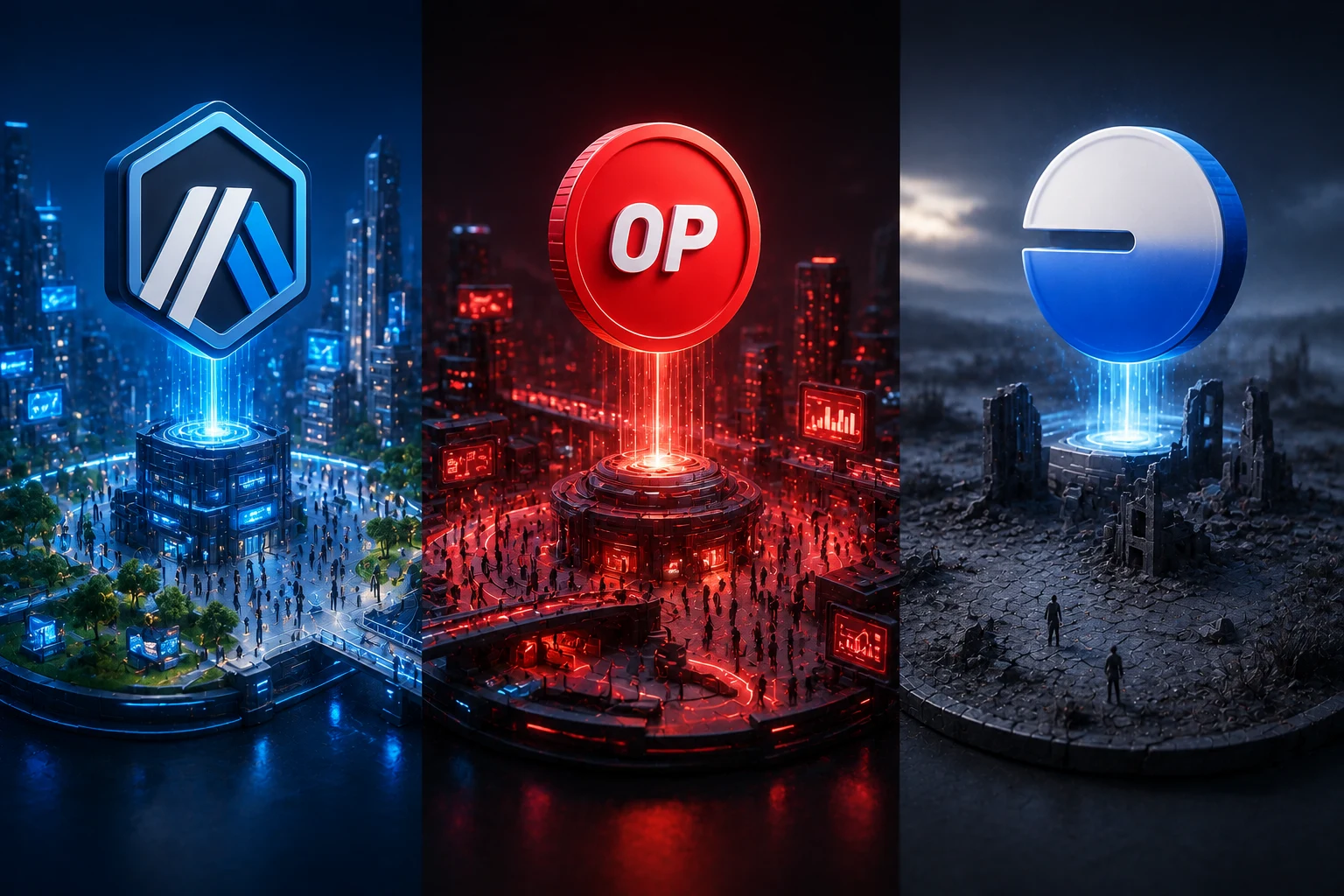
The zombie rollups: what an L2 death actually looks like
An L2 rarely dies in a dramatic hack. The slow death is more common, and it follows a recognizable pattern. First, the initial bridge incentives dry up. Early depositors earn points, airdrops, or yield, and once those rewards end, bridge-in volume drops by 70 to 90 percent within weeks. Net bridge flows turn negative, meaning more value leaves the chain for Ethereum or a competitor than arrives.
Second, sequencer revenue stalls. Without users, gas fees collapse to near zero, and the team has to choose between subsidizing the chain from its treasury or letting block production slow down. Third, applications leave. Builders see falling user counts, pull their teams, and the chain becomes a loop of a few abandoned liquidity pools and a bridge UI. Fourth, the team either winds down, merges into a Superchain, or rebrands and relaunches under a new name, sometimes with the same token, sometimes with a new one.
Recognizable warning signs in 2024 and 2025 included DAAs that fell by more than 90 percent after the airdrop, sequencer revenue under a few hundred dollars per day, and bridge-in volume below 1 percent of the chain's TVL. Several L2s launched in 2023 already match that profile. Calling them out by name is uncomfortable for the ecosystem, but honest ranking is the point: a chain whose only users are the team and its grant recipients is not really a rollup, it is a demo.
Optimistic vs ZK rollups in plain English
Optimistic rollups (Arbitrum, Optimism, Base, Mantle and most of the OP Stack ecosystem) assume transactions are valid by default and rely on a challenge window, typically seven days, during which anyone can submit a fraud proof if they spot a problem. They are simpler to build, fully EVM-equivalent (meaning they run the same smart-contract language as Ethereum), and they have dominated user activity so far.
ZK rollups (zkSync, Starknet, Linea, Polygon zkEVM, and others) generate a cryptographic validity proof for every batch of transactions. There is no challenge window, so finality on L1 is much faster, often minutes instead of a week. The trade-off is that ZK proving is computationally expensive, and full EVM equivalence is harder, which is why some ZK chains use specialized virtual machines or have been slower to attract general-purpose DeFi. Based rollups are a separate category: they post transactions to L1 but rely on a third-party sequencer (often the L1 itself or a rollup like Base) rather than running their own.
Bridge-in vs native mint: why the source of assets matters
When you see a giant TVL figure on a new L2, it is worth asking where those assets came from. Bridge-in TVL means real users moved ETH or stablecoins from Ethereum (or another chain) through the canonical bridge, locking assets on L1 and minting equivalent balances on the L2. Native mint TVL means the assets were issued on the L2 itself, often by the team, often with no L1 backing, and frequently with no deep secondary market.
The difference matters because bridge-in volume is a proxy for real demand, while native mint is a marketing number. A chain with 90 percent native mint and 10 percent bridge-in is essentially a closed loop: the same wallets depositing, withdrawing, and recycling the same treasury-controlled tokens. A chain with steady, two-way bridge flows and a mix of native issuance has users who care enough about the L2 to move real capital across a security boundary.
What this means for users, builders, and investors
For users, the practical implication is that where you bridge matters. Holding assets on an active L2 means deeper liquidity, more reliable apps, and a faster exit if you need to return to Ethereum. Holding on a dormant L2 means you may wait days for a withdrawal to clear, pay high bridge fees on a low-liquidity route, and watch your rewards program evaporate.
For builders, the lesson is that airdrop farming and grant programs can manufacture a temporary user base, but they cannot manufacture stickiness. The chains that retained users after their token events had real apps, fair sequencer economics, and a developer experience that did not require a PhD to deploy.
For investors, the honest takeaway is that the L2 narrative has matured from a pure race for users into a race for revenue and decentralization. Tokens of active chains with growing sequencer revenue tend to accrue fees, while tokens of chains that rely on inflation and treasury subsidies dilute holders. This is education, not financial advice, and your situation, jurisdiction, and risk tolerance should drive any decision.
How to follow the L2 race the smart way
The Ethereum L2 landscape moves fast, and so does the news around it. Tracking which rollups are gaining users, which are bleeding bridge volume, and which are flipping from optimistic to ZK manually is a losing game. Zippfeed surfaces L2 headlines with sentiment scoring (bullish, neutral, or bearish) and an importance rating, so you can see which networks are actually growing and which are quietly going quiet, without reading twenty Twitter threads a day.



 Altcoin Daily
 CryptoSlate
 WuBlockchain