Why these three chains dominate retail DeFi in 2025
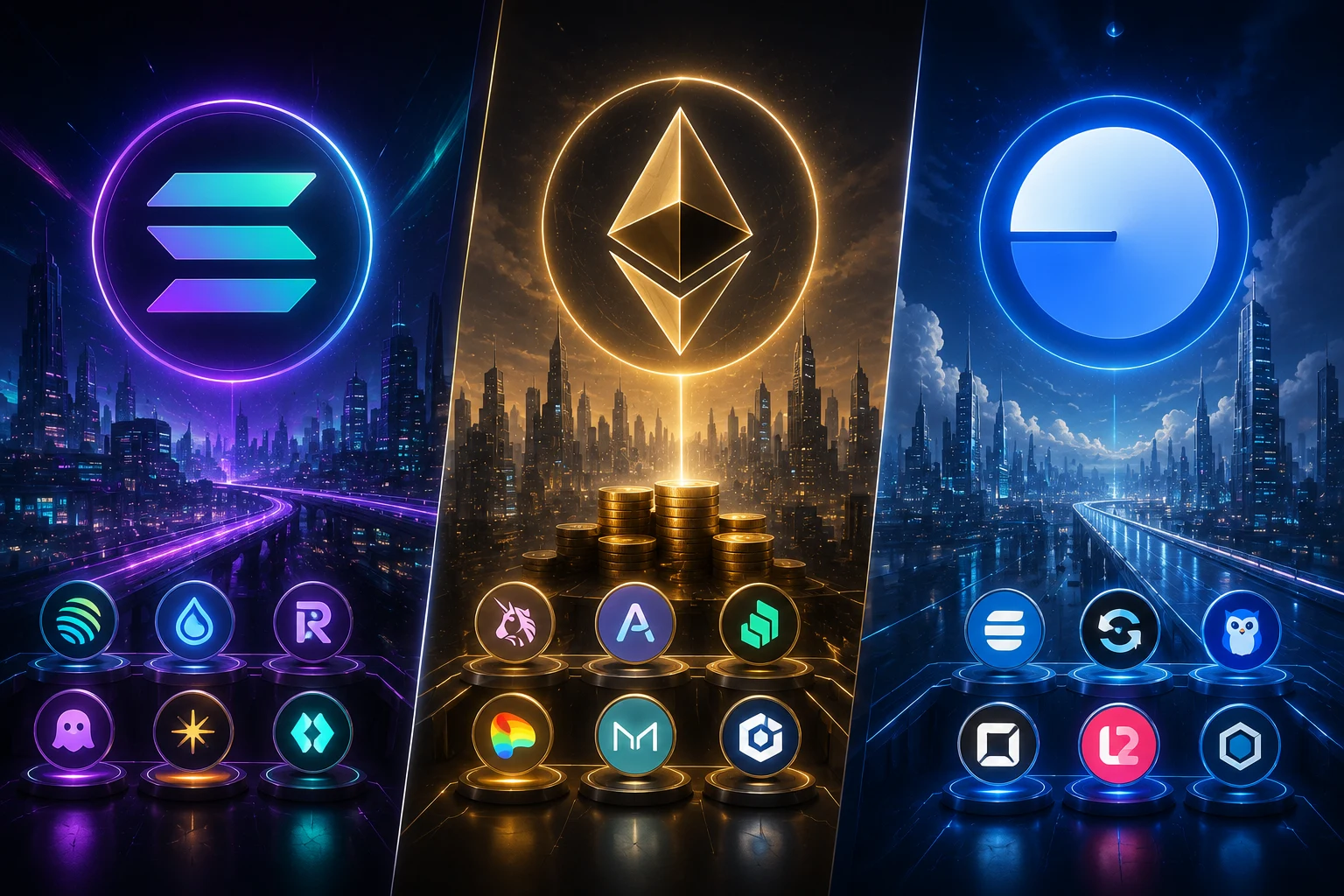
If you deposit funds into a DeFi protocol today, there is a good chance you are doing it on Solana, Base, or Arbitrum. Together, the three account for the majority of active wallets, daily DEX volume, and stablecoin circulation outside of Ethereum mainnet. That concentration did not happen by accident. It is the result of three very different bets about how crypto finance should scale.
Solana is a standalone Layer 1 blockchain with its own validator set and its own native token, SOL. It competes with Ethereum directly on speed and cost, and it has spent several years optimizing for high-throughput trading and consumer applications. Base and Arbitrum, by contrast, are Layer 2 rollups. They inherit security from Ethereum, but they process transactions on a separate chain before posting compressed data back to Ethereum. Their native tokens are governance and utility tokens for the rollup itself, not the gas token of the underlying network.
This structural split matters more than any short-term metric. When you put money into a Solana protocol, you are trusting Solana's validator set and Solana's bridge design. When you put money into a Base or Arbitrum protocol, you are additionally trusting the rollup's sequencer, its upgrade mechanism, and whatever bridge moved your assets onto the chain in the first place. None of those trust assumptions are equivalent, and the rest of this article is about making those differences concrete.
Security models: validator L1 vs rollup L2
Every DeFi user takes on some form of trust risk. The question is how much, and against whom. Comparing Solana, Base, and Arbitrum means comparing three different answers to that question.
Solana's validator L1 model
Solana runs a proof-of-stake consensus mechanism with a globally distributed validator set. Validators stake SOL, vote on blocks, and earn rewards. If they misbehave, their stake can be slashed. The network is known for high throughput and low fees, which it achieves through a combination of hardware requirements, a unique Proof of History clock, and aggressive parallelization.
The trade-off is that Solana's hardware requirements push validator operation toward data centers and professional operators. Decentralization is improving, but the network is meaningfully less accessible to solo stakers than Ethereum. Users should understand that "validator-secured" on Solana means secured by a few hundred professional operators rather than by tens of thousands of home stakers.
Base and Arbitrum as rollups
Base and Arbitrum are both "optimistic rollups" built on Ethereum. Transactions execute on the rollup chain, then a compressed batch is posted to Ethereum Layer 1. If no one challenges that batch during a dispute window, it is considered final. Arbitrum also operates Arbitrum One and Arbitrum Nova, with different data-availability profiles, and has begun rolling out Stylus for non-EVM contracts.
Critical point: the rollup itself runs on a sequencer, a single entity (currently operated by the team) that orders transactions. Most rollups today rely on a centralized sequencer for speed, with decentralization of sequencing as an active workstream rather than a delivered feature. This is not a hidden flaw, it is the current state of rollup design, but it does mean there is one operator that decides transaction ordering until the technology matures.
What this means for users
On Solana, the trust assumption is "the validator set will not collude to rewrite history." On Base and Arbitrum, the trust assumptions are layered: the sequencer will not censor or reorder your transaction unfairly, the rollup's fraud-proof or validity-proof system works correctly, and the bridge you used to get onto the rollup is sound. None of these are deal-breakers, but they compound. A user moving assets between Ethereum and a rollup carries more moving parts than a user staying on a Layer 1.
Fee economics and MEV exposure
Fees are often the first thing users compare, but the comparison gets more interesting once you factor in MEV, the value that block producers or sequencers can extract by reordering, inserting, or censoring transactions.
Raw transaction fees
Solana's fees are typically fractions of a cent, paid in SOL. This is a major reason it became a hub for high-frequency trading, perps, and on-chain arbitrage. Base and Arbitrum charge fees in ETH, with Base generally cheaper due to its EIP-4844 blob usage and Arbitrum's costs varying depending on calldata pricing. Both rollups are much cheaper than Ethereum mainnet, but neither matches Solana's sub-cent floor.
MEV on Solana
Solana's mempool-less design means most MEV happens through priority fees and Jito bundles. Validators running the Jito client can extract value from sandwiching, arbitrage, and liquidations. Users typically pay a small tip to validators for priority execution, but sandwiching remains a known source of slippage on Solana DEXes. Several Solana DEXes have integrated MEV-aware routing to reduce this.
MEV on Base and Arbitrum
On rollups, MEV is split between the sequencer and searchers. Today, the sequencer on Base and Arbitrum captures most of the MEV through private order flow, with some rebated to users depending on the protocol. As sequencer decentralization progresses, this distribution may change. For now, the practical user experience is that large swaps on Base and Arbitrum can attract backrun bots, but sandwiching is less common than on Solana.
What users actually feel
If you are swapping $500 of a token, you will likely pay less and see less impact on Solana than on a rollup, but you may also face more sandwich risk. If you are swapping $50,000, rollups often give more predictable execution because of deeper liquidity and lower MEV variance. Fee tier matters too: Solana's priority-fee market is less mature than Ethereum's, so on a busy day your transaction might land out of order.
DEX designs: CLMMs vs v2/v3 defaults
The default DEX design on each chain is a useful proxy for what kind of liquidity providers and traders the ecosystem serves.
Solana's CLMM dominance
Solana's DeFi culture is built around concentrated-liquidity market makers, or CLMMs. Raydium, Orca, and Meteora all use concentrated-liquidity designs where LPs pick a price range. This is more capital-efficient for active pairs but harder for passive LPs, because out-of-range positions earn nothing and can be hit by impermanent loss more aggressively. The upside is tighter spreads on majors like SOL and USDC.
Perps DEXs like Drift, Jupiter Perps, and Zeta also benefit from CLMM-style order books, which give them tighter funding spreads and faster liquidations. Solana's CLMM-native culture is a structural advantage for traders and a structural hazard for casual LPs.
Base and Arbitrum's v2/v3 mix
Base and Arbitrum lean heavily on Uniswap v3 forks and, increasingly, Uniswap v4 hooks. The default LP experience is still the familiar "pick a range and provide liquidity," but the median LP on these chains tends to be larger and more sophisticated than on Solana. Uniswap v4's hook system lets protocols customize fee tiers and execution logic in ways that Solana's CLMMs do not yet match.
For users, this means swaps on Base and Arbitrum often route through Uniswap with deep passive liquidity, while swaps on Solana route through a mix of CLMMs with active strategies. Both work. They just reward different skill levels.
Perps and lending depth: where capital actually sits
Beyond spot DEXes, the depth of perps and lending markets reveals where sophisticated capital concentrates.
Perps DEXs
Solana is the deepest chain for on-chain perps by volume, with Drift, Jupiter Perps, Zeta, and several smaller venues competing for flow. Funding rates, open interest, and liquidity are all strong on majors. Arbitrum hosts Hyperliquid's L1, GMX v2, and a long tail of smaller perps protocols. Hyperliquid in particular has set a new bar for on-chain order-book perps, but it is technically its own app-chain rather than an Arbitrum-native protocol. Base has a smaller perps footprint, mostly through Aerodrome's perps and emerging entrants.
Lending markets
Arbitrum is the deepest chain for lending outside of Ethereum mainnet, with Aave v3, Compound v3 forks, and a handful of specialized protocols like Silo and Radiant. Base is rapidly growing, anchored by Aave v3, Moonwell, and Aerodrome's lending product. Solana's lending market is anchored by Kamino, MarginFi, and Drift's lending vaults, but loan-to-value ratios and oracle quality have lagged behind Aave on rollups.
For users, this means a leveraged position on Arbitrum often has the deepest borrow liquidity and the tightest oracle redundancy. A leveraged position on Solana executes faster but carries more idiosyncratic risk if a single venue dominates.
Bridging and canonical asset risk
None of these chains are closed systems. Users move assets onto them through bridges, and that bridging step is where a disproportionate share of historical losses has occurred.
How bridging actually works
When you bridge USDC from Ethereum to Base or Arbitrum, you typically deposit into a bridge contract on Ethereum, and a wrapped or canonical version is minted on the destination chain. For major stablecoins, Circle now issues native USDC directly on Base and Arbitrum, which eliminates one layer of wrapping risk. For SOL and other native assets, bridging usually involves a third-party bridge like Wormhole, LayerZero, or a chain-specific canonical bridge.
Canonical vs synthetic assets
A canonical asset is one issued natively on a chain or through a tightly controlled bridge. A synthetic asset is a wrapped or minted token that claims to track an underlying. Most DeFi protocols today prefer canonical assets because they reduce the risk of bridge insolvency or depeg. On Solana, SOL is canonical, but USDC is bridged from Ethereum via Wormhole. On Base and Arbitrum, USDC is native, but SOL and BTC are bridged.
Historical wipeouts
The Wormhole bridge was exploited for over $320 million in 2022. The Ronin bridge lost over $600 million to North Korean hackers in the same year. The Multichain bridge collapsed in 2023. None of these events invalidated the underlying chains, but they did wipe out users who assumed that bridged assets were as safe as native ones. The lesson is simple: the bridge is part of your trust surface, and your risk model should treat it that way.
What this means if you are choosing where to deploy capital
There is no single right answer. There is only a question of which trade-offs you are willing to accept.
Use Solana if you prioritize speed and trading
If you are an active trader, a perps user, or someone who cares about sub-second confirmations and sub-cent fees, Solana is hard to beat. The CLMM-native DEX design and the depth of perps venues are genuine structural advantages. The trade-off is sandwich risk, slightly less mature lending markets, and a smaller validator set than Ethereum.
Use Arbitrum if you prioritize lending and liquidity depth
If you want the deepest borrow liquidity, the most battle-tested lending protocols, and the most mature rollup stack, Arbitrum is the conservative choice. You will pay a bit more in fees and accept some sequencer centralization, but you get the closest thing to "Ethereum with discounts." Perps are strong here too, especially if you count Hyperliquid.
Use Base if you want consumer-facing DeFi with Coinbase's distribution
Base sits between the two. It is cheaper than Arbitrum, more centralized in its sequencer, and increasingly competitive on lending and perps. Its main advantage is distribution: Coinbase's user base and fiat ramps feed directly into Base. If you are a beginner or a builder looking for retail users, Base is worth considering.
Consider splitting across chains
Most sophisticated DeFi users do not put everything on one chain. They hold a trading book on Solana, a lending book on Arbitrum, and a small position on Base to experiment. That diversification is not free, it adds bridging risk, but it reduces exposure to any single chain's failure mode.
How to follow Solana, Base, and Arbitrum DeFi the smart way
DeFi on Solana, Base, and Arbitrum moves fast, and so does the news around it. New protocols launch weekly, bridges get upgraded, sequencers decentralize in stages, and MEV dynamics shift with each major client release. Tracking all of that manually is a losing game. Zippfeed surfaces DeFi ecosystem headlines across these chains with sentiment scoring (bullish, neutral, or bearish) and an importance rating, so you can spot structural changes before they show up in fees or liquidations.


 Lookonchain
 WuBlockchain
 TheBlock
 CoinTelegraph