Why the stablecoin market suddenly has so many "new" dollars
If it feels like a new dollar-pegged token launches every month, that is because, in 2024 and 2025, it roughly did. After years of Tether's USDT dominating the market, U.S. regulators, big banks, and large consumer brands began issuing their own regulated alternatives, hoping to capture a slice of the more than $200 billion in stablecoin float.
The catalyst was the European Union's MiCA regulation going live, which effectively locked USDT out of major European exchanges, and the parallel U.S. push for federal stablecoin legislation, which has not yet passed as of late 2025 but has already shaped how issuers structure themselves. Banks, payment networks, and crypto-native firms all concluded that a regulated, audited, dollar-redeemable token was now table stakes.
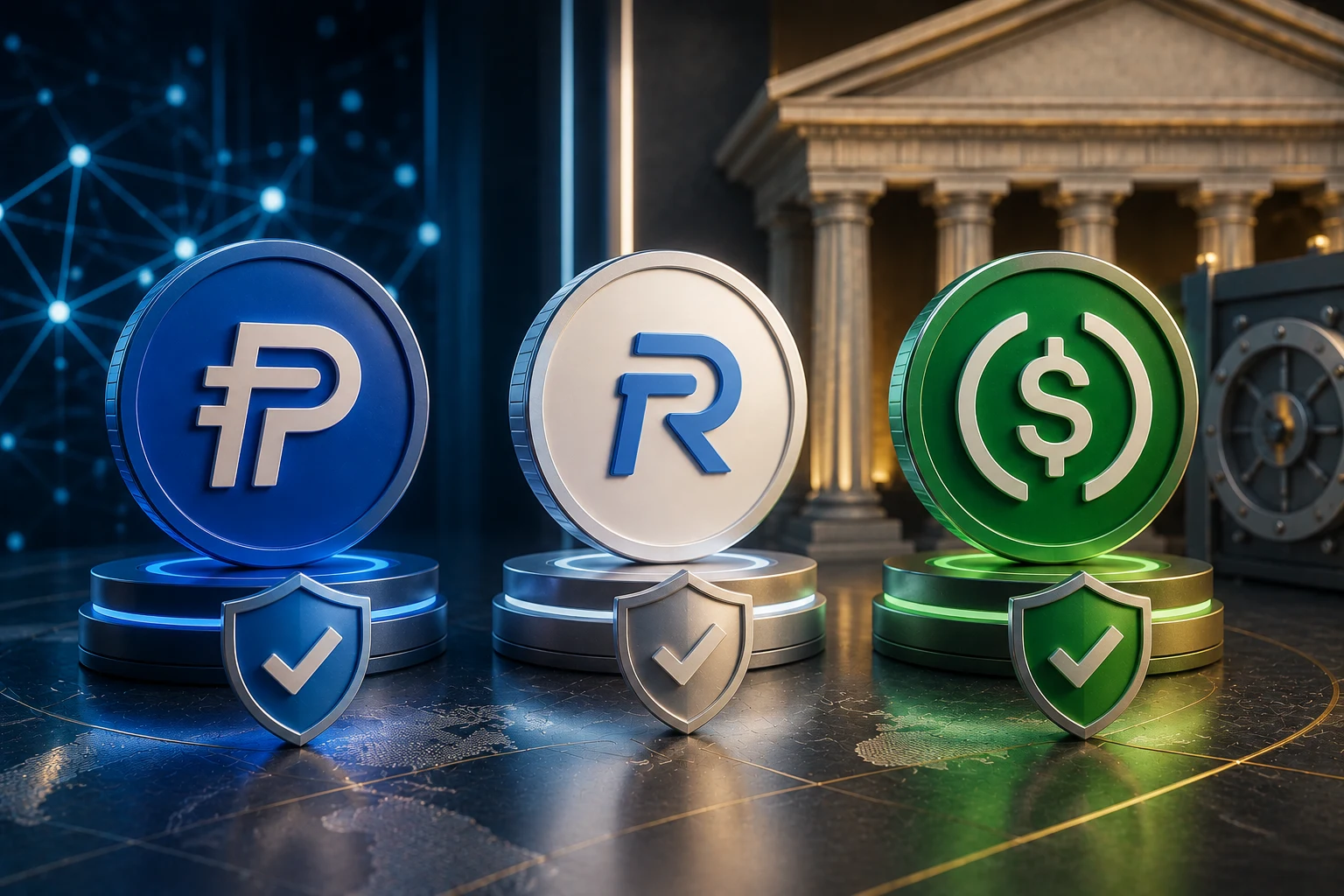
The result is a crowded field. You have the established giants USDC and to a lesser extent USDT. You have PayPal's PYUSD, riding the PayPal and Venmo rails. You have RLUSD from Ripple, chartered in New York. You have USDG, issued by Paxos on behalf of a consortium of crypto firms. And you have USD1, the token tied to World Liberty Financial, the Trump-linked crypto venture. Each claims to be the most compliant, the most transparent, or the most institutional. The reality is more nuanced.
What can actually go wrong: the real risks of "safe" stablecoins
Stablecoins are sold as the boring, safe corner of crypto. They are not risk-free. Before comparing features, it is worth being honest about how dollar tokens have failed or nearly failed in the past, because every newer entrant promises to fix a problem that an older one exposed.
The 2022 TerraUSD collapse is the canonical example. UST was not backed by dollars or Treasuries at all. It was an algorithmic token paired with a volatile asset, and once confidence broke, the peg broke with it. Billions of dollars were wiped out in days. UST was an outlier, but it is the reason regulators now treat the word "stablecoin" as a category that needs rules, not a synonym for cash.
Even properly reserved tokens have had scares. Tether has faced years of questions about the quality of its reserves and its audit disclosures. Circle survived the 2023 Silicon Valley Bank failure, but only because the U.S. government backstopped SVB deposits over a weekend. USDC briefly depegged to around $0.87 during that episode. No customer lost money, but the episode proved that "backed by Treasuries and cash" is not the same as "immune to bank failures," because the reserves sit in banks.
More quietly, issuers also carry operational risk. Smart contract bugs can freeze redemptions. Compliance teams can freeze individual addresses. Custodial partners can be hacked. And in a true issuer bankruptcy, the legal structure of the reserves (whether they sit in a segregated trust, a bankruptcy-remote special purpose vehicle, or just on the issuer's balance sheet) determines whether you are a creditor or an owner. That distinction is the heart of the current "usdg vs usdc" debate.
\h2>Who issues each token, and under what licenseStablecoins look interchangeable, but the legal entity behind the token, and the license it holds, is the single biggest difference between them. This is also the part most marketing pages gloss over.
USDC. Issued by Circle Internet Group. Circle holds U.S. state money transmitter licenses and is registered with FinCEN. It also holds an e-money license in the EU under MiCA. USDC reserves are held in a structure managed by BlackRock, with attestation reports from a Big Four auditor. Circle went public on the NYSE in 2025, which means it now files regular disclosures with the SEC.
USDG. Issued by Paxos Trust Company on behalf of the Global Dollar Network, a consortium that includes Robinhood, Galaxy Digital, Kraken, and others. The interesting twist is the distribution model: network members distribute USDG, and a share of the yield earned on reserves is passed back to those distributors and, in some cases, to end users. Paxos itself is a New York limited purpose trust company, regulated by the New York Department of Financial Services (NYDFS), which is one of the strictest stablecoin regulators in the world.
PYUSD. Issued by Paxos for PayPal. The token itself is the same Paxos-issued engine as USDG, but it sits inside PayPal's consumer and merchant ecosystem. Holders can move PYUSD between PayPal, Venmo, and external wallets, and merchants can accept it at checkout. PayPal holds the user relationship and the compliance obligations on its side.
RLUSD. Issued by Ripple Labs' subsidiary under a New York limited purpose trust company charter from NYDFS, the same framework Paxos operates under. Ripple's pitch is institutional: the token is designed for cross-border payments and tokenized treasury use cases, leveraging Ripple's existing relationships with banks and payment providers outside the U.S.
USD1. Issued by a Cayman-based entity tied to World Liberty Financial, the venture associated with the Trump family. Custody and reserve management are handled through a partnership with BitGo, a regulated custodian. USD1 is the newest and least battle-tested of the group, and its political associations have made it both more visible and more controversial.
What actually backs the tokens: reserves are not all equal
Every issuer claims "1:1 backed by cash and short-dated U.S. Treasuries." That is mostly true at the asset level. The differences show up in two places: the legal wrapper around those assets, and the disclosure cadence.
On the asset side, the menu is similar across the board:
- Short-dated U.S. Treasury bills (typically under 13 weeks).
- Reverse repurchase agreements collateralized by Treasuries, which add a layer of bank counterparty risk.
- Overnight cash deposits at major U.S. banks.
- Sometimes tokenized money market funds like BlackRock's BUIDL, which themselves hold Treasuries.
Where issuers diverge is in the legal structure. Circle's USDC reserves are held by BlackRock in a managed fund structure, with attestations rather than full audits. Paxos-issued tokens (USDG and PYUSD) sit in segregated trust structures under NYDFS oversight, which means the reserves are legally separated from Paxos's operating company. RLUSD follows a similar NYDFS trust model. USD1's structure is less transparent in public filings, and custody is handled by a third party, which is normal for the industry but adds a layer between the user and the assets.
Disclosure cadence also varies. Circle publishes monthly attestations and, as a public company, quarterly 10-Q filings. Paxos publishes monthly reserve reports audited by a Big Four firm. RLUSD publishes attestations on the same NYDFS rhythm. USD1's disclosures are less frequent and less granular, which is a real gap if you care about the "T in transparency."
Fees, redemption, and where each token actually works
Marketing copy treats stablecoins as identical. In daily use, they are not. Three things matter: how you redeem them, what you pay, and where you can spend or trade them.
Redemption. USDC, USDG, PYUSD, and RLUSD all offer 1:1 redemption in U.S. dollars for verified institutional accounts, usually with a minimum size (commonly $100,000 or more) and a small fee. Retail users typically redeem by selling on an exchange or sending to a partner bank, not by going directly to the issuer. USD1 also supports institutional redemption, but the path is newer and less documented.
Fees. Issuers generally do not charge end users a fee for holding the token. Where economics appear is on-chain: Ethereum mainnet USDC transfers can cost several dollars in gas during busy periods, while Solana USDC transfers cost fractions of a cent. USDG and PYUSD exist on multiple chains; RLUSD launched on Ethereum and XRP Ledger; USD1 is primarily on Ethereum and BNB Chain. Choosing a chain matters more than choosing a token for many users.
Where they work. USDC is the most widely accepted stablecoin on DeFi, centralized exchanges, and payment integrations. PYUSD has the unique advantage of native PayPal and Venmo rails, which is meaningful if you actually want to spend stablecoins in the real world. USDG distribution is tied to its consortium partners, so availability depends on whether you use Robinhood, Kraken, or another member. RLUSD's footprint is currently smaller and more institutional, focused on Ripple's payment corridors. USD1's main distribution channel is World Liberty Financial's own platform and a handful of partner venues.
How to choose: a practical decision framework
Given all of the above, the honest answer to "usdg vs usdc" is that there is no single winner. The right stablecoin for you depends on three things: where you live, what you are doing with the token, and how much you care about issuer accountability.
If you are a U.S. retail user trading or holding on exchanges, USDC is the default because it is everywhere, cheap to move on Solana and Base, and backed by a publicly listed company with regular disclosures. PYUSD is worth considering if you are inside the PayPal or Venmo ecosystem, because the on-ramp is seamless.
If you are in Europe, MiCA matters. Circle holds an e-money license and offers a dedicated EU-compliant USDC. PYUSD and several others have either restricted EU distribution or are working through the licensing process. Check what your exchange actually supports before assuming a token is available to you.
If you are an institution or high-net-worth user, the issuer's legal structure is more important than the brand. NYDFS-regulated issuers (Paxos for USDG and PYUSD, Ripple for RLUSD) offer the strongest U.S. regulatory standing, with reserves held in trust structures that survive issuer insolvency. USDC's structure is robust but is organized through a money market fund, which has different bankruptcy treatment.
If you care about decentralization of issuance, none of these are truly decentralized. They are all centralized issuers with a private kill switch. If that is a deal-breaker, you are looking at overcollateralized crypto-backed stablecoins like DAI, not the bank-issued cohort.
The bigger picture: why "who can you sue" is the real question
The non-obvious truth about the 2025–2026 stablecoin market is that the technology is no longer the differentiator. Every major token is fast, cheap, dollar-pegged, and audited. The differentiator is legal recourse. If the issuer fails, if a custodian disappears, if a regulator freezes reserves, who is the accountable party, and in which jurisdiction can you file a claim?
This is why NYDFS charters carry weight: they impose strict capital, audit, and segregation requirements, and they give New York regulators direct authority over the issuer. It is also why Circle's IPO matters: public companies face shareholder suits, SEC oversight, and mandatory disclosures. Paxos' choice to put USDG and PYUSD reserves in segregated trust structures is not a technical detail, it is a legal promise that in a bankruptcy, token holders come before general creditors.
None of this eliminates risk. A U.S. Treasury default would hit every stablecoin, regulated or not. A smart contract bug could freeze any of them. A cyberattack on a custodian could drain reserves overnight. What regulation and good structuring buy you is not safety in the absolute sense, but a clear chain of legal accountability when things go wrong. For most users holding a few thousand dollars, that distinction feels academic. For users holding six or seven figures, it is the only thing that matters.
Stay ahead of the new stablecoin wave
Stablecoin launches now move markets, custody arrangements, and regulatory policy in real time. USDG distribution deals, RLUSD bank partnerships, and USD1 reserve disclosures can all shift user flows within days, and most of the news is buried in press releases, regulatory filings, and on-chain data. Zippfeed surfaces stablecoin headlines with sentiment scoring (bullish, neutral, or bearish) and an importance rating, so you can see which issuers are gaining traction and which are losing it, without having to read every wire yourself.




 CoinDesk
 CryptoSlate
 Lookonchain