Why "backed 1:1" is not the same as "redeemable in bankruptcy"
The phrase "fully backed" describes an issuer's reserve assets on a normal day. It tells you nothing about what happens when the issuer files for Chapter 11 protection, when a Cayman court appoints provisional liquidators, or when a Delaware trustee starts marshaling assets. In those scenarios, the question is not whether reserves exist, it is whose claim on those reserves has legal priority.
For most stablecoins, the legal answer is uncomfortable. A holder of USDC is a creditor of Circle Internet Group, the same as a vendor with an unpaid invoice or a landlord with an unsigned lease. The reserves backing USDC are assets of Circle, sitting on Circle's balance sheet, and in a bankruptcy they form part of the estate available to satisfy all creditors, ranked by class and by the priority rules of the governing jurisdiction.
Compare that to a tokenized money-market fund. Products such as BUIDL (BlackRock) and OUSG (Ondo) place reserves in a bankruptcy-remote special purpose vehicle, a separate legal entity whose assets are ringfenced from the issuer's operating company. If the issuer goes under, the fund's assets are not part of the estate. Investors have a direct claim on the SPV, not a general claim on the issuer. That structural difference is the reason institutional desks prefer tokenized Treasuries for cash management, even when the yield looks similar to a fiat-backed stablecoin.
The risks a holder actually faces
Before going further into the legal mechanics, it is worth listing what is at stake for a person holding USDT, USDC, or any other centralized stablecoin through a normal retail wallet or exchange account.
1. You become an unsecured creditor
Unless you hold a regulated instrument such as USDP (Paxos) issued under New York DFS oversight, or a tokenized fund share backed by a bankruptcy-remote SPV, your stablecoin is a contractual promise from the issuer to redeem at par. In bankruptcy, contract claims without specific collateral become unsecured. They are paid after secured lenders, administrative expenses, employees, and certain tax and regulatory priorities.
2. The reserves may be smaller than reported, or differently composed
Audit and attestation reports describe a point-in-time snapshot. They do not guarantee that on the day of the filing the reserves match the liabilities, nor that all reserves are in the form described (cash, short-dated Treasuries, commercial paper, repo collateral). In a fast-moving bankruptcy, the trustee may discover that a slice of "cash" was actually a 90-day commercial paper note from a related entity.
3. The custodian bank can fail independently
Even if Circle or Tether is solvent, reserves sitting at a single commercial bank create a second layer of risk. If that bank fails or freezes accounts, the issuer's ability to process redemptions collapses even though the issuer itself is healthy. This is the concentration risk that SVB's March 2023 collapse briefly exposed when Circle disclosed a $3.3 billion USDC cash position stuck at Silicon Valley Bank. The peg broke to roughly $0.88 within 48 hours.
4. Commingling with the issuer's other business is dangerous
The clearest historical warning is FTX and Alameda Research. Customer deposits were silently routed into Alameda trading positions, leaving retail creditors with unsecured claims on a balance sheet that had been looted. While no major regulated stablecoin issuer has yet been shown to commingle in this way, the structural risk exists whenever reserves and operating capital share a corporate parent.
5. The peg can break before the bankruptcy
A run on the issuer triggers redemptions and secondary-market discounts. By the time the issuer files for Chapter 11, the peg may already be at $0.97 or lower. Holders who try to exit on-chain during a de-peg face additional slippage, gas fees, and the risk that DEX liquidity thins exactly when they need it most.
How a bankruptcy would actually unfold for a USDC holder
Imagine Circle Internet Group files for Chapter 11 in Delaware, the most likely venue for a U.S.-domiciled issuer. The following sequence is what a holder of USDC would experience, drawing on standard Delaware bankruptcy practice and the disclosures in Circle's reserve reports.
Day 0: Filing and automatic stay
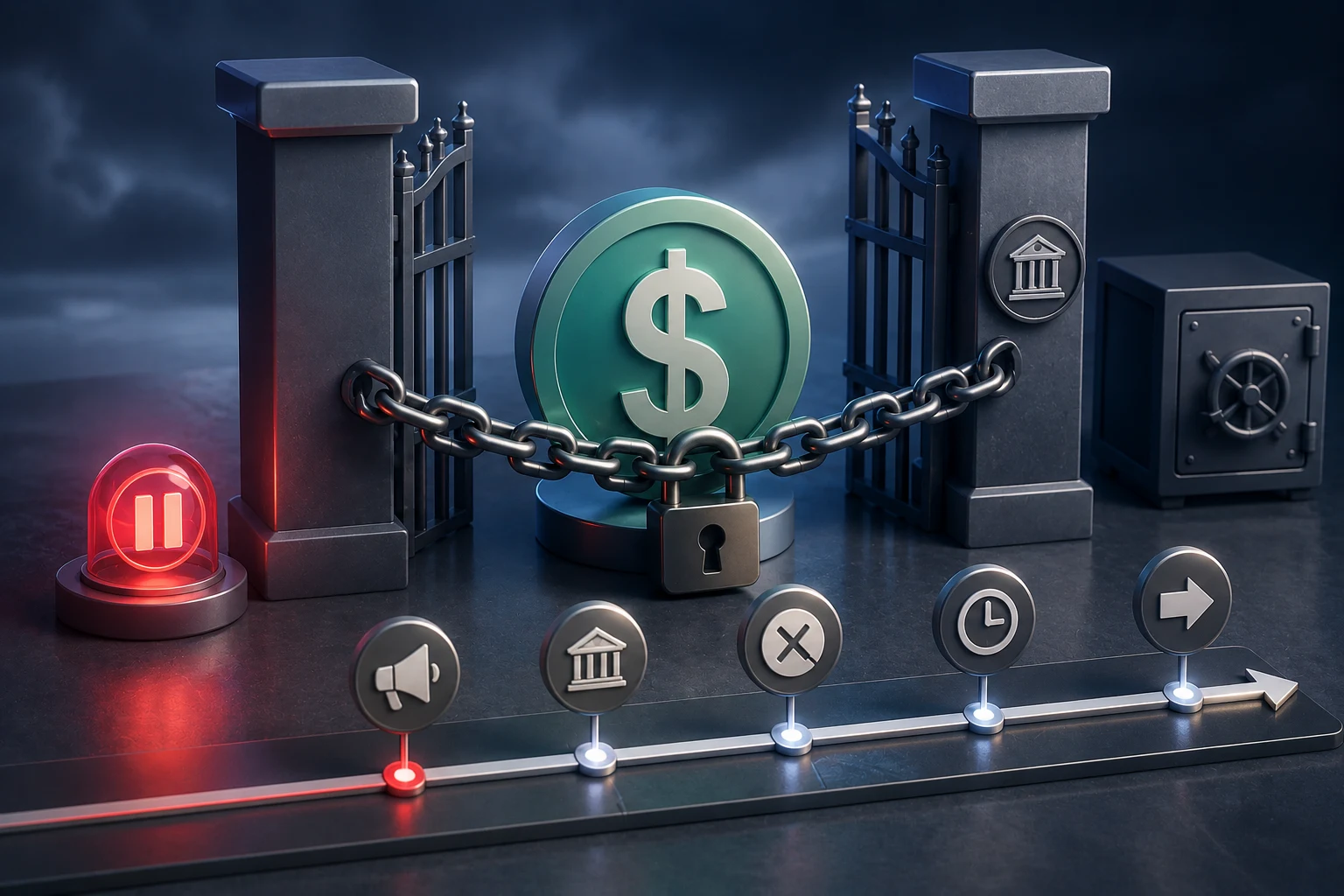
The moment the petition is filed, an automatic stay freezes most collection actions against the estate. You cannot sue Circle, you cannot enforce a redemption at a Circle counterparty, and any pending redemption requests are paused. Circle continues to operate as a "debtor in possession" under existing management, subject to court oversight.
Days 1-30: First-day motions and DIP financing
Circle would seek "first-day" orders to pay employees, keep critical vendors, and continue basic operations. If Circle needed operating cash to fund an orderly wind-down, it would request debtor-in-possession (DIP) financing, a new loan that typically has super-priority over existing creditors, including USDC holders. This is standard practice and it pushes unsecured claims further down the priority stack.
Months 1-6: Claims process and creditor committees
USDC holders would be notified, given a claims bar date, and asked to file proofs of claim. The U.S. Trustee would appoint an unsecured creditors' committee, which would include representatives of large holders. Holders would have standing to object to the disclosure statement and to the plan of reorganization.
Months 6-24: Plan confirmation and distributions
A plan of reorganization would propose how reserves and any new equity would be distributed. In the best case, the plan would convert USDC claims into a combination of cash, new equity, and a long-dated claim on future earnings. In the worst case, recoveries might be 30 to 70 cents on the dollar, paid out over years, with no interest.
Lessons from the BUSD wind-down and the FTX collapse
Two real-world episodes anchor any discussion of stablecoin bankruptcy risk. They are not identical, but together they bracket the range of outcomes a holder might face.
The BUSD wind-down: an orderly, regulator-led shutdown
In February 2023, the New York Department of Financial Services ordered Paxos to stop minting BUSD, the Binance-branded stablecoin, and instructed both firms to wind down the product. Paxos held reserves in cash and short-dated Treasuries at segregated accounts. Crucially, NYDFS oversight meant Paxos was subject to specific asset-custody and reporting rules that the wind-down had to respect.
Over roughly four months, Paxos redeemed BUSD holders directly at par. By September 2023, BUSD supply had fallen from roughly $16 billion to under $1 billion. No holder lost a dollar. The case is the strongest existing precedent for what a regulator-driven shutdown of a well-structured, fully reserved stablecoin can look like.
The FTX collapse: the danger of commingling
FTX is the cautionary tale. Customer deposits were commingled with Alameda Research, the proprietary trading arm, and used as collateral for leveraged bets. When FTX filed for Chapter 11 in November 2022, retail customers discovered that they were unsecured creditors of a balance sheet that had been substantially depleted. Initial recovery estimates for general unsecured claimants have fluctuated, but at various points the implied recovery rate has been in the cents-on-the-dollar range, with distributions stretched over many years.
FTX did not issue a stablecoin, but the commingling pattern is the single largest threat to any centralized stablecoin issuer that treats reserves as fungible with operating capital. The lesson is structural, not specific to any one product.
Why the governing law matters more than the reserves
Stablecoin holders tend to focus on the size and composition of reserves, which is the right instinct. But in a bankruptcy, the governing law of the issuer and the governing law of the reserve structure determine who gets paid first. Three jurisdictions matter most.
Delaware (for U.S. issuers)
Most major U.S. stablecoin issuers are incorporated in Delaware, and Delaware bankruptcy law is among the most creditor-protective in the world. Secured creditors with properly perfected liens are paid first. Unsecured creditors, including stablecoin holders, share whatever is left, pro rata, after administrative and priority claims. A holder's individual claim size is irrelevant to priority, only to the pro rata share of the residual pool.
New York (for DFS-supervised issuers)
Paxos-issued USDP and the now-wound-down BUSD operated under New York DFS BitLicense and trust charters. NYDFS oversight adds an extra layer: reserves are held in segregated trust accounts that are statutorily protected from the issuer's general creditors. In a Paxos bankruptcy, USDP holders would likely have a stronger claim than USDC holders in a hypothetical Circle bankruptcy, because the NYDFS regime treats stablecoin reserves as trust assets, not balance-sheet assets.
Cayman Islands (for Tether)
Tether is incorporated in Hong Kong but its reserves and operating subsidiaries are largely structured through Cayman and other offshore entities. Cayman bankruptcy law follows English common law principles and tends to favor liquidator-driven restructurings. The practical effect for USDT holders is that recoveries depend heavily on the cooperation of the appointed liquidators and the willingness of Tether's banking partners to honor redemption requests, neither of which is guaranteed during a contested proceeding.
The broader point: jurisdiction shapes the legal answer to "who gets paid first." A stablecoin with identical reserves can offer holders radically different protections depending on whether the issuer is a NYDFS trust, a Delaware C-corp, or a Cayman exempted company.
Tokenized money funds: a different model
Institutional cash management has moved steadily toward tokenized U.S. Treasury and repo products because they solve the unsecured-creditor problem at the structural level. BUIDL (BlackRock USD Institutional Digital Liquidity), OUSG (Ondo Short-Term U.S. Government Treasuries), and similar products issued by WisdomTree, Franklin Templeton, and Hashnote share a common architecture.
The bankruptcy-remote SPV
Reserves sit in a special purpose vehicle that is contractually and legally separate from the issuer's operating entity. The SPV has its own board, its own bank accounts, and covenants that prevent the parent from borrowing against or commingling SPV assets. If the issuer files for bankruptcy, the SPV's assets are not part of the estate, and investors have a direct claim on the underlying Treasuries or repo collateral.
What "redemption at par" actually requires
For any stable instrument to redeem at par in a stressed scenario, three conditions must hold simultaneously. First, the reserve assets must be in instruments that can be sold or matured at par within the redemption window, which means short-dated Treasuries and overnight repo, not long-dated bonds or commercial paper. Second, the redemption mechanism must be operational, meaning the issuer's bank rails and smart contracts must still work, ideally through a regulated transfer agent rather than a single corporate signatory. Third, the legal structure must insulate the reserves from the issuer's general creditors, which is precisely the role of the SPV.
Tokenized Treasury funds meet all three conditions. Centralized stablecoins meet the first condition partially (Tether holds some Treasuries but also holds other instruments) and typically do not meet the second and third conditions to the same degree.
What this means for a holder building a stablecoin position
Putting the pieces together, a rational framework for thinking about stablecoin bankruptcy risk looks like this.
First, treat any centralized stablecoin as a credit exposure to the issuer, not as a cash equivalent. The reserves provide confidence on normal days, but the legal structure is what determines outcomes on the bad day. If you would not be comfortable holding an unsecured promissory note from the issuer for the size of your position, reduce the size of your stablecoin position.
Second, diversify across issuers and structures. Holding 50% USDC, 30% USDT, and 20% in a tokenized Treasury fund spreads the risk of any single issuer failure and gives you partial access to bankruptcy-remote structures. The trade-off is operational complexity and the need to understand each issuer's jurisdiction and reserve composition.
Third, prefer regulated, segregated structures for cash you cannot afford to lose. NYDFS-supervised stablecoins (USDP, formerly PAX) and tokenized Treasury funds (BUIDL, OUSG, USDY) sit at the top of the protection hierarchy. Offshore, unregulated stablecoins (USDT) sit at the bottom. USDC sits in the middle, with strong transparency and large reserve buffers but no statutory segregation of reserves from general creditors.
Fourth, keep some dry powder off the issuer's books entirely. Self-custody on hardware, with multisig, removes counterparty risk from the issuer layer entirely, though it introduces new operational risks (key loss, address poisoning, smart-contract bugs in the wallet).
How to follow stablecoin issuer risk the smart way
Stablecoin issuer risk is not a static fact, it is a moving picture. Reserve compositions change, banking relationships change, and regulatory actions can land with little warning. Tracking reserve attestations, banking-partner disclosures, and regulatory news across USDT, USDC, BUSD, USDP, and DAI manually is a losing game. Zippfeed surfaces stablecoin headlines with sentiment scoring (bullish, neutral, or bearish) and an importance rating, so you can spot issuer stress, regulatory action, and reserve changes before they hit the peg.





 CoinDesk
 CryptoSlate
 WuBlockchain
 TheBlock