What people actually mean by "stablecoin payment rails"
The phrase "stablecoin payment rails" gets used to mean three very different things, and most online comparisons blur them. First, there is consumer-facing crypto checkout, where a customer pays with a self-custody wallet or a custodial app at an online merchant. Second, there is merchant settlement, where the customer still pays with a card or bank transfer, but the merchant receives USDC or USDT into a treasury wallet instead of a USD bank deposit. Third, there is B2B and cross-border payout infrastructure, where a platform sends stablecoins to contractors, suppliers, partners, or end users across borders, then those recipients off-ramp locally.
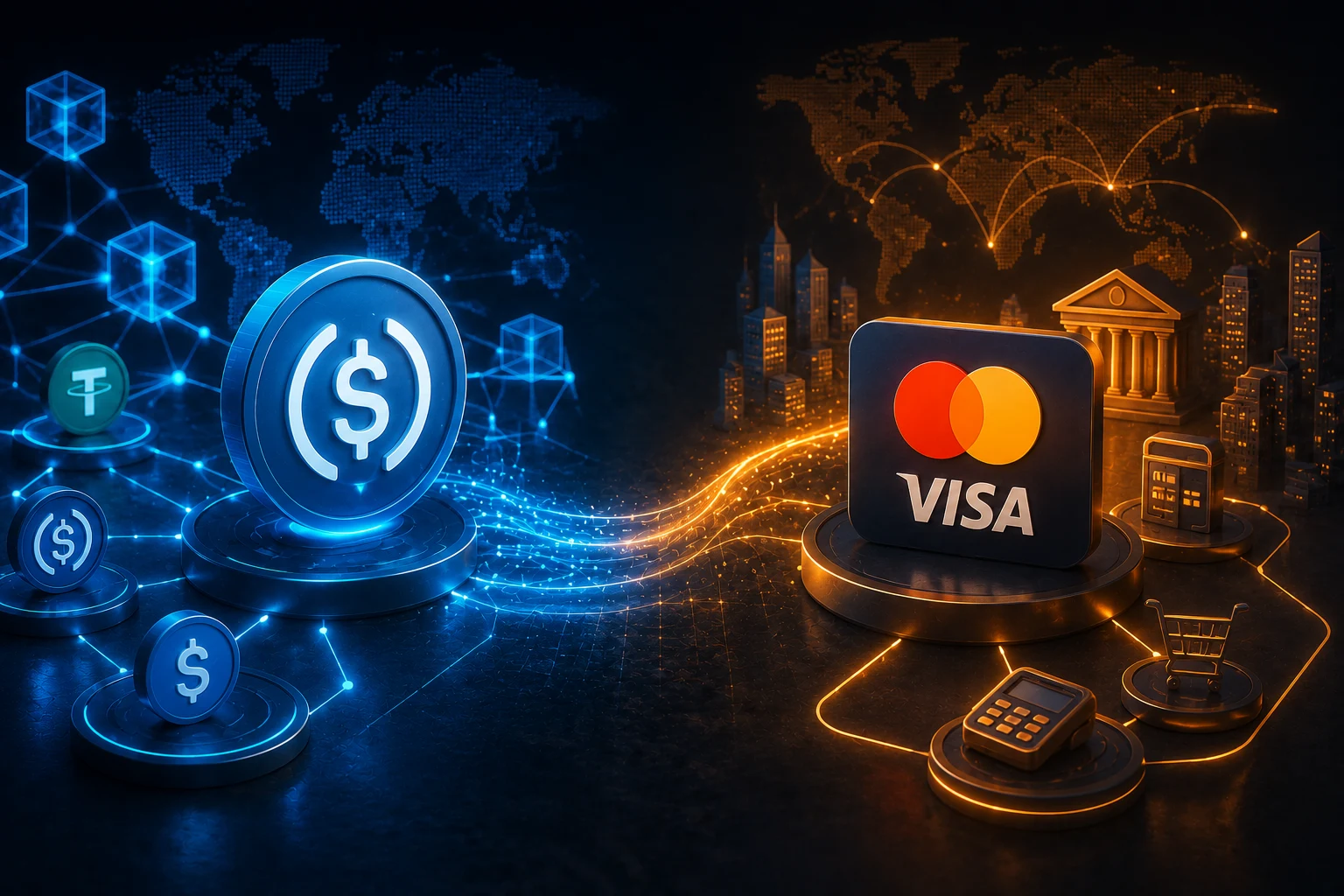
When fintech product teams ask whether "stablecoin rails beat Visa," they are almost always asking about the second or third case. The first case, consumer crypto checkout, is tiny in volume relative to card payments, and most users still do not have a wallet they are willing to use at a point of sale. Cards and account-to-account schemes like ACH, SEPA, and PIX still dominate that layer, and they will for the foreseeable future.
The honest framing, then, is this: stablecoins are not trying to replace the moment you tap your card at a grocery store. They are trying to replace the slower plumbing behind the scenes, the multi-day clearing windows, the correspondent banking fees on a $500 cross-border payout, and the closed-loop treasury handoffs between marketplaces, gig platforms, and their payees. That is a much narrower and more realistic story than "crypto kills Visa."
How on-chain settlement actually works under the hood
When you pay with a card, a surprising amount happens after the swipe. The acquirer authorizes the transaction, the card network routes it to the issuer, the issuer approves or declines, the network clears the transaction in a batch (often T+1 or T+2), and the merchant is funded days later, minus interchange, assessment, and processor markup. That is why a payment processor can quote you 2.6% plus $0.10 and still be telling the truth. The money is moving through several intermediaries, each of whom needs to be paid for the risk and the float.
Stablecoin settlement compresses that chain. A merchant or platform receives USDC or USDT directly into a wallet they control, typically on a low-fee network like Solana or Base, or on an Ethereum L2 such as Arbitrum or Optimism. The transfer is settled on-chain, meaning the transaction is included in a block and, after a small number of confirmations, is final. On Solana that can be sub-second; on Base or other OP-Stack chains, a few seconds; on Ethereum mainnet, roughly 12 to 15 seconds per block, with practical finality after a handful of blocks.
The important distinction, and one the brief flags, is settle in fiat vs settle in stablecoin. Many "stablecoin payment" products you see marketed do not actually put the merchant on-chain. The customer pays in stablecoin, but an off-ramp converts to fiat before the merchant sees it, and the merchant still waits the same one to three business days. That is a hybrid product, useful for customer reach, but it does not give the merchant the speed or programmability benefit. To get the real advantage, the merchant has to be willing to hold a stablecoin balance, even if temporarily, and to manage the treasury side themselves or through a custodian.
Risks: chargebacks, fraud, regulation, and the things cards still do better
The biggest single risk for any merchant or platform considering stablecoin settlement is the loss of the chargeback and dispute system. Visa and Mastercard have spent decades building a framework where, if a cardholder is defrauded, they can claw the money back from the merchant through the issuer. That mechanism is not free, and it has been abused, but it is also why consumers are comfortable entering card numbers into random websites. A buyer knows the network has their back.
On-chain settlement is final. There is no "reverse a transaction" button, no issuer to call, and no network dispute desk. If a customer sends USDC to the wrong address, sends it as part of a scam, or simply never receives the goods they paid for, the merchant has no native mechanism to refund them. Off-chain customer service and goodwill refunds are possible, but they are voluntary, not protocol-enforced. This is a real safety regression for B2C commerce, and it is the main reason consumer-facing crypto checkout has not gone mainstream.
Fraud patterns are also different. Card fraud is dominated by stolen card numbers and account takeover, and the networks have invested heavily in tokenization (replacing the card number with a one-time token) and 3-D Secure authentication flows. On-chain, the equivalent risks are address poisoning, malicious approval signatures, fake token contracts, and phishing that drains a self-custody wallet the moment it is connected. The mitigations are wallet-level: hardware wallets, allowlists, revoke.cx audits, and cautious UX. None of that is standardized across merchants the way 3-D Secure is standardized across card payments.
Regulatory risk is the third pillar. Stablecoins like USDC and USDT sit in a moving target of US state money-transmission rules, EU MiCA categories, and emerging Asian frameworks. Merchant-facing stablecoin products usually lean on a licensed on/off-ramp, such as a US-registered money services business or a MiCA-authorized e-money institution, to handle the fiat side. If that partner loses a license, freezes assets, or de-platforms a merchant for compliance reasons, settlement can halt overnight. The much-hyped programmability of stablecoins is real, but it sits on top of legal entities that can be subpoenaed, sanctioned, or shut down.
What stablecoins genuinely do better than card networks
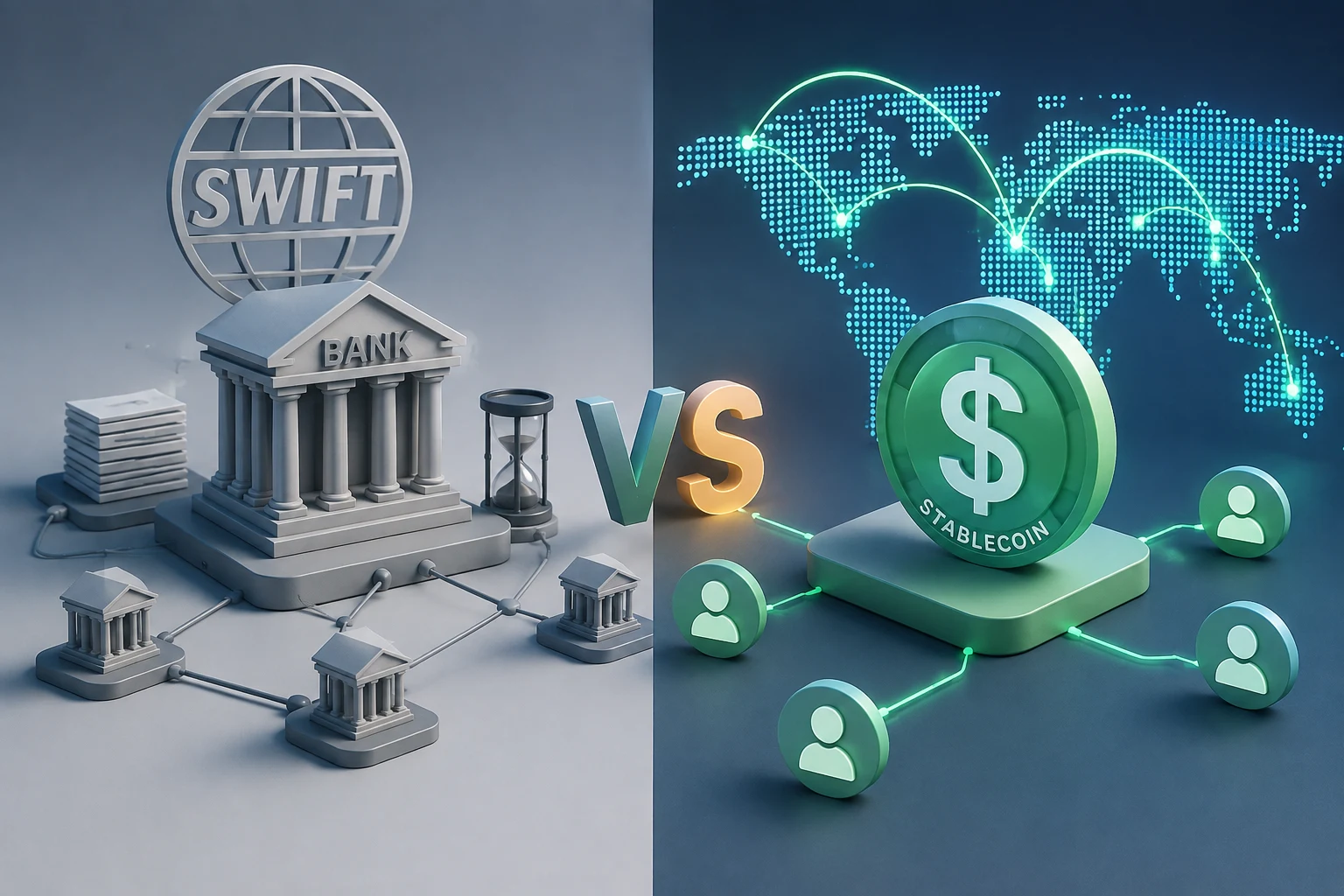
Cross-border payouts are the clearest win. Sending $500 from a US platform to a contractor in the Philippines via SWIFT typically costs $20 to $45 in correspondent bank fees and arrives in two to five business days, sometimes longer. The same payout, funded in USDC on Solana or Base and off-ramped through a local partner, can land in local currency in minutes for a total cost that is often under a dollar. This is not theoretical; it is how a meaningful slice of freelance marketplaces, remittance apps, and creator-economy platforms already move money.
24/7 settlement is the second win. Card networks do not settle on weekends, and bank wires pause outside business hours. A stablecoin transfer settles whenever the underlying blockchain is producing blocks, which is, for practical purposes, always. For a marketplace that does a lot of volume on Friday nights, or a treasury team that needs to rebalance across subsidiaries on a Sunday, this is a real operational improvement, not a marketing claim.
Programmable money is the third, and the most underrated. Because stablecoin transfers are just token movements on a general-purpose blockchain, you can attach logic to them. A marketplace can split a single incoming payment into a seller payout, a platform fee, a tax withholding, and a reserve deposit, all in one transaction, without a back-office reconciliation step. An exchange can stream yield to a user in real time, or vest tokens on a schedule, or release escrow funds only when a milestone is signed on-chain. None of this is possible on a card rail, and replicating it with bank APIs requires months of integration work.
Gas costs and chain choice in practice
Gas is the variable people misunderstand most. On Ethereum mainnet, a simple USDC transfer has, at typical congestion, cost anywhere from $1 to $15 over the last two years, with occasional spikes much higher. That is unworkable for retail-sized payments, and it is one of the main reasons consumer-facing crypto checkout has struggled. Ethereum L2s, especially Base, Arbitrum, and Optimism, drop that cost to a few cents per transfer. Solana is cheaper still, often a fraction of a cent, at the cost of a different security and tooling trade-off.
For a merchant or platform evaluating rails, the practical chain choice in 2025 is usually one of three: Solana for high-frequency, low-value transfers where throughput and cost matter most; Base or another OP-Stack L2 for a balance of Ethereum-grade security, developer tooling, and low cost; or an Ethereum L2 with strong ecosystem support for the specific stablecoins and on/off-ramps you want to integrate. Ethereum mainnet is generally reserved for large B2B transfers where the absolute cost is a rounding error against the transaction size.
The gas cost is also why stablecoin "payment" products aimed at consumers tend to wrap the user in a custodial app that batches transfers, sponsors gas, or uses account abstraction (smart contract wallets) to make the experience feel like a normal payment. The user never sees a gas prompt. The merchant or platform absorbs the cost, or amortizes it across many transactions. This is a workable pattern, but it is worth being clear about who is paying the gas, because in many demos the answer is hidden in the unit economics.
The role of regulated on and off-ramps
On-ramps convert fiat into stablecoin; off-ramps convert stablecoin back into fiat in a bank account. Every realistic stablecoin payment product depends on one or more of these partners, because most merchants cannot, and do not want to, run a money services business themselves. The leading on/off-ramps in 2025 include licensed US entities with state-by-state money-transmitter registrations, MiCA-authorized firms in Europe, and a long tail of regional players for specific corridors. Their KYC and AML posture is what allows a USDC or USDT balance to be acceptable to a regulated merchant's treasury.
This is also where much of the cost lives. A card transaction's headline 2.6% fee includes interchange, assessment, and the processor's margin. A stablecoin settlement, by contrast, has near-zero network cost and a small gas fee, but the on/off-ramp takes a spread, often 10 to 50 basis points, plus a fixed fee, plus potential FX margin. The total can be much cheaper than a card on a cross-border B2B payout, and somewhat more expensive than a card on a small domestic consumer transaction, especially after factoring in the need to eventually off-ramp to fiat.
Regulated ramps also handle the hard parts merchants do not want to deal with: sanctions screening of wallet addresses, Travel Rule compliance for transfers above a threshold, transaction monitoring, and reporting. The downside is concentration risk. If a small number of ramps handle most of the volume, a regulatory action against one of them can ripple through a large chunk of the ecosystem, and there is no Visa or Mastercard equivalent to step in.
PYUSD, USDC, and USDT in real merchant use cases
USDC, issued by Circle, is the stablecoin most often used in regulated merchant and B2B contexts, partly because of its US regulatory positioning, its monthly reserve attestations, and its broad support across chains. USDT, issued by Tether, has by far the largest trading volume and liquidity, especially on Tron and Ethereum, and dominates in cross-border payouts to less-regulated corridors. PYUSD, issued by Paxos under New York Department of Financial Services oversight, is newer and smaller but explicitly designed for payment use cases, including integration with PayPal's merchant stack.
Real merchant deployments today fall into a few patterns. Crypto-native businesses, exchanges, and DeFi protocols settle in stablecoins by default because their treasury is already on-chain. Freelance and creator platforms, especially those paying out to regions with weak banking, use stablecoins as a payout rail with local off-ramps. Some larger retailers and travel companies have run pilots accepting stablecoins at checkout, but the merchant typically receives fiat, which puts the product in the hybrid category discussed earlier. The fully on-chain, consumer-facing, stablecoin-denominated checkout is still rare outside a few crypto-curious brands.
For a merchant considering this, the most useful first question is not "should I accept stablecoin?" but "should I be willing to hold a stablecoin balance, even for a few hours, and who is going to handle the on/off-ramp, the treasury, and the regulatory exposure?" Answering that honestly usually narrows the use case to either a B2B payout flow, where the savings are concrete, or a niche consumer checkout where the customer base actively wants the option, and even then it is rarely a card replacement.
How to follow stablecoin payment rails the smart way
Stablecoin payment rails move fast and so does the news around them, with chain upgrades, new regulated ramps, merchant pilots, and regulatory shifts all landing weekly. Tracking which announcements are real product launches, which are press releases, and which are quietly winding down is a losing game if you do it manually. Zippfeed surfaces stablecoin and payments headlines with sentiment scoring (bullish, neutral, or bearish) and an importance rating, so you can spot the genuinely meaningful shifts in merchant settlement, regulation, and chain choice without wading through noise.


 CoinDesk
 CryptoSlate
 Crypto Rank News
 TheBlock