What does "backed 1:1" actually mean?
Every major fiat-backed stablecoin markets itself as fully backed. USDT says each token is 100% backed by reserves. USDC publishes monthly attestations from Deloitte. PayPal's PYUSD is issued by Paxos Trust under New York Department of Financial Services oversight. On the surface, the marketing sounds identical.
Beneath that surface the meaning is different. "Backed" describes the issuer's promise that, for every token outstanding, somewhere on its books there is an equivalent dollar of assets. It does not describe ownership. When you buy USDT from Tether, you do not acquire a dollar in a segregated vault with your name on it. You acquire a liability of Tether Limited, redeemable at Tether's discretion and governed by the terms of service you almost certainly did not read.
This distinction matters in exactly one scenario: insolvency. If the issuer is healthy, you can always sell your stablecoin in the secondary market for roughly one dollar. The question is what happens when the issuer itself breaks. The honest answer for most tokens is that you join a long line of creditors and wait.
The risks nobody puts on the front of the website
The risk discussion belongs early, because this is the scenario the article exists to explain. Four failure modes actually matter for a stablecoin holder.
1. Unsecured creditor status
Under standard U.S. Chapter 11 and similar regimes, a stablecoin holder's claim is treated as a general unsecured claim against the issuer. Secured creditors, employees with priority wage claims, and bankruptcy professionals are paid first. Recoveries for unsecured creditors in Chapter 11 historically average somewhere between single-digit percentages and a few tens of cents on the dollar, depending on the estate. There is no reason to assume stablecoin claims would be treated better than trade debt.
2. Reserve commingling
"Reserves" are assets on an issuer's balance sheet. They are not your assets. When an issuer holds reserves in the same legal entity that runs the business, those reserves are available to satisfy the issuer's other creditors in bankruptcy. The cleanest historical example is Tether's well-documented commingling: for years reserves and operating funds sat in the same corporate accounts, and the company's own 2021 settlement with the CFTC acknowledged reserve-management failures. If Tether Limited had failed in 2018 or 2019, holders would not have walked away with the underlying cash; they would have received a fractional share of whatever was left after the bankruptcy estate was administered.
3. Frozen redemptions
Even before a formal bankruptcy, an issuer under stress can halt redemptions. Paxos did exactly this in February 2023 when ordered by New York DFS to stop minting new Binance USD (BUSD) tokens and to wind down the BUSD relationship with Binance. Holders who tried to redeem through Paxos were generally serviced through the wind-down, but the experience showed how a regulator-driven shutdown of an issuance program works in real time. Paxos BUSD redemption case proved the wind-down can happen even when reserves are intact and the issuer is solvent.
4. Counterparty collapse
USDC holders learned a different lesson in 2022. When Silicon Valley Bank failed, Circle disclosed that roughly $3.3 billion of USDC reserves sat at SVB. Circle could not immediately access those funds, USDC depegged to about $0.87, and a market-wide scramble followed. The bank, not Circle, went bankrupt. USDC survived because the FDIC ultimately made SVB deposits available and because Circle was diversified across multiple banking partners. But for nearly 48 hours, USDC traded below its peg, and the episode made clear that even well-managed issuers carry hidden bank-custody risk.
How reserves actually sit on the balance sheet
Picture a stablecoin issuer's books in three layers.
Assets. Cash at banks. Short-dated U.S. Treasuries. Commercial paper. Sometimes corporate bonds, repo agreements, or money-market fund shares. The composition matters: cash and Treasury bills are nearly default-proof; commercial paper and corporate bonds are not. Circle publishes a detailed monthly breakdown by asset type. Tether publishes a more opaque quarterly breakdown that includes less liquid categories.
Liabilities. The outstanding stablecoin supply, recorded as a liability. Critically, this liability is almost always unsecured. It sits in the same column as accounts payable, vendor invoices, and loan obligations. There is no statutory preference that puts stablecoin holders ahead of trade creditors.
Capital. Whatever equity the issuer holds. This is the cushion that absorbs losses before stablecoin holders are impaired. For Tether, reported capital is a fraction of total liabilities. For Circle, retained earnings are meaningful but still small relative to USDC's roughly $30 billion in circulation.
The mechanics matter because they tell you where your recovery, if any, comes from. In a bankruptcy, secured creditors take specific collateral. Priority claimants take fixed preferences. Everyone else shares the remaining pool pro rata. Stablecoin holders usually land in that last bucket.
New York DFS trust treatment versus offshore issuers
Not all stablecoin structures are identical, and the legal wrapper is arguably the most important variable for a holder.
The Paxos / New York DFS model
Paxos Trust Company operates under a New York limited-purpose trust charter supervised by the New York Department of Financial Services. PYUSD reserves are held by Paxos and, under New York trust law, must be kept separate from corporate operating funds. Trust assets are technically not the property of the trustee's general estate; they are held for the benefit of the beneficiaries, who in this case are the stablecoin holders.
This is a meaningful upgrade. In a Paxos bankruptcy, there is a colorable legal argument that PYUSD reserves belong to holders and should not be reachable by Paxos's other creditors. The argument is untested in court, and there are still failure modes (a regulator-imposed freeze, a shortfall discovered during wind-down), but the structural starting point is stronger than the offshore alternative.
The offshore issuer model
Tether Limited is incorporated in Hong Kong and operates largely outside any single rigorous regulator. USDT reserves sit on Tether's balance sheet. There is no statutory segregation, no trust structure, and no external supervisor with the authority to compel a real-time audit. Tether's terms of service grant the company wide discretion to delay or refuse redemptions and limit liability to the fair market value of the token.
Circle sits between these poles. USDC is issued by Circle Internet Financial, a U.S. company regulated by state regulators and subject to federal oversight. Circle publishes monthly third-party attestations and holds reserves primarily in cash and short-dated Treasuries at multiple U.S. banks. But the reserves are corporate assets, not trust assets segregated for holders, so a Circle bankruptcy would still produce an unsecured-creditor claim for USDC holders. The quality of the reserves improves the expected recovery; the legal structure does not change the priority.
Why "1:1 backed" is not "FDIC-insured"
This is worth restating because the marketing blurs the line. FDIC insurance covers deposit accounts at insured banks, up to $250,000 per depositor. Stablecoin balances are not deposits. They are not held at banks in your name. They are claims on a non-bank private company. No regulator currently treats USDT, USDC, or PYUSD as FDIC-insured, and no legislation in force extends deposit insurance to stablecoin holders.
What a Chapter 11 would actually look like
Suppose a major issuer files. What happens next?
Day one. The company files for Chapter 11 (or its local equivalent). An automatic stay freezes most collection efforts. The existing management typically continues running the business under bankruptcy-court supervision, with a creditors' committee formed to represent unsecured claimants.
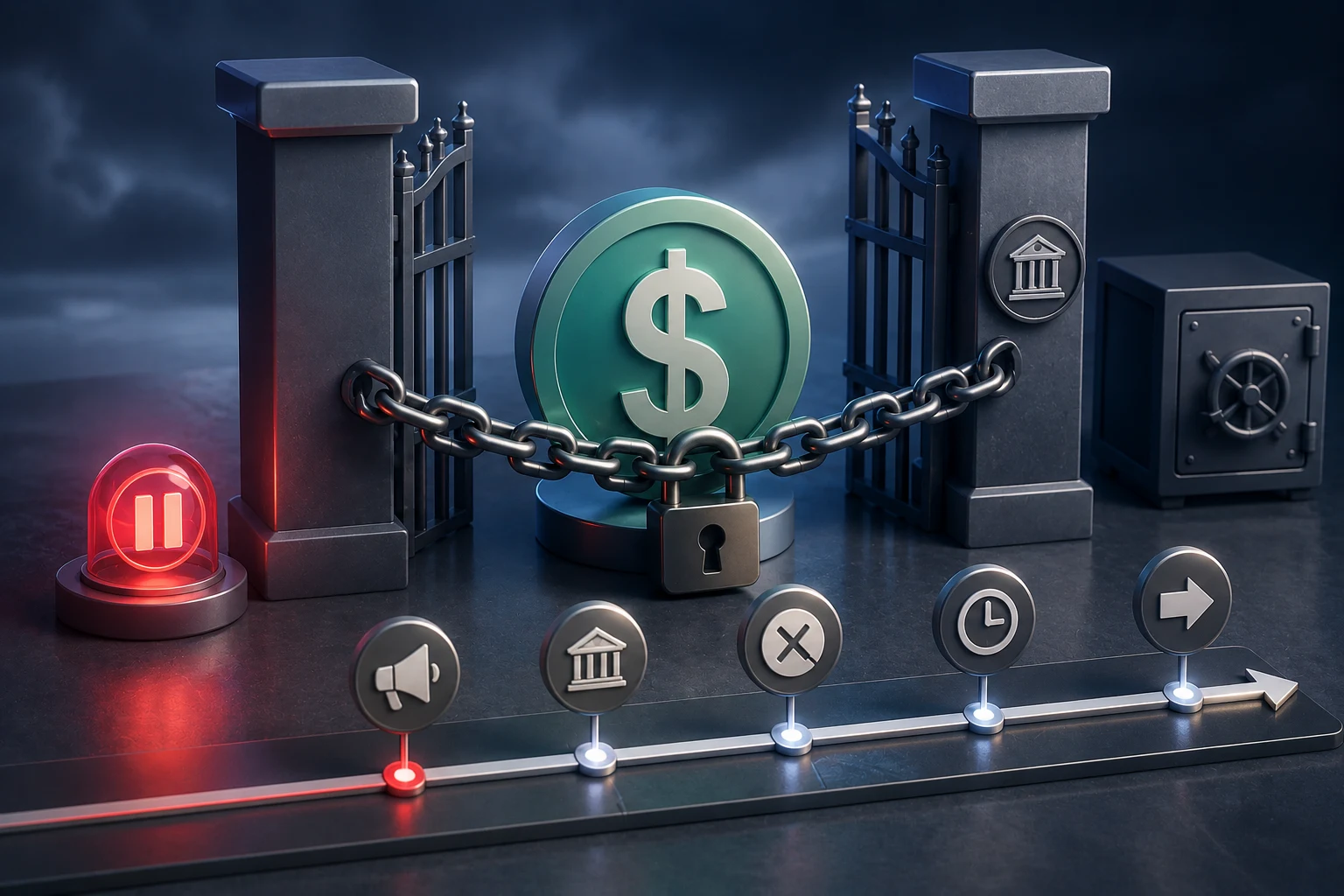
Redemptions halt. Almost every distressed issuer stops honoring redemption requests. The on-chain market continues to trade, usually at a discount reflecting the probability of recovery. Holders who can sell in the secondary market at $0.90, $0.80, or lower effectively realize that price; holders who cannot exit are stuck waiting.
The estate is administered. A trustee or debtor-in-possession reviews assets and liabilities. Reserves are identified and valued. Secured creditors with claims against specific reserve pools negotiate. Unsecured creditors, including stablecoin holders, file proofs of claim.
A plan of reorganization is proposed. The plan describes how unsecured creditors will be paid. In practice this might mean a partial cash distribution, new equity in a reorganized company, or a multi-year payout from future earnings. Some holders receive cents on the dollar.
Recovery is uncertain. The Celsius and Voyager bankruptcies, although different in structure, give a rough sense of the timeline and the haircut. Celsius customers waited more than a year for distributions and received meaningful fractions of their claims in cash and a new token. Voyager customers recovered roughly 35% initially and have been receiving incremental distributions since. The point is not the exact number but the fact that recovery is slow, partial, and contingent on the bankruptcy court's process.
How to assess a stablecoin's claim priority before trusting it
You do not need a law degree to evaluate the structural risk. A short checklist covers most of the meaningful variables.
- Where is the issuer incorporated, and which regulator supervises it? A New York DFS trust charter is stronger than an unregulated offshore entity. U.S. state money-transmission oversight is stronger than nothing. Cayman Islands with no public supervision is the weakest.
- Are reserves held in a segregated trust, or on the issuer's corporate balance sheet? Trust treatment is meaningfully better. If the marketing materials do not use the word "trust," assume the worst.
- Who audits the reserves, and how often? A Big Four attestation is better than a small-firm review. Monthly is better than quarterly. A true audit under PCAOB standards, with auditor liability, is best; most issuers publish attestations, which are narrower in scope.
- What is the reserve composition? Cash and short-dated U.S. Treasuries are the safest. Commercial paper, certificates of deposit, and corporate bonds add credit risk. Tokenized assets, Bitcoin, and "other" categories add market risk.
- How concentrated is the banking relationship? If 50% of reserves sit at one bank, that bank is a single point of failure. Circle's SVB episode is the relevant cautionary tale.
- What do the terms of service actually say? Most holders never read them. They typically grant the issuer broad discretion to delay redemptions, freeze accounts, and limit liability.
- What is the issuer's capital relative to outstanding supply? A thin capital cushion means small operational losses translate directly into holder losses.
None of these checks guarantees safety. They are filters that separate the obviously fragile from the merely imperfect. Differences between New York DFS trust treatment and offshore issuers are the single biggest filter on the list.
What this means for your wallet
For most users, the practical lessons are straightforward. Do not hold more in any single centralized stablecoin than you could afford to lose a meaningful fraction of. The math is unforgiving: in a typical Chapter 11, unsecured creditors recover somewhere between pennies and half their claim, often over years.
Diversification helps because the realistic failure modes are issuer-specific. Tether has its own legal and regulatory risks. Circle has its own banking relationships. PYUSD has its own market liquidity constraints. Holding a mix spreads the idiosyncratic risk while accepting the systemic risk that a stablecoin runs cannot solve at the wallet level.
If you need dollar exposure without issuer risk, the closest available alternatives are decentralized over-collateralized stablecoins such as DAI or USD-denominated positions on lending protocols. These do not rely on a single issuer's solvency; they rely on collateral locked in smart contracts. They carry their own risks (smart-contract bugs, oracle failures, governance attacks) but those are categorically different from bankruptcy-creditor risk. Tokenized money-market funds from regulated issuers are a second option, with their own tradeoffs.
Most importantly, do not confuse on-chain convenience with legal protection. Holding USDC in a self-custody wallet means you control the private key. It does not mean you own the dollars. The dollars are a liability of Circle, and your private key only protects your ability to send the token to another address, not your ability to redeem it at par in a liquidation.
Follow stablecoin risk with the right signals
Stablecoin solvency rarely fails loudly. It fails through quiet reserve-quality erosion, banking-relationship concentration, and regulatory pressure that builds over months. Catching it requires watching the right signals rather than the loudest headlines. Zippfeed surfaces stablecoin and issuer news with sentiment scoring (bullish, neutral, or bearish) and an importance rating, so you can spot deteriorating reserves, regulator action, and redemption stress before the peg breaks.
Frequently asked questions
Is holding USDT or USDC safe?
Both tokens have run for years without insolvency, and both maintain large reserve buffers relative to outstanding supply. "Safe" in the bankruptcy sense, however, means something specific: if the issuer failed, would holders be made whole quickly and in cash? The honest answer is no, because neither USDT nor USDC holders hold a segregated ownership claim on the underlying dollars. You are an unsecured creditor of Tether or Circle, and your recovery would depend on the bankruptcy process. Education, not financial advice: size any single stablecoin position to a loss you could absorb.
How does a stablecoin bankruptcy actually work?
The issuer files for Chapter 11 (or an equivalent proceeding in its home jurisdiction). An automatic stay halts redemptions. A creditors' committee forms, assets are valued, and a plan of reorganization proposes how unsecured creditors, which usually includes stablecoin holders, will be paid. Recoveries typically come as partial cash distributions, new equity, or extended payout schedules, often over months or years. The Celsius and Voyager bankruptcies illustrate how long and partial this process can be.
Should I move to a decentralized stablecoin like DAI?
Decentralized over-collateralized stablecoins remove issuer-creditor risk by replacing it with smart-contract and collateral risk. Your exposure shifts from a company's balance sheet to code and on-chain collateral. For users who are uncomfortable with single-issuer concentration, this is a meaningful trade. It is not a free lunch: smart-contract exploits, oracle failures, and governance attacks are real categories of loss that have hit DeFi protocols. Diversification across stablecoin types reduces the chance that any single failure wipes you out.
What was the Paxos BUSD situation and what did it teach holders?
In February 2023, New York DFS ordered Paxos to stop minting new Binance USD tokens and to wind down the BUSD program with Binance. Paxos itself remained solvent and continued honoring redemptions; the shutdown was regulatory, not financial. The lesson for holders is that even a well-capitalized, audited issuer can lose a major distribution channel overnight on regulator action. The Paxos/Binance BUSD redemption case showed that "backed 1:1" and "operating normally" are not the same as "stable for the foreseeable future."



 CoinDesk
 CryptoSlate
 WuBlockchain
 TheBlock