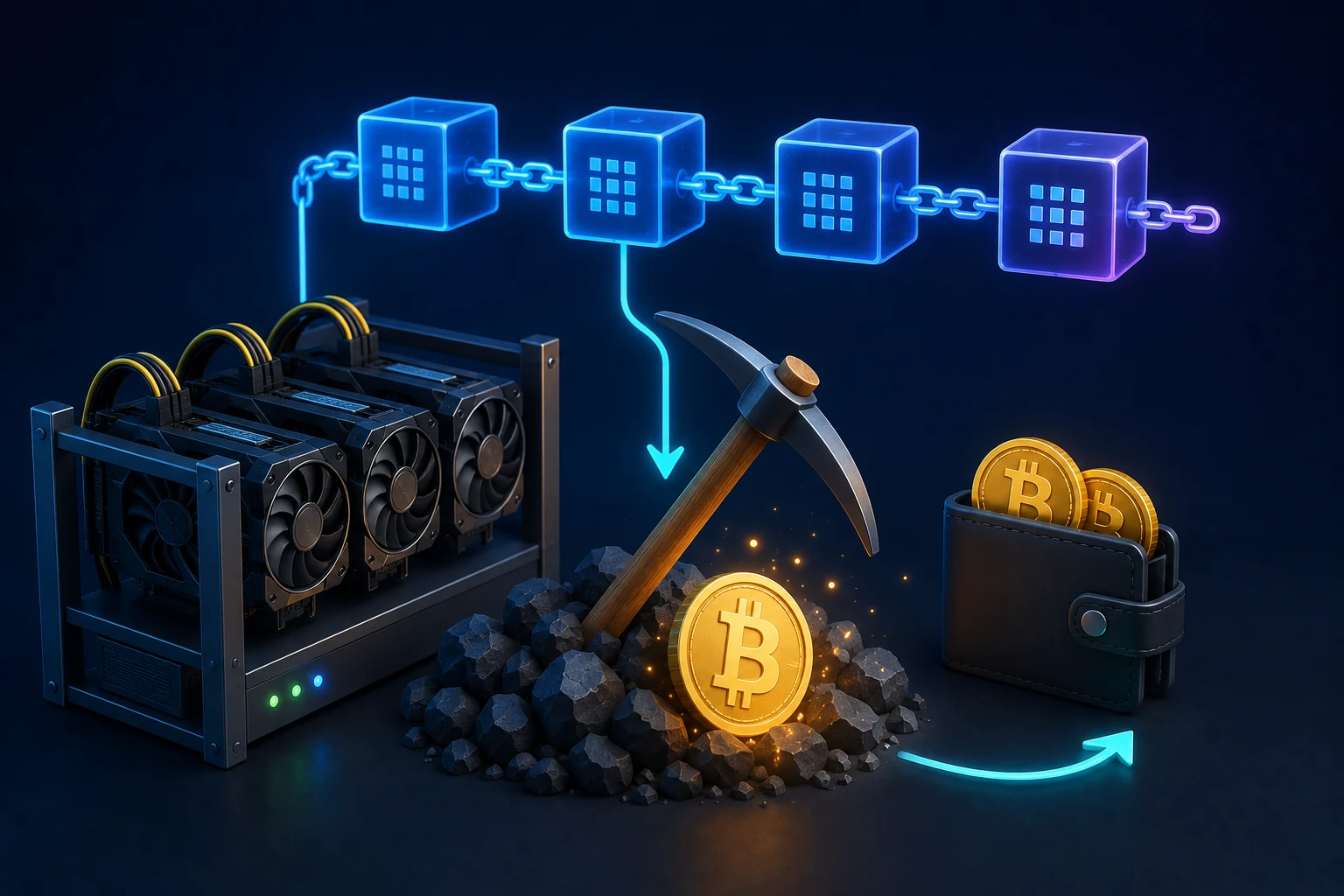
What mining actually means
The word "mining" conjures images of digging for gold, and the metaphor is half-right: miners do extract new coins. But what is actually happening is closer to a global computing competition that keeps a blockchain honest. Understanding mining clears up one of the most misunderstood parts of crypto — and explains how Bitcoin works at its core.
Crypto mining is the process by which new transactions are verified and added to a Proof of Work blockchain, and new coins are created in the process. Miners use computers to compete at solving a hard mathematical puzzle; whoever solves it first gets to add the next block of transactions and is rewarded with newly minted cryptocurrency. Mining is what secures the network and issues new supply at the same time.
Importantly, mining only applies to Proof of Work networks. Blockchains that use Proof of Stake, like Ethereum today, do not mine — they use staking instead.
The mining process, step by step
Here is what happens, stripped of jargon:
1. Transactions are collected. Pending transactions across the network are gathered into a candidate block.
2. The puzzle begins. Miners must find a special number that, when combined with the block's data and run through a cryptographic function, produces a result meeting strict criteria. There is no clever shortcut — miners must guess, billions of times per second. 3. The race. Miners worldwide compete simultaneously, their machines churning through guesses. It is essentially a lottery where more computing power buys more tickets. 4. A winner emerges. The first miner to find a valid solution announces it. The rest of the network instantly verifies the solution is correct — hard to find, easy to check. 5. The block is added and rewarded. The winning miner's block is added to the blockchain, and they receive the block reward (newly created coins) plus transaction fees. For Bitcoin, this reward halves over time via the Bitcoin halving. 6. It repeats. The whole process begins again for the next block, continuously.
Why it works: turning electricity into trust
The puzzle exists for one reason: to make adding blocks costly. Because finding a solution requires real computing power and electricity, rewriting the blockchain or cheating would require out-computing the entire honest network — an astronomically expensive feat on a large network. The cost of the "work" is what secures the chain. In effect, mining converts electricity into trust.
The network automatically adjusts the puzzle's difficulty so that blocks are added at a roughly steady pace, no matter how much total computing power is mining. More miners join, difficulty rises; miners leave, difficulty falls.
The hardware: from hobby to industry
Mining has evolved dramatically:
- In the early days, ordinary computers could mine Bitcoin. Those days are long gone.
- Today, competitive Bitcoin mining uses specialized machines called ASICs — hardware built to do nothing but mine as efficiently as possible.
- Scale matters. Mining is now largely an industrial operation, with large facilities housing thousands of machines, located where electricity is cheap.
- Other coins, other hardware. Some Proof of Work coins are mined with graphics cards (GPUs) rather than ASICs.
For most individuals, profitably mining Bitcoin alone is no longer realistic — the competition is industrial. This reality is worth understanding before anyone is lured by "mining" schemes promising easy returns.
The energy question
Mining's enormous electricity consumption is its most debated aspect. Critics raise environmental concerns; defenders argue the energy is what makes the security real and point to growing use of renewable and stranded energy. We explore this fully in our Proof of Work guide. The honest takeaway: mining's security and its energy use are inseparable.
A note on mining scams
Because "mining" sounds like passive income, it is a common theme in scams: cloud-mining schemes that pay out nothing, fake mining apps, and "guaranteed returns" that are anything but. Be deeply
skeptical of any mining opportunity promoted to you, especially those promising fixed profits. Real mining is a competitive, capital-intensive business, not free money.
Follow mining developments
Mining economics, regulation, energy policy, and difficulty shifts all move with the news and affect Proof of Work networks. Zippfeed tracks Bitcoin and mining-related headlines with sentiment and importance scoring, so you can follow the developments that genuinely matter — regulatory changes, major facility news, network milestones — with a clear read on how the market is responding.

 CryptoSlate
 Glassnode
 WatcherGuru
 Altcoin Daily
 WuBlockchain